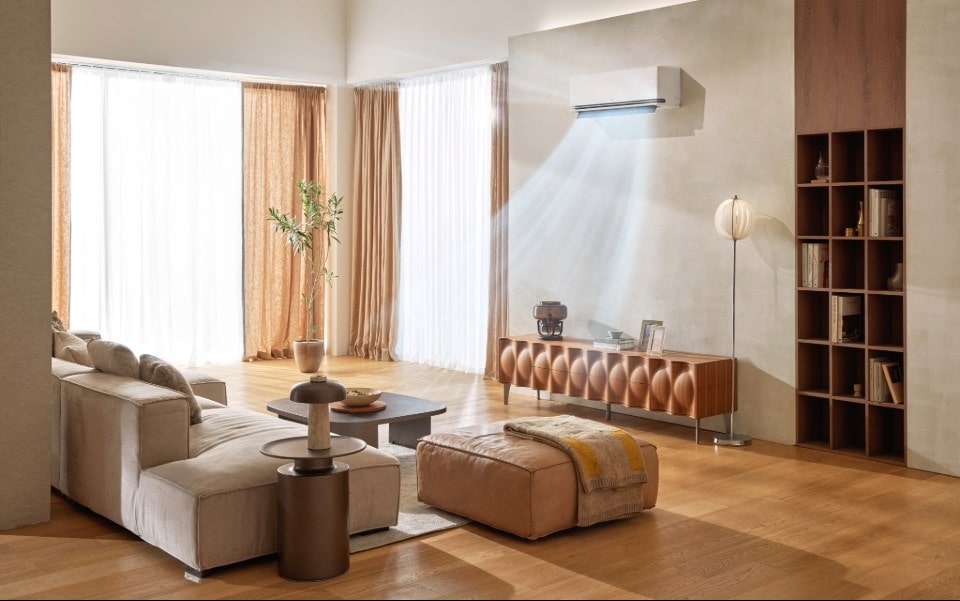
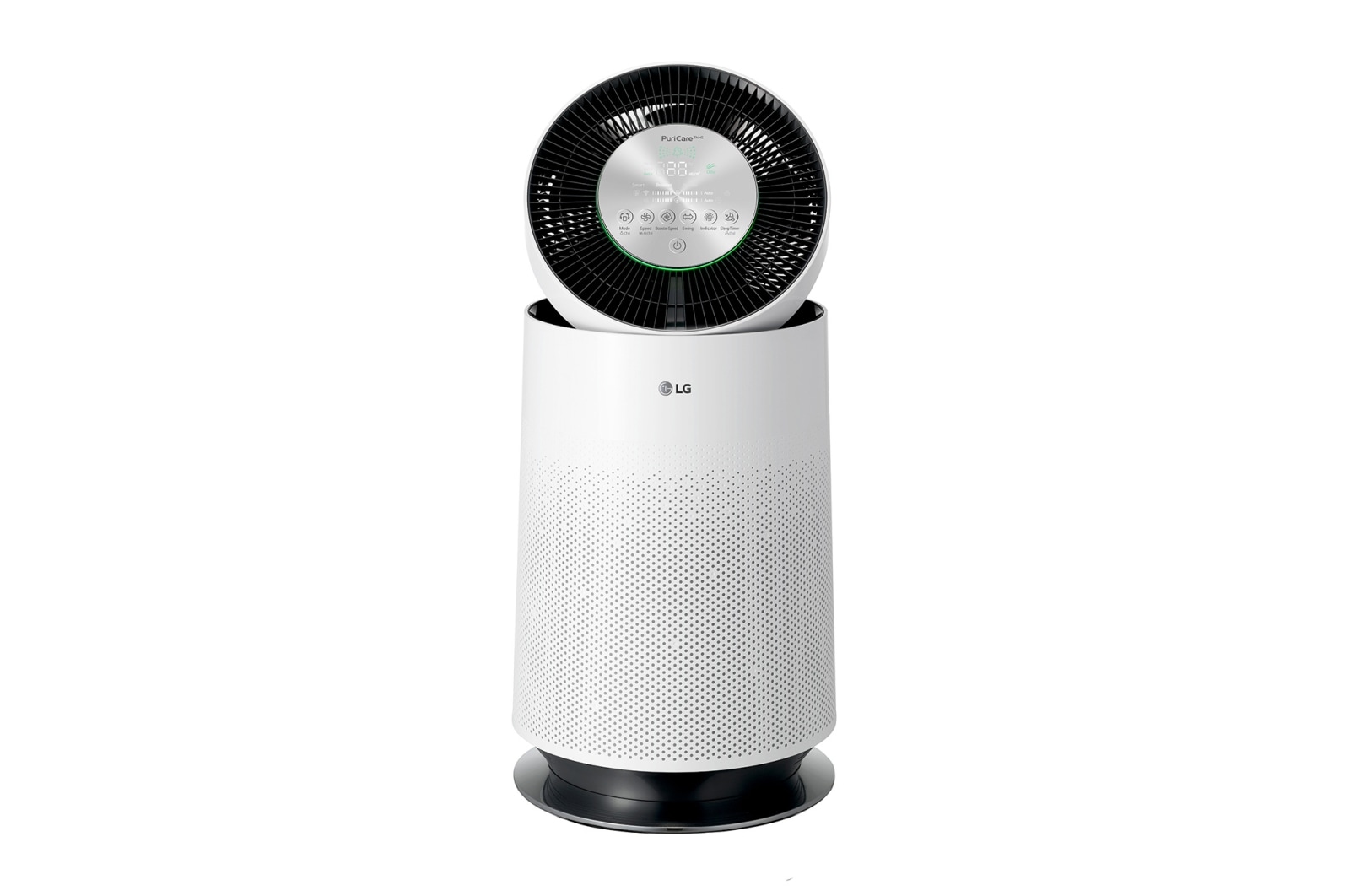
A residential LG air conditioner blowing cool air into a modern, sunlit living room with neutral-toned furniture.

Air conditioning typically accounts for 60 to 70% of total household electricity consumption in the UAE during summer months. No other appliance comes close, and no other appliance decision has a comparable impact on what you pay every month from May through September. The choice between an inverter and a non-inverter AC is where most of that impact is determined.

The technology difference between the two is straightforward. What is less understood is how that difference interacts with the UAE's tiered billing structure to produce savings that are consistently larger in the UAE than generic efficiency comparisons suggest. An inverter AC goes beyond simply using less electricity. In a market where summer consumption regularly pushes households into higher billing tiers, it keeps consumption in cheaper brackets where standard calculations do not account for that dynamic.

This guide covers how the two compressor types actually work, what the cost difference looks like over five years at UAE usage rates, and how to get the maximum return from an inverter unit once it is installed.

How a Non-Inverter AC’s On-Off Cycle Drives Up Your Electricity Bill

A non-inverter AC runs at full power or not at all. That binary operation is the source of its inefficiency, and in a UAE summer where units run for eight hours or more daily, the cost of that inefficiency is significant.

Each Restart Draws a Full-Power Surge

A non-inverter compressor has one operating speed: maximum. When the room reaches the set temperature, the compressor cuts out completely. When the temperature rises again, it restarts at full load. Each of those restarts draws a surge of power before the system settles into its running consumption. In a hot climate where the room temperature rebounds quickly after the compressor cuts out, those restart cycles happen frequently throughout the day. The cumulative energy cost of that pattern across a full operating day is considerably higher than the nameplate wattage suggests.

Frequent Cycling Increases Total Daily Consumption

The on-off cycle does more than draw restart surges. It prevents the compressor from ever reaching the steady, lower-load operation that characterizes efficient cooling. A non-inverter unit running in a UAE summer room cycles on and off repeatedly throughout the day. Each cycle brings the room temperature down past the set point, then lets it climb before the next cycle begins. The result is a unit that works harder than necessary to maintain a comfort level it never quite stabilizes.

A Non-Inverter Running 12 Hours Daily Costs Up to AED 202 Monthly

Based on typical UAE usage patterns and current electricity tariff rates, a 1.5-ton non-inverter AC running 12 hours daily costs approximately AED 161 to AED 202 per month. The same cooling capacity delivered by an inverter unit over the same hours costs roughly AED 101 to AED 151. That gap of AED 50 to AED 100 per unit per month is before the slab tariff effect is applied, which the next section covers. For a household running multiple AC units through a UAE summer, the monthly difference across the whole system is substantial.

Why the UAE's Slab Tariff Structure Changes the Inverter AC Savings Calculation

Standard inverter efficiency claims are calculated against a flat electricity rate. The UAE's electricity tariff is not flat. It charges progressively more as monthly consumption increases, which means inverter air conditioner savings in the UAE are worth more per unit as a direct result.

Heavy Summer Usage Pushes Households Into Higher Electricity Billing Tiers

According to the UAE's published 2026 electricity tariff structure, residential consumption is billed across four tiers:

Tier Monthly consumption Rate per kWh Typical UAE household status
1 0–2,000 kWh AED 0.23 Most households in winter
2 2,001–4,000 kWh AED 0.28 Many 2-bed apartments in summer
3 4,001–6,000 kWh AED 0.32 Larger apartments and villas in peak summer
4 Above 6,000 kWh AED 0.38 High-usage villas in peak summer

A typical two-bedroom Dubai apartment consumes 1,200 to 1,800 kWh monthly under normal conditions. In summer, with AC running through the day and into the evening, that figure rises sharply. Households that sit comfortably in the first tier through winter regularly cross into the second or third during the summer months.

Each Unit Saved in a Higher Tier Is Worth More in Dirhams

When a household's consumption crosses from the green slab into the yellow, the rate per unit increases from AED 0.23 to AED 0.28. At that point, every kilowatt-hour an inverter AC saves is worth AED 0.28, or AED 0.32 if consumption has climbed further. The inverter's efficiency advantage stays the same, but the financial value of that advantage increases in proportion to which tier the saved units would have landed in. That is the mechanism generic efficiency percentages do not capture, and it is why the real-world UAE saving consistently exceeds the advertised figure.

Standard Efficiency Claims Are Not Calculated Against Tariff Slabs

When manufacturers publish efficiency ratings or savings percentages for inverter AC units, those figures are calculated under standardized test conditions against a flat electricity rate. They are useful for comparison between models but they do not reflect what a UAE household actually saves. A household that avoids crossing from the first into the second billing tier saves at the lower rate on all the units it pulls back. One that is already in the second or third tier saves at the higher rate on every unit the inverter technology eliminates. The practical saving depends on where the household sits in the tariff structure as much as on how efficient the unit is.

What Five Years of Running Costs Actually Look Like for Each AC Type

The upfront price difference between a non-inverter AC and an inverter AC is significant. What it obscures is how quickly that difference reverses once running costs are factored in, and how far the gap continues to widen after the break-even point is passed.

The Inverter Premium Recovers Within 1.5 to 3 Years in UAE Conditions

An inverter AC typically carries an upfront premium of AED 800 to 1,200 compared to a non-inverter equivalent. At typical UAE usage rates of eight or more hours daily through a summer that runs from May to October, the annual energy saving from an inverter unit ranges from approximately AED 300 to AED 550 per unit. That range does not account for the slab tariff effect. For households already operating in the second or third electricity billing tier during summer, the annual saving is higher. At those figures, the upfront premium recovers within 1.5 to 3 years, after which every year of operation represents a net saving relative to what the non-inverter alternative would have cost to run.

Non-Inverter Running Costs Rise as the Unit Ages

A non-inverter AC loses efficiency over its operating life. The on-off cycling that characterizes its operation places repeated mechanical stress on the compressor, and as components wear, the unit draws more power to deliver the same cooling output. An older, degraded non-inverter unit consuming 24 to 30 kWh daily can cost between AED 200 and AED 315 per month to run at current electricity tariff rates. That figure represents the upper end of what a unit in decline costs, but it is a realistic outcome for a non-inverter appliance past its efficiency peak in UAE conditions. An inverter unit, because its compressor runs at variable speed instead of cycling repeatedly at full load, experiences less mechanical wear over the same period.

The Saving Compounds Significantly Beyond Break-Even

Once the inverter premium has recovered, the annual saving it generates continues for the remaining lifespan of the unit, which for a well-maintained inverter AC in UAE conditions is typically ten to fifteen years. Over a ten-year ownership period, the total saving relative to a non-inverter alternative ranges from approximately AED 3,000 to AED 5,500 per unit after the initial premium is recovered. For a household running two or three AC units, the aggregate figure across that period is substantial. The inverter premium effectively buys access to a saving that pays back a multiple of itself over the life of the appliance.

How to Get the Maximum Efficiency Out of an Inverter AC in the UAE

An inverter AC delivers its efficiency advantage under the right operating conditions. How the unit is used and maintained determines how much of that advantage is realized in practice.

Each Degree Below 24°C Adds 4 to 5% to Cooling Costs

The recommended optimal indoor temperature setting in the UAE is 24°C, and the published energy data supports that recommendation precisely. According to standard conservation guidance, each degree the thermostat is set below 24°C increases cooling energy consumption by approximately 4 to 5%. A unit set to 20°C is consuming 16 to 20% more energy than the same unit set to 24°C, regardless of whether the compressor is inverter or non-inverter technology. That overhead applies on top of the efficiency gap between compressor types, which means a poorly set inverter AC can cost more to run than a well-set non-inverter. The temperature setting is the single most controllable variable in the monthly bill.

A Dirty Filter Forces the Compressor Into Sustained High Load

An inverter compressor saves energy by modulating its speed to match the cooling demand of the room. When the air filter is clogged, airflow through the unit is restricted, and the room takes longer to reach the set temperature. The compressor responds by running at higher speed for longer, which eliminates the low-load steady state that makes inverter technology efficient. A heavily clogged filter restricts airflow enough that the compressor runs at high speed for longer to reach the same temperature. Published maintenance guidance from AC manufacturers generally puts the efficiency reduction from a blocked filter at 15 to 25%.

Peak Consumption Occurs Between Noon and 6pm Daily

Electricity demand in Dubai peaks between noon and 6pm, when outdoor temperatures are highest and cooling loads across the city are at their maximum. During this window, AC units work harder than at any other point in the day. An inverter unit handles this period more efficiently than a non-inverter because its compressor can sustain a high but variable speed instead of cycling repeatedly at full load. A few practical habits reduce the cooling demand during peak hours:

● Keep blinds closed during the hottest part of the day

● Avoid running heat-generating appliances inside the peak window

● Pre-cool the space before the peak begins so the compressor enters the window already on top of the load

Together, those habits reduce the load the compressor carries during the most expensive part of the operating day.

Conclusion

An inverter AC costs more to buy and less to run, and in the UAE the gap between those two figures closes relatively quickly. A summer that runs six months, daily usage that regularly exceeds eight hours, and a tariff structure that charges more per unit as consumption climbs all work in the same direction. They make the efficiency advantage of inverter technology worth more in dirhams per year than any standardized comparison suggests.

The break-even point sits between 1.5 and 3 years at typical UAE usage rates. Beyond that point, the saving continues for the remaining life of the appliance. Over ten years and across multiple units, the cumulative difference between an inverter and a non-inverter household runs to several thousand dirhams per unit.

What the numbers do not capture is that the inverter advantage has to be earned in daily operation. It depends on the thermostat being set correctly, the filter being cleaned on schedule, and the unit being sized appropriately for the space it cools. An inverter AC that is poorly maintained or set too low delivers less of its potential than the technology is capable of. The efficiency is built in. Getting the full return on it requires using it correctly.

LG's Dual Inverter technology takes the core inverter principle further, using a dual-cylinder compressor that operates across a wider frequency range than single-cylinder designs. The result is faster cooling, more stable temperature control, and energy savings that go beyond what standard inverter comparisons reflect. In a market where AC running costs are the single largest household electricity expense, that difference is worth understanding before the purchase decision is made.

Life's Good, LG!

More To Read

HELPFUL GUIDE

Beat The UAE Heat with LG Split and Inverter ACs

Explore inverter AC energy savings for long UAE summers, plus split AC value for smaller rooms. Pick 1 ton for 120–150 sq ft, 1.5 ton for 180–240, with LG UAE.

Learn more

HELPFUL GUIDE

What Smart AC Features Matter Most for UAE Homes?

Smart AC features like geofencing, scheduling & AI learning reduce energy waste across a long cooling season. LG UAE breaks down what each one actually does.

Learn more