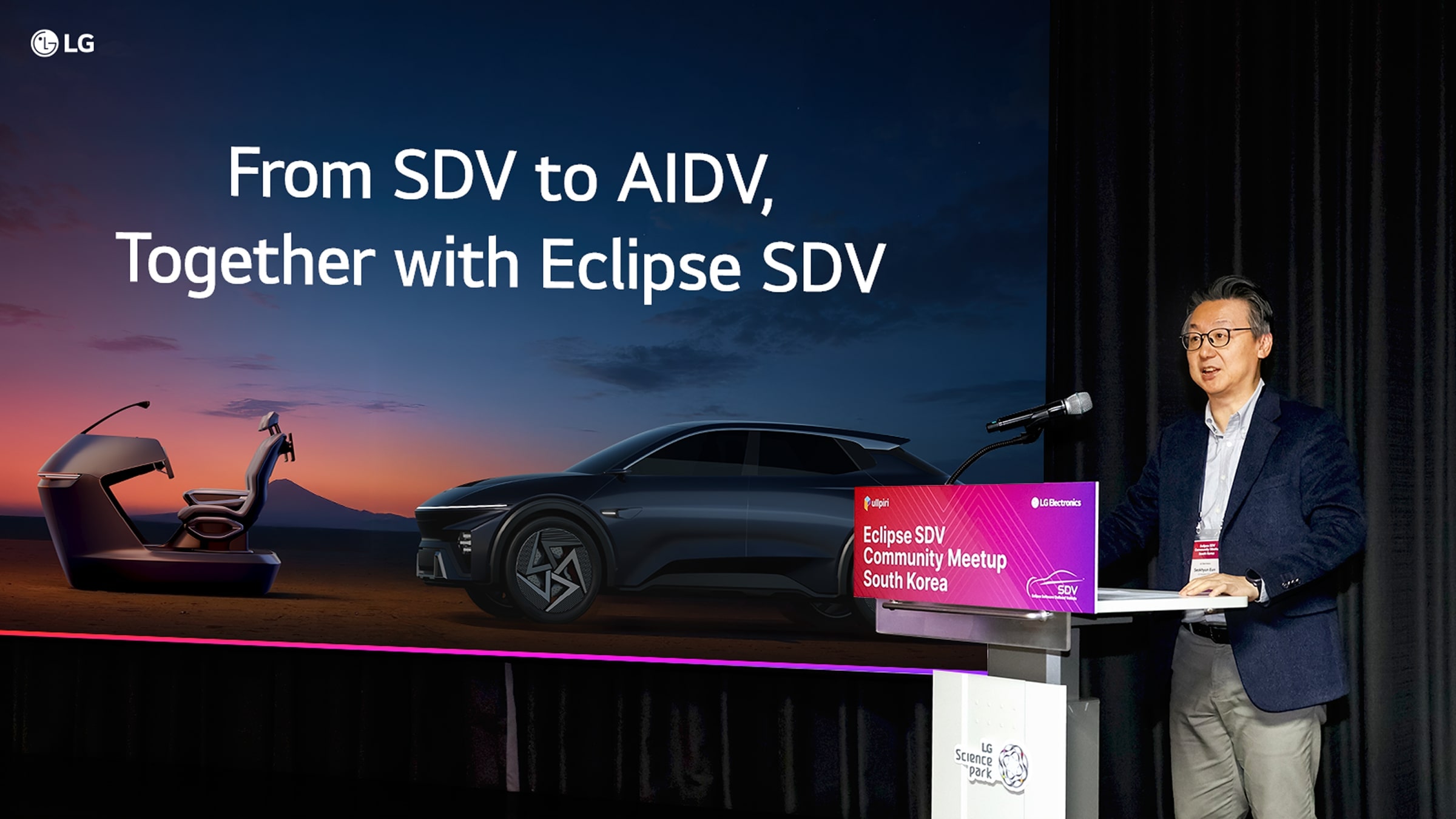
SEOUL, Dec. 4, 2025 — LG Electronics (LG), a global leader in mobility technologies, is advancing the software-defined vehicle (SDV) landscape as co-host of the Eclipse SDV Community Meetup, a developer-focused event dedicated to building an automotive open-source software ecosystem. Through this forum of global tech leaders, LG aims to accelerate the standardization and adoption of next-generation automotive software and reinforce its leadership in SDV innovation.
Held on December 4 at LG Sciencepark in Seoul, the Eclipse SDV Community event marks its South Korean debut in collaboration with the Eclipse Foundation, an international non-profit that drives open-source software ecosystem development. In addition to LG, the meetup brings together other key players including ETAS and Hyundai Mobis to present new projects and discuss open-source standardization strategies that will drive the industry forward.
A single vehicle today contains more than 100 million lines of code – a number expected to grow significantly in the SDV era. Around 70 percent of this software covers non-differentiating, foundational technologies such as operating systems, security and authentication tools, and communication frameworks. Despite this overlap, automakers and suppliers often develop these basics independently, resulting in duplicated effort and unnecessary resource consumption.
The Eclipse SDV Community aims to unify the industry around shared software foundations through open-source collaboration. By jointly developing standardized components, automakers can reduce cost and development time, enabling greater focus on differentiated innovations such as In-Vehicle Infotainment (IVI) and Advanced Driver Assistance Systems (ADAS).
Since 2018, LG has been operating its webOS Open-Source Edition (OSE), equipping the company with the know-how to play a pivotal role in the Eclipse SDV ecosystem. With this expertise, LG has worked alongside partners to advance the SDV Community Reference (S-CORE) project, which focuses on aligning shared software building blocks to eliminate duplication, shorten development and delivery timelines as well as enhance safety and reliability.
Further to its participation in key Eclipse SDV projects, LG is actively proposing and leading new initiatives, such as the Pullpiri project. The project aims to develop technologies that enable a variety of differentiated solutions to operate reliably and evolve continuously on the S‑CORE foundation.
LG also serves on the board of Scalable Open Architecture for Embedded Edge (SOAFEE), a global automotive open-source standardization organization. As a governing body member, LG actively collaborates with the SOAFEE community, which now comprises around 150 member companies worldwide.
“LG is committed to fostering a robust open-source ecosystem based on our accumulated software capabilities and global partnerships,” said Seokhyun Eun, president of the LG Vehicle Solution Company. “We will remain dedicated to leading the SDV transition to enable safer, smarter and more efficient mobility.”