



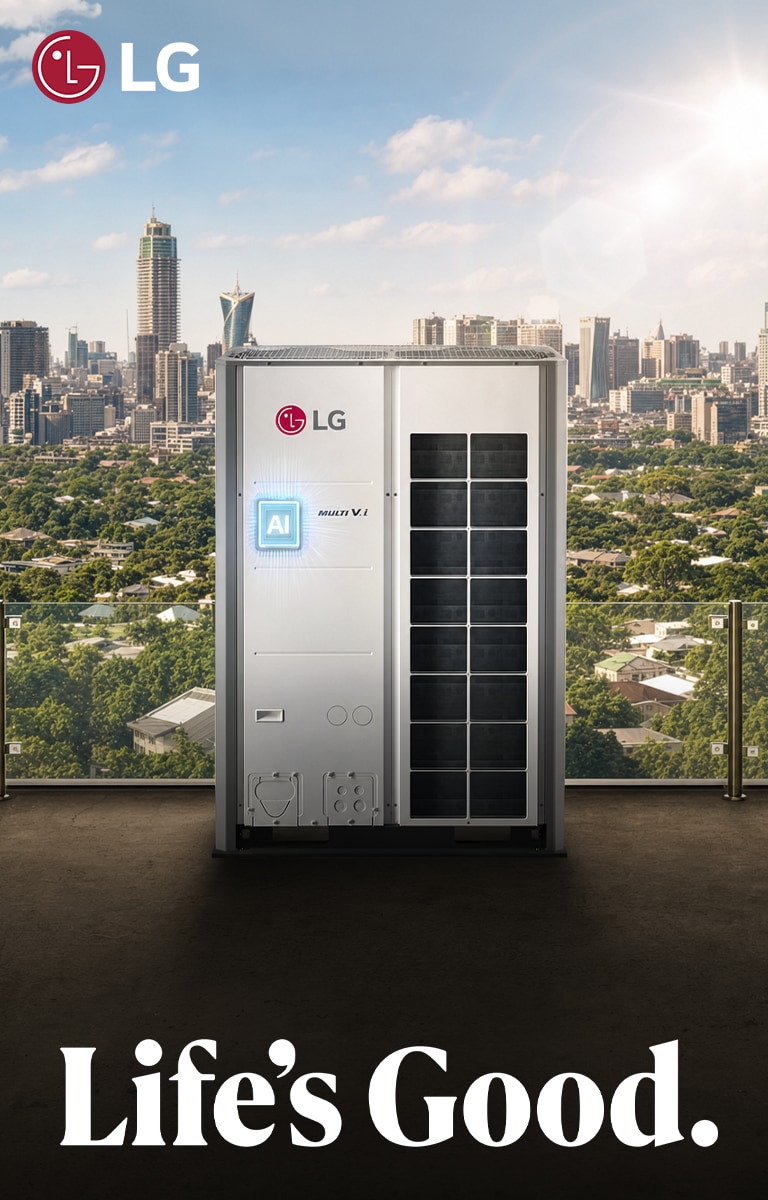
How AI-Powered HVAC Is Transforming Commercial Buildings in East Africa
-
Key Takeaways
● AI-powered HVAC continuously reads sensor and system data and adjusts cooling on its own, instead of running on a fixed schedule or waiting for a technician's next visit.
● LG Multi V i puts that intelligence on the unit itself through AI Smart Care, AI Energy Management, AI Energy Waste Alert and AI Smart Diagnosis, allowing it to keep working through power cuts and patchy connectivity common across East Africa.
● Kenya's grid interrupts supply for roughly eight to ten hours a month through 2025 and 2026, according to the Energy and Petroleum Regulatory Authority. Any HVAC system specified for the region must survive that plus the daily generator changeover many commercial buildings now use.
● AI-powered VRF earns its keep in large, multi-zone buildings such as hotels, hospitals and malls. A small office on a short lease is usually better off with a conventional split system.


-
Introduction
Commercial HVAC is moving beyond simple heating and cooling equipment as building owners push for lower energy costs, better occupant comfort and tighter operational control. Artificial intelligence, automation and connected controls make this possible: systems that read a building's actual conditions and respond, rather than running on a fixed schedule regardless of what is happening inside or outside.
Facility managers balance energy spend, occupant expectations, maintenance backlogs, and conditions that rarely stay the same for long. AI earns its place by turning a flood of operating data into decisions the system can act on immediately, making it increasingly standard in modern HVAC rather than a premium add-on.
-
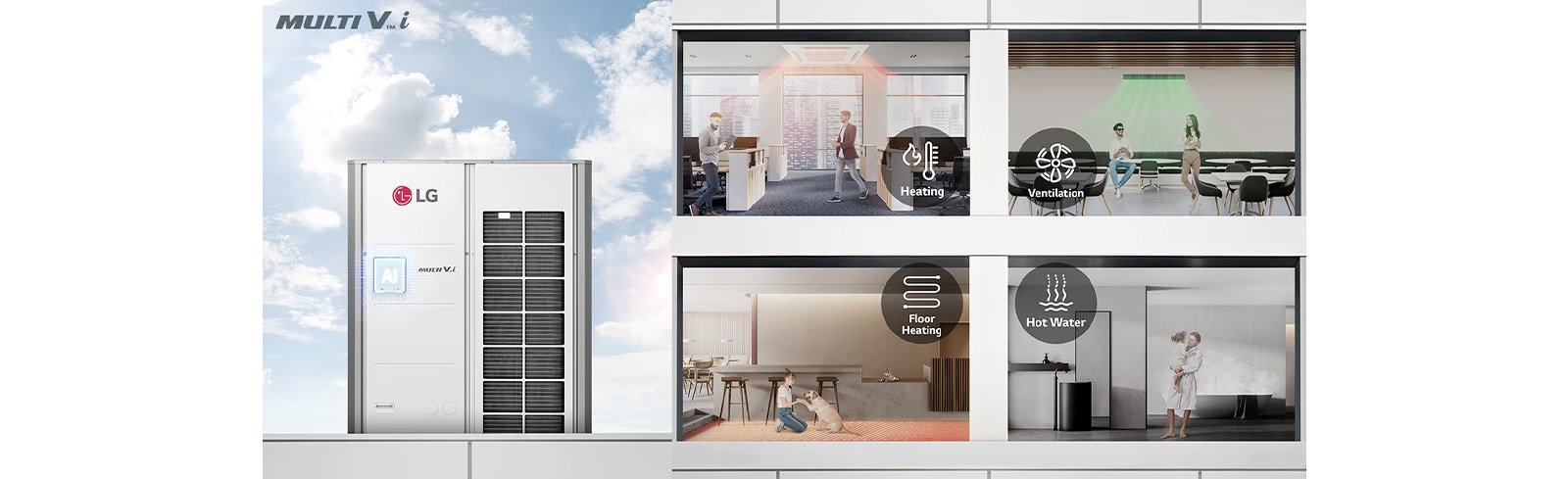
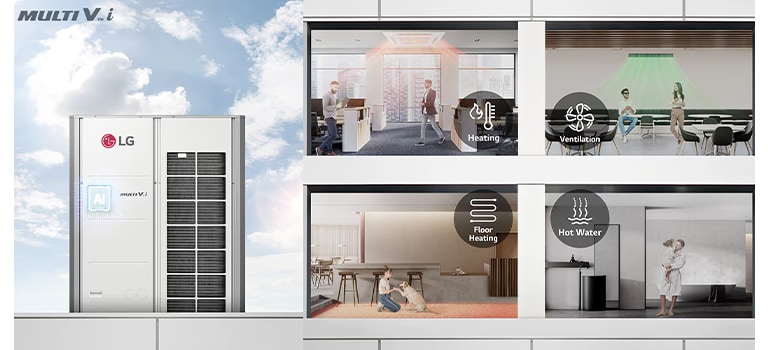
East Africa adds a layer most HVAC technology was never designed around, and the next section sets out exactly what that means in practice. What AI does not change is the physics of cooling a building; what it changes is how much of the ongoing adjustment a facility team has to do by hand. This article makes the case for LG's Multi V i system: what it actually does, where it earns its cost in buildings, and where a simpler system is still the right call.
-
How Does AI Improve Commercial HVAC Performance in East Africa?
Artificial Intelligence earns its value in HVAC by turning large volumes of operating data into decisions the system can act on immediately, rather than waiting for someone to notice a problem. Instead of manual adjustments or a fixed schedule, AI-enabled controls continuously read system behaviour and adapt in real time. Three factors make this more valuable in East Africa than in most markets.
● Power instability: Frequent grid interruptions and generator changeovers subject compressors and controls to many more start-stop cycles than on a stable grid, so automated, self-correcting operation becomes a practical requirement rather than a nice feature.
● Altitude and climate variation: A building in Nairobi and one in Mombasa can have a similar design brief but face very different cooling loads. A system that reads real site conditions rather than fixed assumptions handles that difference far better.
● Cost sensitivity: With commercial power tariffs and diesel backup weighing on operating budgets, even a modest cut in wasted cooling appears as a real line item for finance teams.
This is the market LG built Multi V i for.
-
How Does LG Multi V i Use AI to Optimise Building Performance?
LG Multi V i was developed to bring artificial intelligence directly into commercial HVAC operation. Built on LG's Variable Refrigerant Flow (VRF) platform, the system incorporates an on-device AI engine that continuously analyses operating conditions and improves performance using real-time data, including temperature, load and refrigerant flow across connected indoor and outdoor units. Unlike cloud-dependent systems, it does not rely solely on remote processing to make operational decisions, delivering fast response and continuous performance optimisation.
That on-device design matters: the AI keeps optimising even where sites lack reliable internet, which is common outside the region's major cities.
-
AI Smart Care
AI Smart Care evaluates factors such as temperature, humidity, refrigerant conditions, fan speed and operating settings to determine efficient operating parameters. Based on this analysis, the system can autonomously adjust operation to help achieve target conditions while operating at the most efficient point possible, helping reduce energy consumption without compromising comfort.
-
AI Energy Management
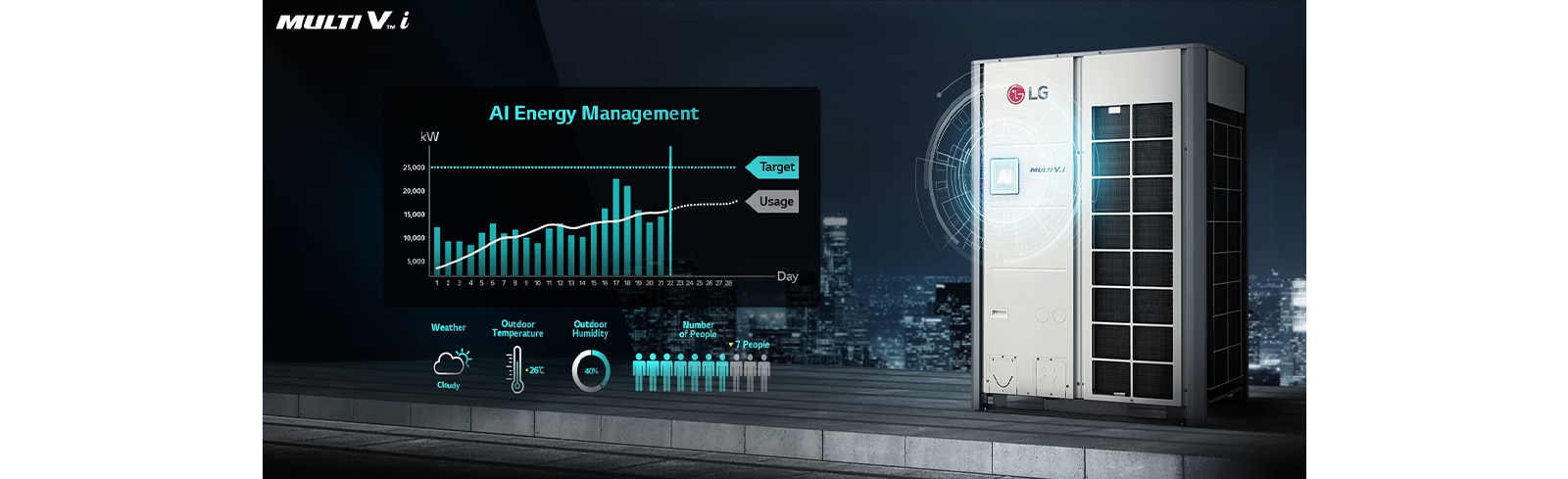
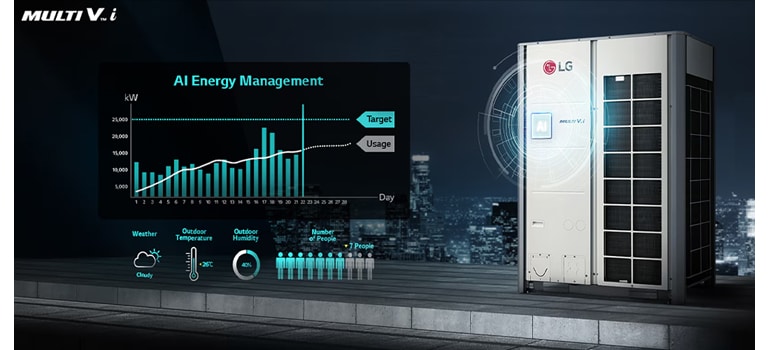
AI Energy Management enables users to set monthly energy consumption targets and supports HVAC operation to align with those goals. The system collects and analyses operational data to learn usage patterns, establish daily energy targets, and monitor real-time consumption. Based on this analysis, it predicts remaining energy usage and calculates the required saving rate to stay within the target.
● To use this function, users should input the monthly target consumption on the wired remote controller.
● For sites with less than one year of operational history, a recommended energy consumption target based on approximately one month of operational data is provided to help customers set their target value.
-
For a facility watching energy costs closely, this turns "use less power" from a vague instruction into a number the system actively works towards.
-
AI Energy Waste Alert
AI Energy Waste Alert uses continuous monitoring and analysis to learn operating patterns and identify behaviour that may result in unnecessary energy consumption. By comparing real-time operation against expected performance, the system can detect potential inefficiencies early and notify users before they lead to excessive energy use.
● To use this function, at least two weeks of usage pattern learning are required.
● The waste alert will be displayed at least two hours after the indoor unit is turned on.
-
AI Compressor Diagnosis
Building on this foundation, AI Compressor Diagnosis takes a deeper, data-driven approach to fault detection. By learning normal current patterns from historical operating data, it can identify abnormalities in real time and detect issues earlier and more precisely than conventional CH error codes, enabling faster response and increasing the likelihood of completing repairs in a single visit.
● Compressor fault diagnosis factors include pressure, frequency, operating mode, temperature, seasonality and voltage.
● Up to two years of data can be used for learning; longer learning improves accuracy.
That last point is worth planning for: switching maintenance providers or resetting the system resets the learning curve, so it pays to build service contracts around data continuity rather than price alone.
-
How Does LG Multi V i Support Comfort in East African Buildings?
LG Multi V i also supports comfort-focused operation through Noise Adaptive Control, Noise Target Control and Weather Information Interlocking Control, which help the system respond intelligently to both indoor requirements and changing outdoor conditions.
-
Noise Adaptive Control
Noise Adaptive Control continuously evaluates background noise levels and the distance between the outdoor unit and nearby occupants to determine an appropriate operating noise level. By adjusting the operation so that product noise does not exceed surrounding environmental noise, the system helps minimise disruption while maintaining performance.
● The AI engine calculates target noise considering background noise and the distance between the product and the user.
● The installer must input the installation distance between the product and the user for this function to work.
● Operation may differ according to the environment, and noise reduction may affect performance.
That installer input is where quality of installation genuinely shows up in the result, not just as a formality.
-
Noise Target Control
Noise Target Control lets users set a target sound level in advance, with available settings from 50 to 70 dB. This can help reduce disruption in noise-sensitive environments such as offices, hotels, schools and residential-adjacent commercial buildings. This is a smart function of Multi V i, not one based on AI algorithms.
-
Weather Information Interlocking Control
Weather Information Interlocking Control uses live and forecast weather information from AccuWeather to help optimise system operation based on outdoor conditions. By automatically adjusting for changing weather, Multi V i can support functions such as pre-heating, air-cleaning display, and comfort or energy-saving mode recommendations, helping improve both comfort and operational efficiency.
● This is a smart function of Multi V i, not one based on AI algorithms.
● To refer to weather information from AccuWeather, the Wi-Fi modem should be connected to the ThinQ server.
● Results may vary depending on the environment, and function application may vary depending on the indoor unit and controller type.
The connectivity requirement is the point to watch: this feature matters most for buildings at altitude with cooler evenings. It only works where the site has a stable internet connection to begin with.
-
How Does AI Improve HVAC Maintenance and Reliability?
The same concerns come up in every facility management and HVAC forum discussion: unplanned downtime, the cost of reactive repairs, spare parts availability, and how quickly a fault gets diagnosed on-site. All four are sharper where technical support often has further to travel and where power interruptions can mask or trigger fault codes that make troubleshooting harder than it should be.
LG Multi V i incorporates AI Smart Diagnosis, which automatically analyses operating conditions and provides visualised system-status information to help technicians evaluate equipment performance. By simplifying fault identification and highlighting areas that may require attention, the feature helps reduce troubleshooting time and improve service efficiency. Paired with AI Compressor Diagnosis, it shifts maintenance from a reactive, wait-for-the-breakdown model to a proactive one, where issues get flagged before they cause an outage.
For a facility manager in this region, that means fewer emergency callouts in a market where technician availability and parts logistics are real constraints, and a stronger case for planning maintenance around data rather than a fixed calendar.
-
What Does LG's VRF Technology Look Like in Hospitality?
Glee Nairobi is a 211-room hotel in Kenya's capital, with rooms ranging from superior to a presidential suite, running LG's Multi V 5 VRF system with smart controls. The property needed consistent comfort across a large, varied room mix without energy use or maintenance spiralling, and Multi V 5 delivers that through centralised monitoring that lets the engineering team manage the system with minimal disruption. It is a verified regional deployment of LG's VRF technology in a demanding hospitality setting.
-
Is AI-Powered VRF Right for Your Building?
Scenario Recommended approach Why Hotel, hospital or mixed-use building with many zones and long-term occupancy AI-powered VRF (Multi V range) Justifies the investment through zoned control, energy savings and lower long-term maintenance costs across many indoor units Single-tenant office or small retail unit on a short lease Single split or multi split Lower upfront cost, simpler installation, no need for centralised monitoring across zones Data centre or server room requiring precision cooling Chiller or dedicated precision system, VRF for supporting spaces Cooling stability and redundancy requirements exceed typical VRF comfort-cooling design intent Warehouse or manufacturing floor with high dust and large open volumes Rooftop packaged units or ventilation-led solutions, with VRF for office areas Open volumes and dust loads favour robust, easily filtered equipment over dense zoned VRF layouts Building targeting EDGE or similar green certification AI-powered VRF with monitoring Measurable energy data supports the certification's efficiency evidence requirements
-
What Should You Consider When Designing and Installing AI-Powered HVAC?
● Confirm how the system behaves through generator changeover and voltage fluctuation, and size backup power with the HVAC load included from the start, not added on afterwards.
● Check altitude derating at the design stage for highland sites. Cooling capacity and compressor performance can shift at elevation, and sea-level specifications will not tell you that.
● Plan outdoor unit placement, filter specification and cleaning schedules around dust, particularly near unpaved roads, construction sites, or through the dry season.
● Budget for corrosion-resistant coatings and more frequent condensate and coil checks on coastal sites where humidity works harder on equipment than it does at altitude.
● Get the installation distance right wherever Noise Adaptive Control is used. The feature depends entirely on that input, and getting it wrong quietly defeats the whole point of having it.
● Plan around on-device AI features for sites with unreliable internet, since weather-linked control and cloud monitoring both need a stable connection to the ThinQ server or BECON cloud to function.
-
What Does AI-Powered HVAC Cost to Own and Maintain?
Total cost of ownership comes down to servicing reliability as much as the purchase price. Facility managers raise the same three concerns in almost every industry discussion: how fast a fault gets diagnosed, how available parts are locally, and how much a weak installation quietly adds to running costs over the years.
AI-assisted diagnosis solves the first of those. The other two still come down to choosing an authorised installer and dealer network with local stock and trained technicians, which is worth confirming through LG's dealer network and engineering support resources before specification, not after installation.
Build maintenance contracts around data continuity, not just fixed intervals. AI Compressor Diagnosis gets more accurate the longer it runs, drawing on up to two years of learning data, and switching providers or resetting the system resets that learning curve with it. That is an easy cost to miss when comparing service contracts on price alone.
-
How Can Facility Managers Maximise Energy Savings from AI-Powered HVAC?
● Configure AI Energy Management with a realistic monthly target rather than leaving it unset. The system cannot work towards a target it has never been given.
● Give the system its learning period before judging results: about two weeks for Energy Waste Alert, longer for Compressor Diagnosis.
● Pair HVAC efficiency gains with a central controller so energy reporting for tenants, boards or certification bodies comes from one consistent data source.
● Use real consumption data as evidence for EDGE or similar certification rather than modelled estimates. IFC financing has driven a real expansion of EDGE-certified stock across the region.
-
Frequently Asked Questions
-
What is AI-powered HVAC?
AI-powered HVAC uses sensors, connectivity and on-device or cloud-based artificial intelligence to analyse real-time building conditions and automatically adjust heating, cooling and system operation, rather than relying only on fixed schedules or manual control.
-
Does AI HVAC still work during a power outage or generator changeover?
The AI functions themselves run on the unit's on-device processing, so they resume as soon as power is restored. However, any feature depending on a live internet connection, such as weather-linked control or cloud monitoring, will only resume once connectivity is back, so it is worth distinguishing between on-device and connected features when planning for an unstable grid.
-
How does altitude affect commercial air conditioning?
Higher elevations change air density and can affect compressor performance and rated cooling capacity, so systems for high-altitude cities should be checked against site-specific design conditions rather than sea-level specifications.
-
How much energy can AI-powered HVAC actually save?
Savings depend heavily on the building, prior operating practices and how well features like AI Energy Management are configured. Rather than quoting a single figure, the more useful approach for a facility manager is to set a realistic monthly target through the system and track actual consumption against it over several months.
What is VRF and how is it different from a split system?
VRF (Variable Refrigerant Flow) connects multiple indoor units to shared outdoor units and varies refrigerant flow to match the load in each zone, giving finer zoned control and generally better part-load efficiency than standalone split systems, at a higher upfront design and installation complexity.
How often does an AI-powered VRF system need servicing?
Manufacturer-recommended service intervals still apply, but AI Smart Diagnosis and AI Compressor Diagnosis support a more proactive approach by flagging early signs of a developing fault between scheduled visits, rather than replacing the need for scheduled maintenance altogether.
Can AI HVAC support green building certification such as EDGE in East Africa?
Yes. Real-time consumption data from AI-enabled systems can support the energy-efficiency evidence required for certifications such as IFC's EDGE standard, which requires a minimum 20 percent improvement in energy, water and embodied carbon compared with a local baseline building.
What noise levels can be expected from LG Multi V i near guest rooms or offices?
Noise Target Control allows a target sound level between 50 and 70 dB to be set in advance, and Noise Adaptive Control adjusts operation so that product noise stays below measured ambient noise. However, results depend on correct installation inputs and site conditions.
Conclusion
AI does not change the physics of cooling a building. What it changes is how much of the ongoing adjustment, waste detection and fault diagnosis a facility team has to do by hand. That shift from reactive to proactive management is worth more here than in a stable-grid, temperate market, because East Africa gives a system so much more to react to.
LG's VRF technology is already proving that out in the region, at properties such as Glee Nairobi. The return on the AI-specific features covered here, though, depends entirely on specifying, installing and maintaining Multi V i for the conditions it will actually run in, not the conditions it was designed and tested against.