



BMS and HVAC Integration: Why Dedicated VRF Controls Still Matter
-
Key Takeaways
• A Building Management System (BMS) coordinates a building's major systems, and HVAC is typically its largest responsibility, managed through a networked hierarchy of controllers rather than a single device.[1]
• While a BMS provides centralized monitoring and coordination, each HVAC technology still relies on dedicated, field-level controls optimized for its own operation.[1]
• VRF systems are 20–30% more efficient than conventional HVAC, but achieving that efficiency requires advanced control of refrigerant flow, compressor operation, and zone-level load balancing, not just building-wide scheduling.[2]
• LG's Advanced Control Solution (ACS) delivers this specialized VRF control through energy scheduling, seven-step energy navigation, peak demand control, tenant energy allocation, COP compliance tracking, and indoor air quality monitoring.
• A BMS delivers the greatest value when paired with dedicated VRF controls, combining centralized building management with the refrigerant-side optimization fundamental to VRF performance.[1]
[1] https://www.wbdg.org/resources/smart-controls
[2] https://www.csemag.com/back-to-basics-vrf-systems/

-
1. Why Is BMS–HVAC Integration Essential for Modern Buildings?
Heating and cooling account for roughly 35% of a building's energy use, the largest share of any end use, making HVAC management one of the most consequential efficiency decisions an owner faces, according to the U.S. Department of Energy.[1]
Modern offices meet this challenge by integrating HVAC with a Building Management System (BMS), unifying building systems onto one platform to cut energy waste, tighten occupant comfort, and streamline operations.
Within this context, Direct Digital Control (DDC) and Variable Refrigerant Flow (VRF) control both represent control methodologies in building HVAC systems, but differ in their control scope and functional roles.
• Direct Digital Control (DDC) supports as a centralized, supervisory control method, applying programmed logic, scheduling, and system-level optimization across multiple HVAC components.
• VRF (Variable Refrigerant Flow) system control operates at the equipment level as an operational control method, directly regulating refrigerant flow and indoor unit performance in response to zone demands, enabling precise and localized thermal control.
It is at this zone level that advanced VRF control becomes essential, delivering the precision and efficiency that make office buildings genuinely smarter to run. To understand why this integration matters, we first need to clarify how VRF controls fit within a BMS.
[1] https://www.energy.gov/cmei/buildings/heating-ventilation-air-conditioning-refrigeration-and-water-heating
-
2. How Do VRF Controls Fit Within a Building Management System?
Within a BMS, the control layer that actually runs the HVAC is the DDC, the current industry standard for major building control systems.[1]
The DDC's job is broad: through networked microprocessors, sensors, and controllers, it coordinates HVAC alongside lighting, security, and other systems, comparing live sensor data against setpoints and issuing commands across the whole facility.[1] It is the layer that gives operators a single, building-wide view.
VRF system control solutions work one level deeper. Instead of overseeing the building as a whole, they are purpose-built for the VRF equipment itself, modulating refrigerant flow to the real-time heating and cooling loads of each zone.
In a well-designed office, the two are complementary rather than competing. DDC delivers building-wide oversight; VRF control delivers the zone-level precision that complex, multi-tenant spaces demand, and the tighter that precision, the more efficient the building becomes overall. While this layered approach is general, the real question is how specific manufacturers such as LG implement this integration in practice.
[1] https://www.wbdg.org/resources/smart-controls
-
3. How Does LG Integrate VRF Controls with a Building Management System?
Many HVAC manufacturers offer controllers that integrate VRF systems with BMS, extending the benefits of dedicated VRF control to building-wide management.
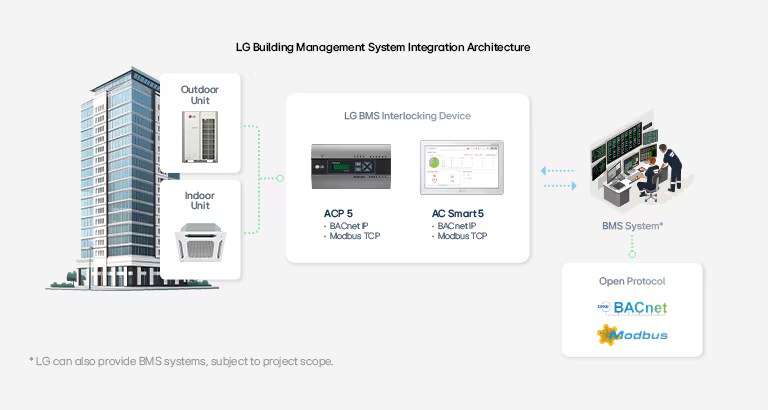
LG follows this approach by supporting open protocols, including BACnet IP and Modbus TCP, that allow its VRF control solutions to integrate with a wide range of BMS.
*AC Smart 5 and ACP 5 are accessible across PC, tablet, and smartphone without dedicated software.

-
This matters because these are not proprietary channels. BACnet, maintained by ASHRAE, is the global standard for building automation and was designed specifically to enable vendor-independent interoperability among control devices.[1]
For a building owner, that open protocol support is what keeps the VRF system from becoming an isolated island. It lets LG's zone-level control feed directly into the BMS, so the precision described earlier is monitored and managed as part of the whole building rather than beside it.
[1] https://data.ashrae.org/bacnet/
-
4. What Operational Value Does LG’s VRF Control Solution Deliver?
Once integrated with a BMS, the value of advanced VRF control comes from the operational intelligence built into the manufacturer's control platform. LG's ACS extends centralized building management with tools for energy optimization, cost allocation, air quality management, and access control.
*Some features described below may vary or may not be available depending on the compatibility, configuration, and capabilities of the connected Building Management System (BMS) and system integration.
4-1. Energy Optimization
ACS schedules operation around actual occupancy and building use patterns, automatically switching systems on and off to prevent waste, such as shutting down after hours instead of conditioning an empty floor. Three functions sharpen this:
Energy Navigation: The system analyzes usage from past data, simulates operation against a target, then applies a seven-step automatic adjustment to stay within that target.
Peak Control: During high-demand periods, priority control powers down lower-priority indoor units, while capacity control throttles the outdoor unit to meet energy goals without disrupting the whole building.
Lock Functions: Managers can restrict individual controllers, locking temperature, fan speed, mode, or all settings, so occupants cannot override the efficiency strategy.
4-2. Cost Allocation and Compliance
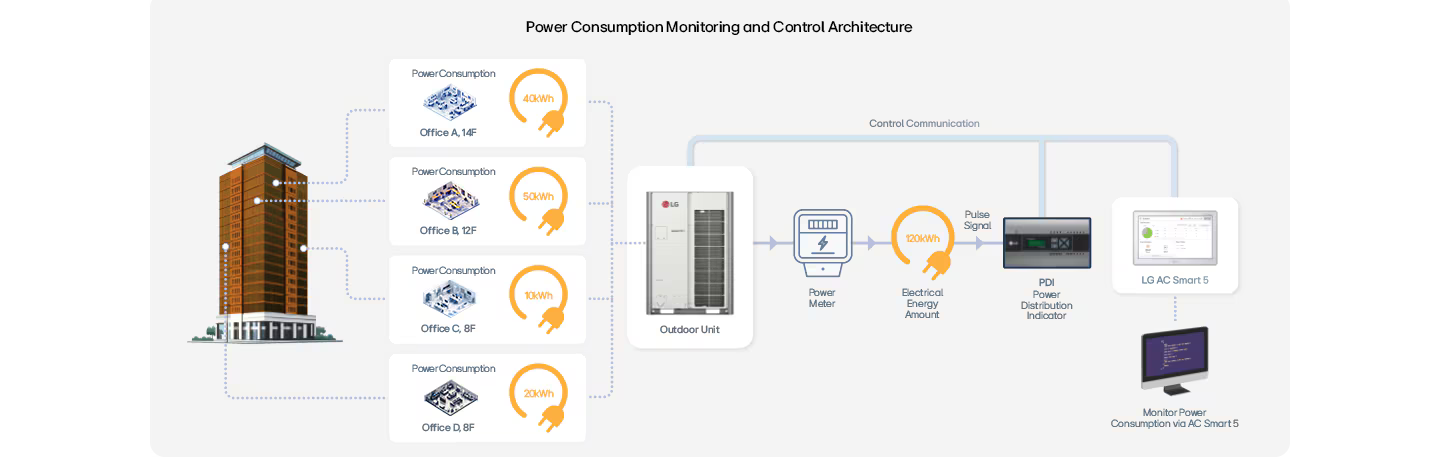
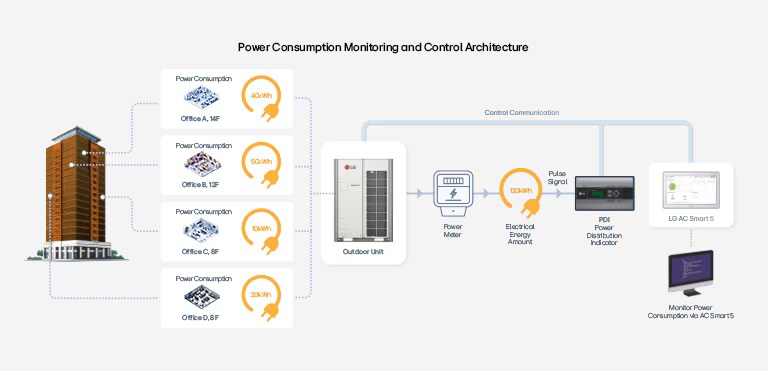
For multi-tenant offices, the Power Distribution Indicator (PDI) is an energy monitoring solution that distributes and visualizes an outdoor unit’s total electricity consumption across connected indoor units based on their operating conditions and usage patterns, providing facility managers with data to allocate energy costs more accurately among tenants. ACS also tracks Coefficient of Performance (COP), viewable in numerical and graphical form and exportable to Excel, which may assist documentation and reporting for green building regulations and incentive programs.*
*This solution may vary by country.
-
4-3. Air Quality and Access
Beyond energy, ACS integrates indoor air quality monitoring directly into the control interface, tracking CO₂ and dust concentration so managers can maintain a healthy office environment alongside efficient operation. Access itself is customizable: administrators can assign roles to as many as 20 users and grant authority by sector, floor, or tenant company, tailoring control to how the building is actually occupied.
Together, these functions make ACS less a single feature set than a management layer, one that helps translate VRF control capabilities into operational insights that can support more efficient facility management. Having implemented this integration, the next step is to extend it beyond simple connectivity into more intelligent, AI-driven operation, which LG addresses with ACP i.
-
5. How Does ACP i Extend Integration from Connectivity to Intelligent Optimization?
Modern HVAC control is no longer limited to simply turning equipment on and off. LG's ACP i combines broad system connectivity, AI-driven analytics, and an intuitive user experience to help facility managers operate buildings more efficiently and reliably.
5-1. Broad Connectivity Across HVAC Systems
ACP i is designed to work beyond VRF alone. With an expandable communication module, it integrates with a wide range of LG HVAC solutions—including VRF, Inverter Scroll Chillers, Rooftop Units (RTUs), Dedicated Outdoor Air Systems (DOAS), and Oil-free Centrifugal Chillers. It can also monitor and manage large numbers of indoor and outdoor units from a single platform, making it suitable for everything from medium-sized offices to large commercial facilities.

-
5-2. AI-Powered Optimization and Predictive Insights
ACP i continuously collects and analyzes operating data from indoor and outdoor units, including EEV opening values, water inlet and outlet temperatures, and room temperatures. Using advanced AI algorithms, it identifies inefficient operating patterns, detects potential energy waste, and provides Energy Waste Alerts that help operators improve system performance. The same AI-driven monitoring can help flag abnormal operating conditions for operator review, supporting proactive maintenance and system management.

-
5-3. User Experience and Intelligent Interface Insights
ACP i simplifies day-to-day facility management through an intuitive, AI-optimized interface. Industry-specific applications can be customized for offices, hotels, hospitals, retail stores, and other commercial environments, while a centralized dashboard provides real-time system status, operational recommendations, and HVAC On-Air alerts. The result is a control platform that makes complex HVAC systems easier to monitor, manage, and optimize.

-
Powered by advanced AI algorithms, ACP i continuously monitors and analyzes data from indoor and outdoor units to support energy management, help identify potential abnormal conditions, and assist facility managers in operating the HVAC system.
-
6. Conclusion
Advanced VRF control can contribute to improving building performance beyond basic automation. While a BMS coordinates the building as a whole, additional efficiency improvements, along with per-zone control, the energy navigation, and the peak controls, may be supported at the VRF system level, where more granular control is available than at the general building control layer.
This is why VRF's energy-saving potential is only fully realized when its own control layer is integrated into the BMS, not left to DDC alone. LG's Advanced Control Solution makes that integration practical, pairing zone-level VRF precision with open protocol support that connects it to the wider building system.
Building on this foundation, LG’s ACP i further extends integration beyond connectivity to intelligent operation. By applying AI-driven analytics to real-time system data, it can support ongoing performance monitoring, help identify potential inefficiencies, and enable more proactive, data-informed facility management.
For owners weighing energy costs, occupant comfort, and long-term sustainability, this combination of precision, openness, and intelligence is no longer an optional add-on. It is the foundation of truly smart building management.
FAQs
-
Q.
Can HVAC systems like VRF integrate with a building management system (BMS)?
-
A.Yes. VRF systems integrate with a BMS through open communication protocols, letting the VRF equipment be monitored and managed as part of the wider building. The BMS handles building-wide coordination, while the VRF controller manages the zone-level precision inside the refrigerant system, and the two exchange data so operators get one unified view. LG's controllers support BACnet IP and Modbus TCP for exactly this purpose.
-
Q.
Why can't a BMS manage everything a VRF system does on its own?
-
A.Because VRF equipment carries manufacturer-specific smart functions, such as balancing simultaneous heating and cooling across zones or allocating energy per indoor unit, that live on the VRF controller and are not exposed to a general building management layer. A BMS coordinates broadly, but the granular refrigerant logic and zone-level monitoring data reside in the VRF control system.
-
Q.
Which LG controllers support BMS integration?
-
A.LG's ACP 5 supports BACnet IP and Modbus TCP, while AC Smart 5 supports BACnet IP and Modbus TCP. Because BACnet, maintained by ASHRAE, is the global building automation standard built for vendor-independent interoperability, these controllers connect LG VRF systems to virtually any major BMS platform.
-
Q.
How does LG's control solution help allocate energy costs among tenants?
-
A.LG's Power Distribution Indicator (PDI) is an energy monitoring solution that distributes and visualizes the total electricity consumption of an outdoor unit across connected indoor units based on their operating conditions and usage patterns. This provides facility managers in multi-tenant offices with data that can be used to support more accurate allocation of energy costs, reducing reliance on estimation and improving cost transparency.