




What Is Free Cooling? A Guide to Energy-Efficient Data Center Cooling
-
Key Takeaways
• Cooling is one of the largest controllable energy costs in a data center, making energy efficiency increasingly important as electricity demand continues to grow. Global data center electricity use rose 17 percent in 2025 and is projected to double by 2030, driving greater demand for efficient cooling solutions.[1]
• Free cooling reduces cooling energy by using cool outdoor air instead of relying solely on mechanical refrigeration. Depending on outdoor conditions, it can replace or supplement compressor-based cooling, lowering energy consumption and operating costs.[2][3] • The effectiveness of free cooling depends on climate and operating conditions. Within ASHRAE's recommended 18–27°C temperature range, many locations can use free cooling for a significant portion of the year.[2]
• LG's refrigerant-based free-cooling technology helps improve efficiency by minimizing the impact of a heat exchanger that is not used during free-cooling operation, which in some configurations may be associated with additional airflow resistance. Its Series Counter Flow is designed to reduce compressor lift, supporting system efficiency depending on system design and operating conditions.
[1] https://www.iea.org/news/data-centre-electricity-use-surged-in-2025-even-with-tightening-bottlenecks-driving-a-scramble-for-solutions
[2]https://www.ashrae.org/file%20library/technical%20resources/bookstore/ashrae_tc0909_power_white_paper_22_june_2016_revised.pdf
[3] https://www.energy.gov/sites/default/files/2024-07/best-practice-guide-data-center-design_0.pdf


-
1. Introduction: Why Free Cooling Matters?
Energy demand in data centers is accelerating rapidly, driven by AI and high-density computing. Data centers consumed around 415 terawatt-hours of electricity in 2024, roughly 1.5 percent of the world's total.[1] That figure rose another 17 percent in 2025, far outpacing the 3 percent growth in overall electricity demand, and is projected to double by 2030.[2]
That growth puts every watt of overhead under scrutiny. Servers and networking are essential investments in a data center, but cooling energy is an operating cost that can often be reduced through more efficient infrastructure and operations. Cooling and other facility infrastructure account for a large share of data center electricity, and as that total climbs, cutting cooling energy becomes one of the clearest ways to control both consumption and operating costs.[3]
This is where free cooling earns its place. By using cool outdoor air instead of mechanical refrigeration whenever conditions allow, it can substantially reduce cooling energy, making it a key technology for improving data center efficiency and reducing operating costs.
[1] https://www.iea.org/reports/energy-and-ai/executive-summary
[2] https://www.iea.org/news/data-centre-electricity-use-surged-in-2025-even-with-tightening-bottlenecks-driving-a-scramble-for-solutions
[3] https://eta-publications.lbl.gov/sites/default/files/2024-12/lbnl-2024-united-states-data-center-energy-usage-report_1.pdf
-
2. How Does Free Cooling Work?
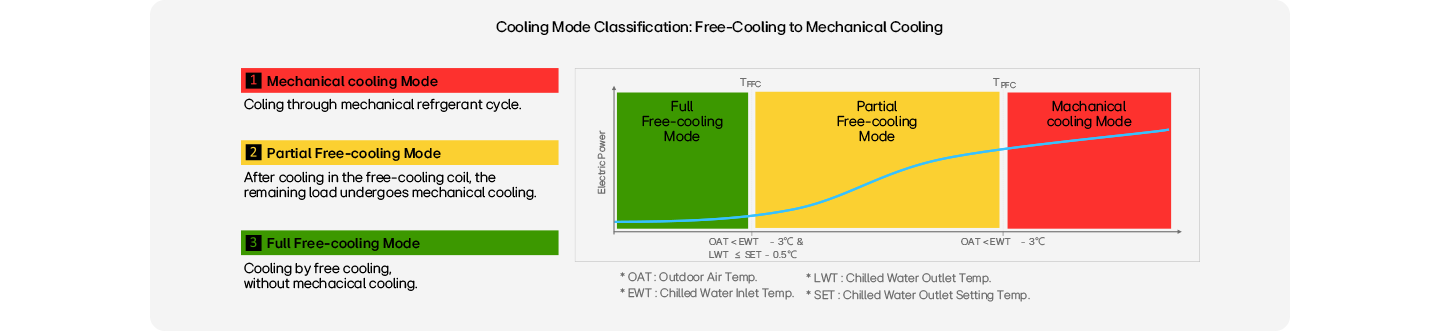
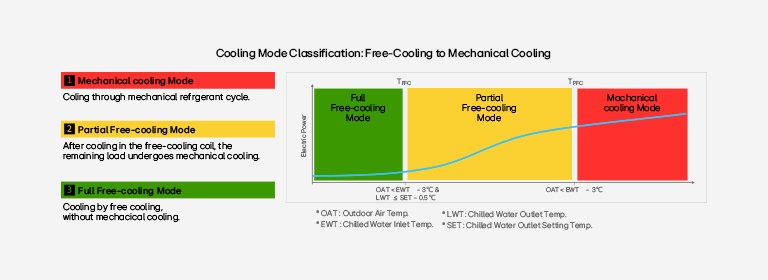
Free cooling allows a chiller to transfer heat to cool outdoor air, reducing or even eliminating the need for compressor-based cooling depending on outdoor conditions. In configurations using hydronic free-cooling, partial free-cooling may handle a portion of the load when outdoor air is moderately cool, with mechanical cooling covering the remainder. Under sufficiently cold conditions, both hydronic and refrigerant free-cooling systems can enable full free-cooling, allowing the cooling load to be met with the compressors switched off. In data center applications, this can reduce chilled-water production energy use under suitable conditions.[1]
-
2-1. Hydronic Free-cooling
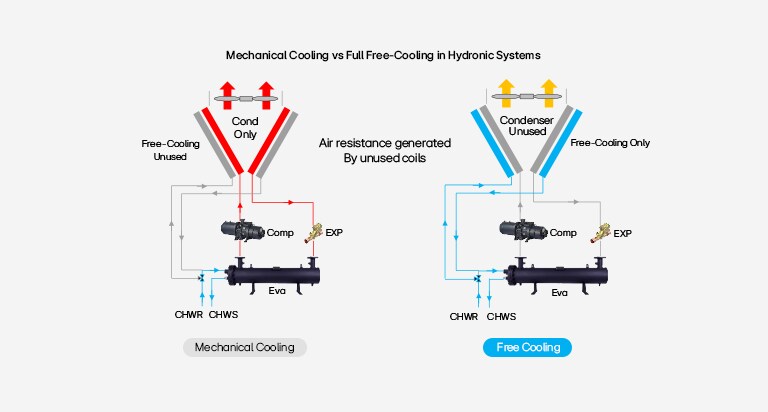
Hydronic free-cooling circulates water or a water-glycol mix through an outdoor coil to shed heat before the fluid returns to the chiller. It is a proven approach, but depending on the system design, glycol may be required to protect the outdoor coil from freezing, adding ongoing concentration management. In some configurations, a heat exchanger not used for free cooling may be associated with additional airflow resistance, potentially leading to increased pressure drop and minor efficiency impacts.

-
2-2. Refrigerant Free-cooling
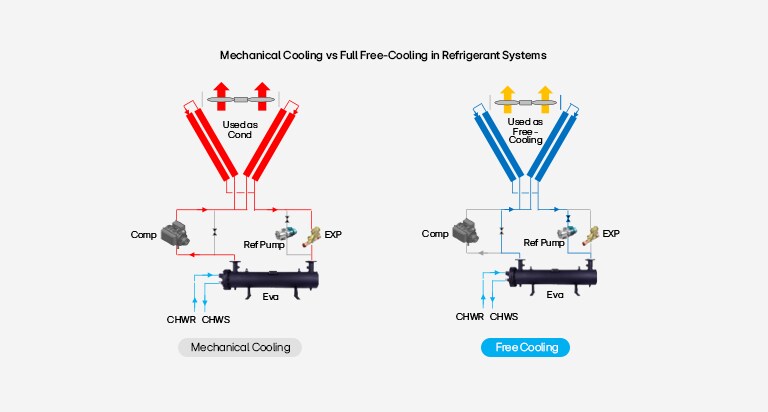
Refrigerant free-cooling circulates refrigerant directly to the outdoor coil rather than a water‑glycol loop, which can reduce freezing risk and the need for glycol management. In addition, LG's refrigerant-based free-cooling technology is designed to reduce the impact of a heat exchanger that is not used during free-cooling operation, adding airflow resistance in some configurations. The chiller also incorporates Series Counter Flow evaporator technology as a supporting feature for reducing compressor lift to improve efficiency.

-
[1] https://www.energystar.gov/products/data_center_equipment/16-more-ways-cut-energy-waste-data-center
-
3. Where Does Free Cooling Deliver the Most?
Free cooling delivers the most in cool, dry climates and in facilities willing to run warmer server-inlet temperatures, because both extend the hours when outdoor conditions alone can carry the cooling load.
3-1. How Warm Are Operators Willing to Run the Room?
Server-inlet temperature has a direct impact on free-cooling hours. The higher the allowable inlet temperature, the more often outdoor conditions can provide cooling. Even within ASHRAE's recommended envelope of 18 to 27 degrees Celsius (64 to 81 degrees Fahrenheit), many locations can use free cooling for nearly half of the year, while the broader allowable temperature ranges extend those opportunities further.[1] Intel demonstrated this potential in a high-density data center operating with 95°F (35°C) server-inlet temperatures, where free cooling was available for all but 39 hours of the year, and the facility achieved a PUE of 1.07.
3-2. How Does Local Climate Factor In?
Local climate has a direct impact on free-cooling hours, but the key weather factors vary by cooling method. Air-side systems are more sensitive to humidity because outdoor air enters the data hall, whereas water-side systems and refrigerant-side systems isolate the data hall from outdoor air.[1]
As a result, cooler climates generally provide more opportunities for free cooling than warmer ones, although the actual number of free-cooling hours depends on the system design and operating conditions. For example, a cool, dry location such as San Francisco can support free cooling for most of the year, while a warmer, more humid climate such as northern Florida offers fewer opportunities, particularly for air-side systems.[1]
[1] https://www.energystar.gov/products/data_center_equipment/16-more-ways-cut-energy-waste-data-center
-
4. How LG Approaches Data Center Cooling
Free cooling is most effective when it is integrated into the wider cooling chain, and LG's approach spans that full chain rather than a single product. Its data center portfolio runs from chillers to room cooling and liquid cooling: water-cooled and air-cooled centrifugal chillers, CRAH and fan-wall units for the data hall, coolant distribution units and cold plates for direct-to-chip liquid cooling, and BECON controls that tie them together.
Chillers sit at the heart of it, and this is where LG solutions lean into the free-cooling theme. Its air-cooled centrifugal chiller uses refrigerant free-cooling with a Series Counter Flow design that extends full free cooling into higher ambient temperatures than a conventional water-based (hydronic) free-cooling setup.
The chiller’s design plays a key role in supporting both operating efficiency and long term reliability. LG's oil-free magnetic bearing centrifugal chillers remove oil from the refrigerant cycle to cut friction losses, and the air-cooled model is rated at an EER of 4.0.*
*This rating is based on a microchannel heat exchanger configuration.
Internal testing indicates up to approximately 21 percent higher part load (IPLV) efficiency under comparable AHRI rating conditions than a similar capacity R 513A inverter screw chiller. Performance ratings are developed in accordance with AHRI 550/590, the industry’s widely recognized standard for chiller performance evaluation.
Bringing chillers, room cooling, and liquid cooling under one BECON control platform also gives operators a single view of the whole system and one point of accountability.
-
5. Conclusion
Cooling remains one of the highest controllable costs in the data center, and with power demand climbing faster than efficiency gains, that cost is only getting harder to ignore. Free cooling is one of the clearest ways to close the gap, trading compressor runtime for cool outdoor air whenever conditions allow.
Realizing those savings, however, requires more than a single high-efficiency component. It requires an integrated cooling system that transitions seamlessly between free and mechanical cooling, coordinated by controls that optimize the entire operation. When designed well, this approach reduces energy consumption while maintaining the reliability that data centers demand.
FAQs
-
Q.
What is free cooling in a data center?
-
A.Free cooling is a method that uses cool outdoor air or water to remove heat and reduce or eliminate the need for mechanical refrigeration, thereby saving energy by operating the chiller’s compressor less or, in some cases, not at all. In air-cooled chillers with free cooling, it takes two forms: hydronic free cooling circulates a water-glycol mix to the outdoor coil, while refrigerant free cooling circulates refrigerant directly.
-
Q.
How much energy can free cooling save?
-
A.Free cooling saves energy by reducing the need for mechanical cooling. The longer outdoor conditions allow free cooling, the greater the savings. In many climates, free cooling can be used for nearly half of the year while remaining within ASHRAE's recommended operating conditions.
-
Q.
Is free cooling reliable enough for critical workloads?
-
A.Yes, because free cooling is designed to work alongside mechanical cooling rather than replace it. When outdoor conditions cannot carry the full load, mechanical cooling covers the remaining hours, so a facility never depends on the weather alone to stay within safe temperatures.
-
Q.
What is the difference between full and partial free cooling?
-
A.Full free cooling means outdoor conditions are cold enough to handle the entire cooling load with the compressors switched off. Partial free cooling means outdoor air handles part of the load while mechanical cooling covers the remainder.