




How Does a Chiller Work? A Practical Guide with Diagram
Share this content.
-
Modern buildings often move cooling with water rather than long air ducts. A chiller sits at the heart of that approach: it removes heat from water using the vapor-compression cycle, then the plant circulates this chilled water to Air Handling Units (AHU) or Fan Coil Units (FCU) throughout the building. This article defines what a chiller in HVAC is and what a chiller does, then explains how a chiller works with a clear diagram.
-
What is a Chiller in HVAC?
In common use, “chiller” or “water chiller” refers to a factory-made water-chilling package that serves space or process loads. The package is part of a larger chiller system that includes pumps, controls, and —when specified—cooling towers and condenser-water circuits. Thinking of the system this way helps non-engineers understand what a chiller does and how the chilled-water loop fits into day-to-day operations.
-
How Does a Chiller Work?
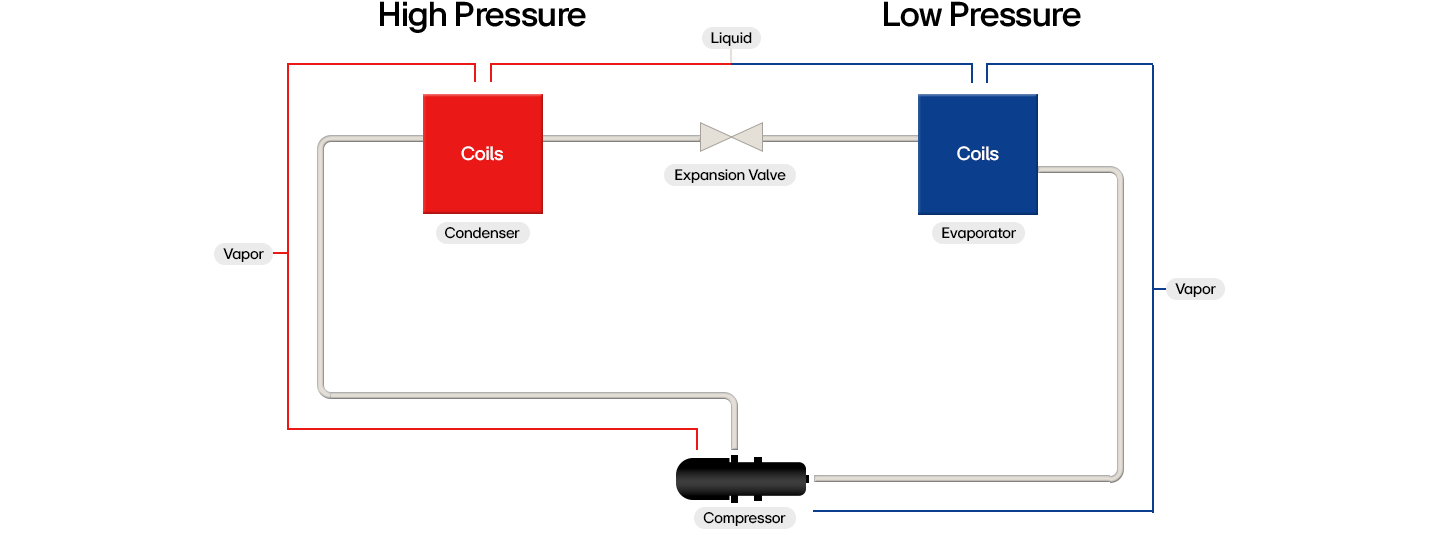
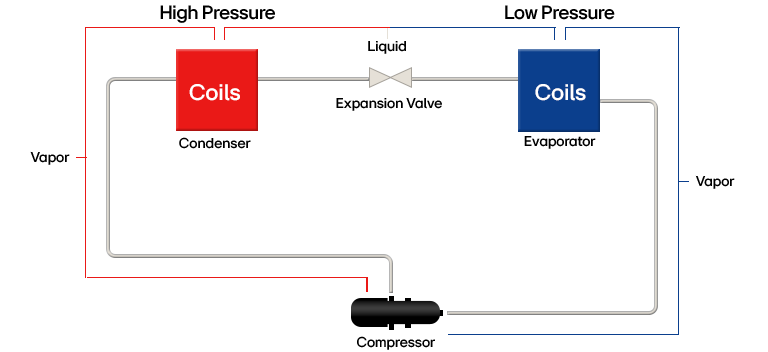
At its core, the cycle moves refrigerant through compressor → condenser → expansion valve → evaporator.
-
The compressor raises refrigerant pressure and temperature. The condenser rejects heat and condenses the refrigerant to a high-pressure liquid. The expansion valve meters flow and drops pressure and temperature. The evaporator absorbs heat from the chilled-water loop, and that chilled water is supplied to AHU/FCU coils, then returns warmer to the chiller. With that foundation, let’s see how LG’s water-cooled and air-cooled chillers apply this cycle in practice.
-
Water-Cooled Chillers at a Glance
A water-cooled chiller is part of a central plant that rejects heat to cooling water and cooling tower, then delivers chilled water throughout the building. This layout fits large or multi-building sites that benefit from stable capacity and centralized control.
-
How an LG Water-Cooled Chiller Works
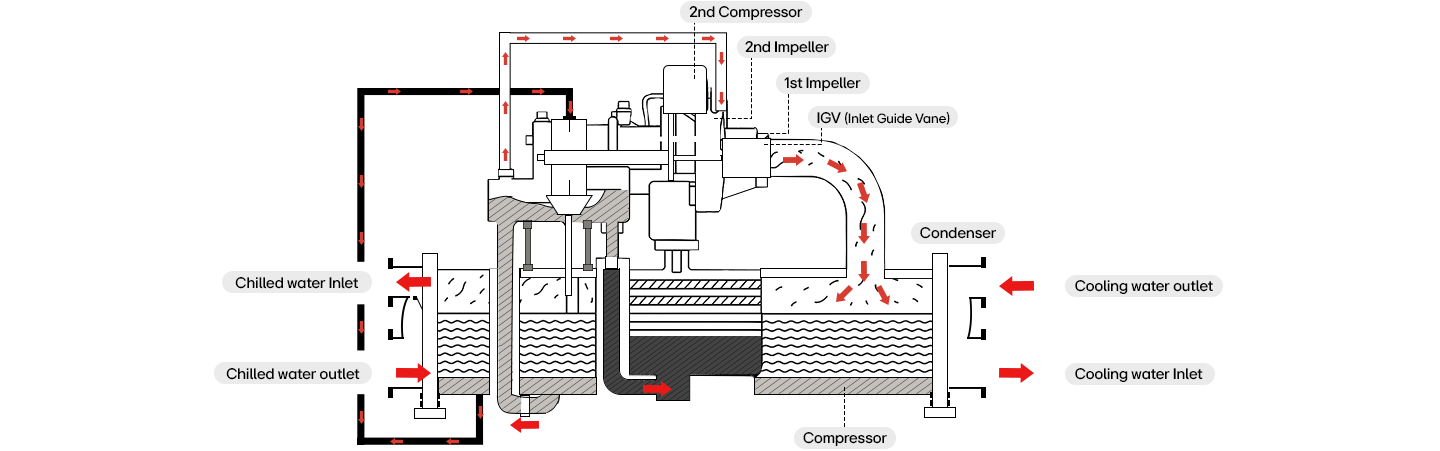
LG’s centrifugal chiller uses a two-stage compressor with two-stage expansion and an external economizer. Inlet Guide Vanes (IGV) meter low-pressure vapor into the first impeller for capacity control. After first-stage compression, the flow mixes with cold vapor from the economizer and enters the second impeller for final compression. In the condenser, the high-pressure gas rejects heat to cooling water from the cooling tower; LG routes this water through the condenser bundle to condense gas refrigerant to a high-pressure liquid. The liquid passes a first and second expansion device, dropping pressure and temperature before the evaporator.

-
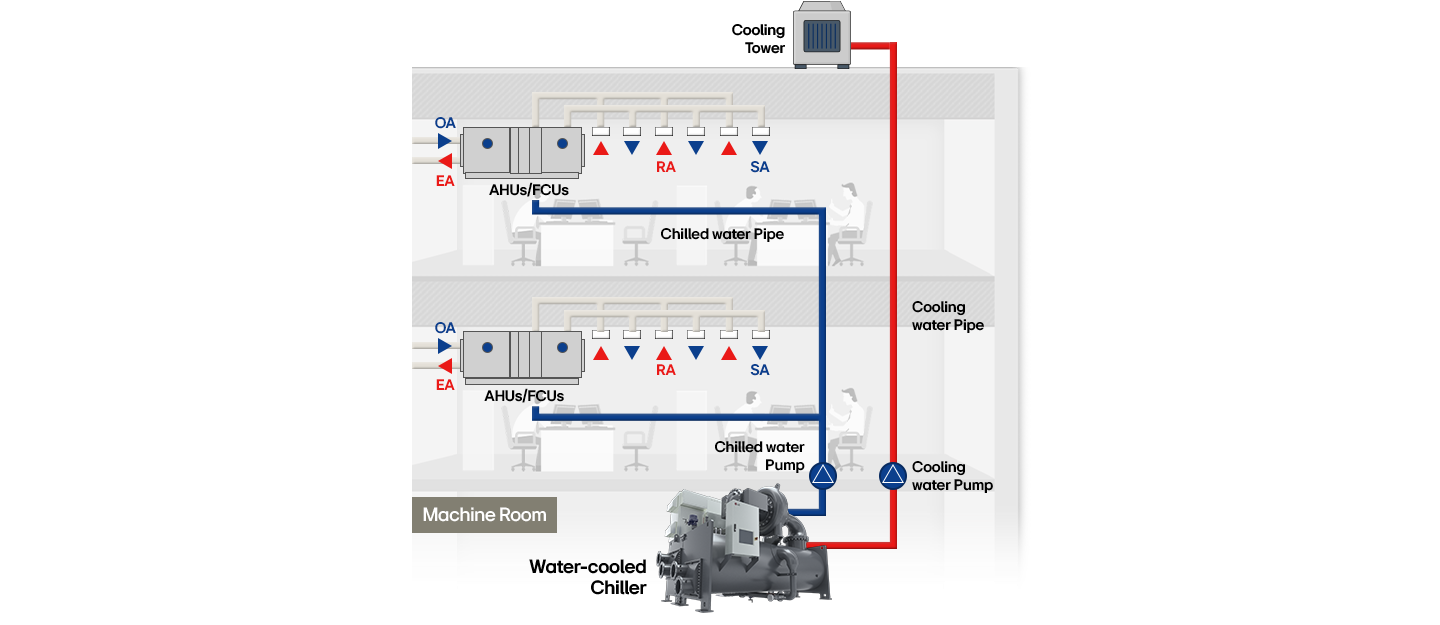
In the evaporator, that low-pressure mixture absorbs heat from the chilled water inside the tubes and evaporates. The plant then pumps this chilled water through the building’s cooling coils (AHUs/FCUs) to cool the supply air, and the warmer return water comes back to the chiller to repeat the cycle; meanwhile the condenser-water loop carries rejected heat back to the cooling tower. The LG controller can directly command chilled- and cooling-water pumps as well as the tower fan. It monitors chilled-water temperature and flow to maintain the target setpoint.

-
Next, we explain how LG’s air-cooled chiller works—how it rejects heat to ambient air and how the chilled water it produces is delivered to AHU/FCU coils for space cooling.
-
How an LG Air-Cooled Chiller Works
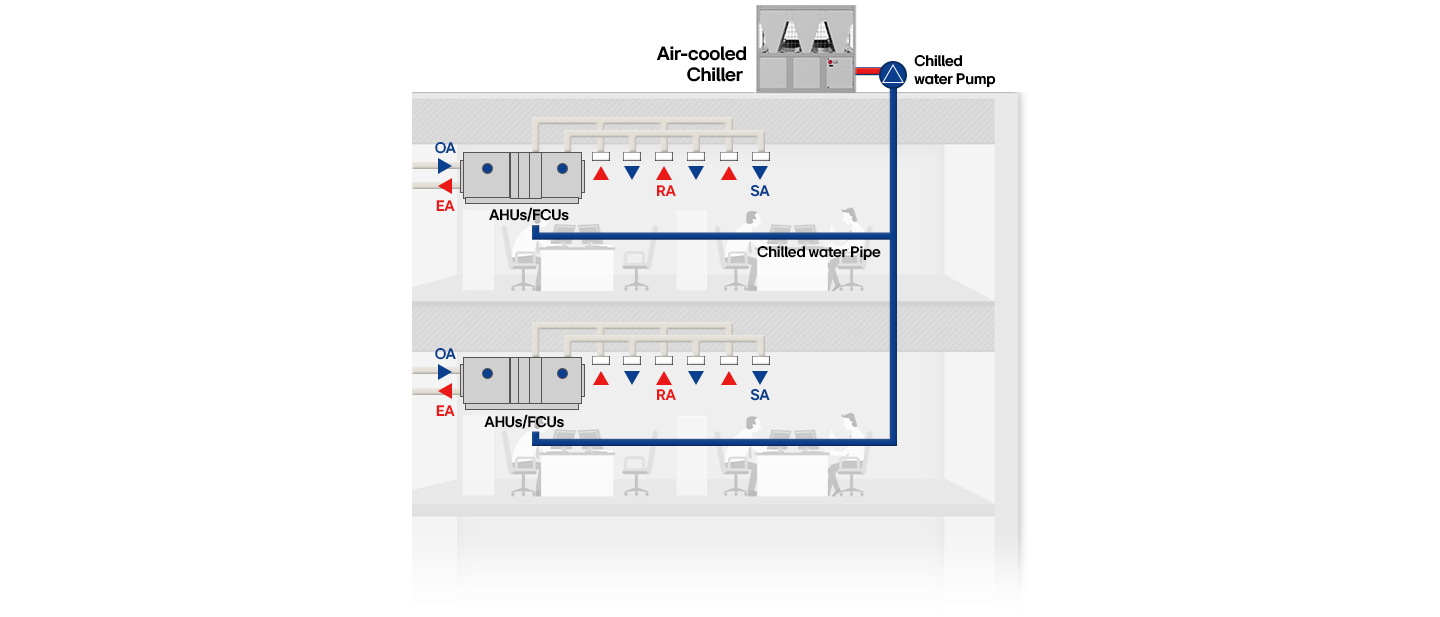
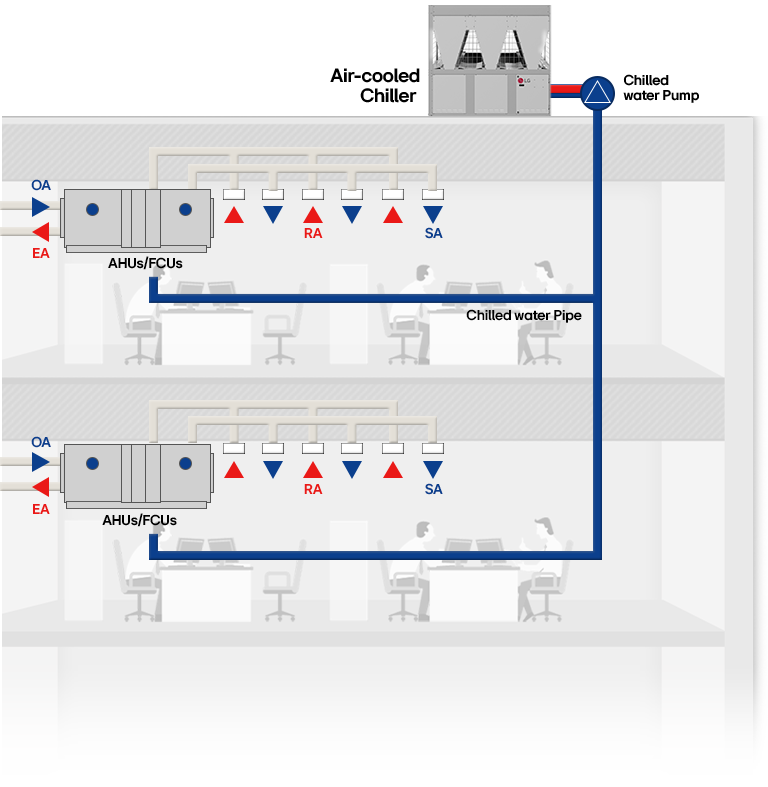
LG’s air-cooled chiller cools water and rejects heat to outdoor air. It uses inverter-driven scroll compressors, an Electronic Expansion Valve (EEV), a shell-and-tube falling film evaporator, and an air-cooled condenser with Electronically Commutated (EC) fan motors. In the cycle, hot high-pressure refrigerant gas leaves the compressor; condenser fans move ambient air across the condenser coil to remove heat so the refrigerant condenses to liquid; then the EEV drops its pressure and temperature before the cold mixture enters the evaporator and boils.
-
On the water side, chilled water leaves the evaporator at the water-out connection, is pumped through the building to cooling coils in AHU/FCU where it cools the supply air, and then returns warmer to the water-in connection to repeat the cycle. Because heat is rejected directly to outdoor air, there is no condenser-water loop or cooling tower in this configuration; the condenser fans handle heat rejection.
-
Types & Fit
Chillers are the heart of hydronic cooling. They make chilled water and send it through the building. Water-cooled plants add a cooling tower and a condenser-water loop, while air-cooled units reject heat directly to outdoor air. This one decision shapes piping, pumps, controls, and day-to-day maintenance.
-
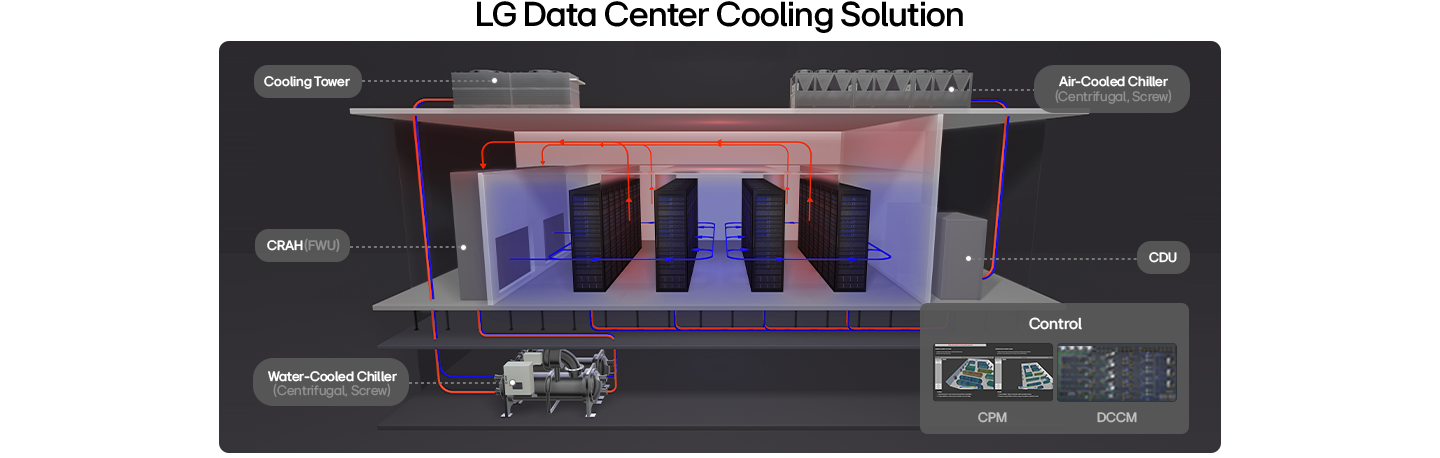
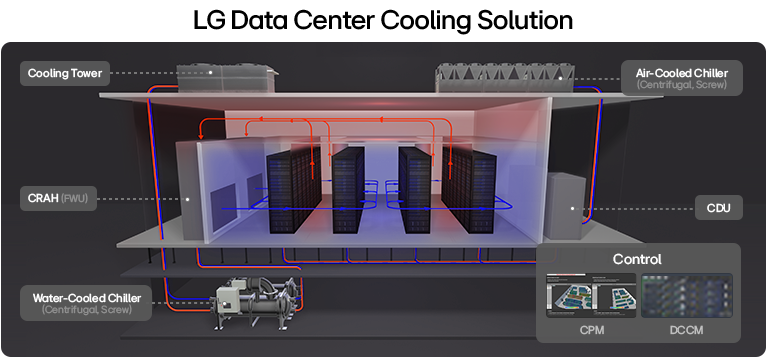
• Where LG water-cooled chillers fit, and why They suit large, continuous-load sites that benefit from a central plant: district-cooling plants and campus networks, turbine inlet air-cooling at power stations, semiconductor clean rooms, and heat-recovery arrangements that deliver chilled and useful hot water at the same time. A tower-based loop handles big heat rejection and distributes chilled water to many buildings over buried piping, which aligns with these applications. Data centers are also trending toward central chilled-water plants; LG materials show water-cooled chillers in room-cooling and chip-cooling schemes with LG BECON (Building Energy Control) providing integrated plant control, plus domestic project references.
Summary
-
More about LG HVAC


