We use cookies, including cookies from third parties, to enhance your user experience and the effectiveness of our marketing activities. These cookies are performance, analytics and advertising cookies, please see our Privacy and Cookie policy for further information. If you agree to all of our cookies select “Accept all” or select “Cookie Settings” to see which cookies we use and choose which ones you would like to accept.

Helpful Tips
How Many Watts does a Washing Machine Use and How to Save Electricity
Understanding your washing machine’s energy consumption is the first step toward managing your household’s electricity bills and making more environmentally friendly choices. A common question homeowners ask is, “How many watts does a washing machine use?” There’s no single number; it varies based on the type of machine, the cycle you choose, and the temperature of the water. This comprehensive guide will break down the typical wattage of washing machines, explain the factors that influence energy usage, and provide clear methods for calculating your electricity costs. We’ll also share practical tips for reducing consumption and help you choose an energy-efficient model, like those from LG, to ensure long-term savings.
Typical Wattage Usage of Washing Machines
A washing machine’s power consumption is measured in watts (W), which represents the rate of energy use at any given moment. However, your electricity bill is based on kilowatt-hours (kWh), which is the total energy consumed over a period. Generally, washing machines’ wattage can range from 400 to 2,000 watts, but the biggest variable is the heater used for warm or hot washes. The motor that tumbles the clothes uses a relatively small amount of energy, but the heater consumes the most power by far.
Front-Load Washing Machines
These are typically more energy-efficient, using between 1,000 and 1,500 watts, primarily when the heater is active. During a cold wash, the consumption can be as low as 200–400 watts.
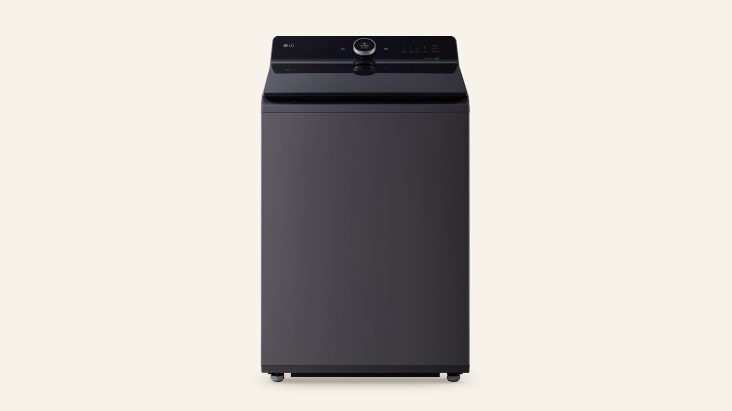
Top-Load Washing Machines
Traditional top-loaders can use slightly more, ranging from 1,200 to 1,800 watts, especially older models that use more water.
For example, a 1-hour cycle on a 1,500-watt machine would use 1.5 kilowatt-hours (kWh) of electricity. Understanding this basic principle is key to managing your laundry-related energy costs.
Factors that Affect Washing Machine Energy Usage
Several factors determine how many watts your washing machine uses per cycle. Being mindful of them can lead to significant savings.
✔ Water Temperature: This is the single biggest factor. Around 80–90% of a washing machine’s energy consumption comes from heating the water. A hot wash (60°C or higher) uses significantly more electricity than a warm or cold wash.
✔ Wash Cycle Selection: A heavy-duty or “sanitize” cycle will run longer and use hotter water, increasing kWh consumption. Conversely, an “eco” program is designed to save energy.
✔ Load Size: Washing a full load is more energy-efficient than washing half-loads. Modern LG washing machines with AI DD™ technology solve this by automatically detecting the load’s weight and fabric softness to select the optimal washing pattern, ensuring a perfect clean without wasting energy.
✔ Machine Age and Condition: Older machines are generally less energy-efficient. Regular maintenance, such as cleaning the filter, can also help your machine run more efficiently.
Comparing Front Load and Top Load Machines for Energy Efficiency
When it comes to saving electricity, front-load washing machines typically have a distinct advantage over top-load models. This difference comes down to their fundamental design. Front-loaders use a tumbling action to lift clothes in and out of a small pool of water, requiring significantly less water—sometimes up to 50% less—than a top-loader. Because less water is used, less energy is needed to heat it, resulting in lower electricity savings on warm and hot cycles. Furthermore, front-load machines often achieve higher spin speeds, which removes more water from clothes and reduces the time and energy needed for drying.
Estimated Electricity Cost per Washing Cycle
Calculating the electricity cost of a single wash cycle is straightforward. Here’s a simple step-by-step guide:
✔ Find the Wattage: Check your machine’s manual for its power rating in watts (W). Let’s use a 1,500 W LG washing machine as an example.
✔ Determine the Cycle Length: Note the duration of your chosen wash cycle in hours. A standard cycle might be 1.5 hours.
✔ Calculate kWh: Use the formula (Wattage × Hours of Use) ÷ 1,000 = kWh. Example: (1,500 W × 1.5 hours) ÷ 1,000 = 2.25 kWh
✔ Check Your Electricity Rate: In Thailand, the latest EGAT average rate is approximately 4.68 Baht per kWh (this can vary).
✔ Calculate the Cost: Multiply the kWh by your electricity rate.
Example: 2.25 kWh × 4.68 Baht/kWh = 10.53 Baht
So, one warm wash cycle could cost around 10.53 Baht.
Reduce Power Consumption when Using a Washing Machine
Saving energy is easy with a few simple habit changes:
✔ Wash with Cold Water: Whenever possible, choose a cold wash to drastically reduce energy use.
✔ Wash Full Loads: Make the most of every cycle by washing full loads to reduce the total number of washes you need to run.
✔ Use the Eco Program: This cycle uses lower temperatures and less water over a longer period to achieve the same clean with less energy.
✔ Choose a High Spin Speed: A higher final spin speed will extract more water, reducing the workload for your clothes dryer.
✔ Pre-soak Heavily Soiled Items: Pre-soaking tough stains can prevent the need for a second wash.
✔ Maintain Your Machine: Regularly clean the filter to help your machine run at peak efficiency.
✔ Leverage Smart Features: Use the LG ThinQ™ app to schedule washes during off-peak electricity hours if your utility provider offers them.
Ready to Find a Washing Machine that Saves You Money?
FAQ
Q.
How many watts does a washing machine use per cycle?
A.
A typical washing machine uses between 400 and 2,000 watts, depending on its type and whether the built-in heater is used. Front-load models consume around 1,000–1,500 W, while top-load machines may reach 1,800 W.
Q.
What factors affect a washing machine’s electricity consumption?
A.
The main factors include water temperature, chosen wash cycle, load size, and machine age. Heating water accounts for 80–90 % of total energy use, so using cold water can greatly reduce consumption.
Q.
How much does it cost to run one washing cycle in Thailand?
A.
If you use a 1,500 W LG washing machine for a 1.5-hour cycle, it consumes about 2.25 kWh, costing roughly 10.5 Baht at an average rate of 4.68 Baht/kWh.
Q.
How can I calculate my washing machine’s power cost?
A.
Multiply your machine’s wattage by the number of hours used and divide by 1,000 to get kWh, then multiply by your local electricity rate. Example: (1,500 × 1.5)/1,000 × 4.68 = 10.53 Baht.