HELPFUL HINTS

    How Does an Air Purifier Clean the Air?


    You switch on your air purifier, and within minutes the air feels fresher. But what exactly is happening inside that quiet machine? Where does the air go, and how does it come back out so much cleaner? And how exactly does it trap those tiny particles that can be so unhealthy? 


    In this article, we'll look inside your air purifier at how it works, explain what HEPA and CADR really mean, and help you choose the right system for your home.

    Illustration of the LG PuriCare™ 360˚ air purifier showing the internal filtration system and airflow.

    Illustration of the LG PuriCare™ 360˚ air purifier showing the internal filtration system and airflow.

    How an Air Purifier Turns Dirty Air Into Clean Air

    While air purifiers come in a wide range of designs, most clean your air in the same basic way.

    A Look Inside an Air Purifier

    The simple, sleek outside of an air purifier hides a precisely engineered system inside. It steadily pulls air in, leading it through multiple filtration stages, and sends cleaner air back into the room.


    Air Intake: The opening that pulls indoor air into the unit, through the front, sides, or a 360° intake system.

    Fan: The motor that moves the air, drawing it through the filters and pushing clean air back out.

    Filtration System: The core of the purifier: usually three or four filter layers, each targeting a different type of pollutant.

    Air Outlet: The vent that releases purified air back into the room, usually from the top of the unit.


    If any one of these four parts isn't doing its job, the purifier's overall performance drops with it.

    What's Happening in an Air Purifier?

    Once you switch on an air purifier, this cycle begins and repeats nonstop. You won't see it happening, but indoor air is constantly moving through several filtration stages.


    Air Intake: The fan pulls in the surrounding air, drawing airborne particles, odors, and other pollutants into the filter system.

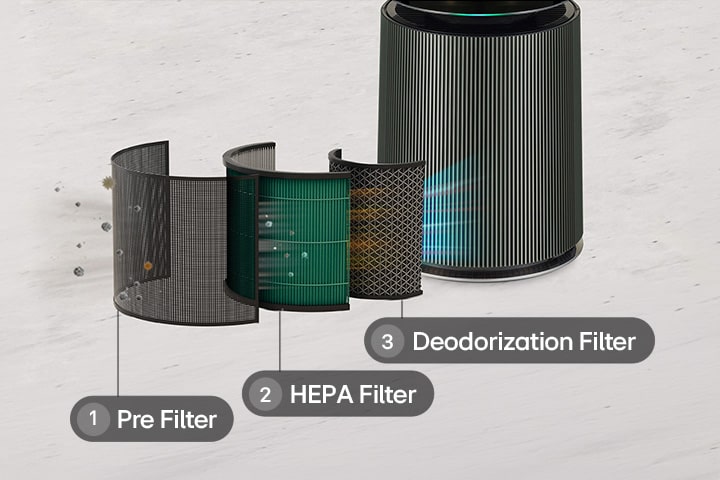
    Pre-Filter: As first line of defense, it catches larger particles like dust, lint, and pet hair to help prevent the main filters from clogging.

    HEPA Filter: This high-efficiency filter helps capture the tiny particles you can't see, including PM2.5 fine particles, pollen, and other allergens.

    Deodorization Filter: This layer handles gaseous pollutants, adsorbing household odors, cooking smells, and volatile organic compounds (VOCs).

    Clean Air Release: After moving through the filtration layers, clean air flows back out into your room.

    Real-Time Air Quality Monitoring: Built-in smart sensors constantly monitor indoor air quality, automatically adjusting modes when air quality changes.

    Advanced Tech for Even Cleaner Air

    Beyond the filtration system, some air purifiers also include additional technologies that help support cleaner and more hygienic indoor air, such as:


    UVnano: Uses ultraviolet light to help reduce bacteria on hard-to-clean areas such as the fan blades.

    Ionizer: Releases ions that interact with airborne pollutants to help support cleaner indoor air.

    Filters, Explained. What Each One Removes

    Each filter is designed to remove a different type of pollutant. Knowing the job of each filter helps you choose the right purifier and keep it working as it should.

    1. The Pre-Filter: Dust and Hair Stop Here

    Large particles like pet hair and dust are the first things an air purifier has to deal with. That's where the Pre-Filter comes in. It captures these larger particles before they reach the main filters, helping keep the filtration system running efficiently.


    It helps capture:


    • Pet hair

    • Human hair

    • Fabric lint

    • Large dust particles


    The standard Easy-to-Clean Pre-Filter can be easily taken out, washed with water, and reused, making routine maintenance simple. Keeping the Pre-Filter clean also helps your purifier perform consistently over time.

    2. The HEPA Filter: Capturing the Fine Particles You Can't See

    The HEPA filter is designed to capture the tiny particles that are hardest to see but can have the biggest impact on your indoor air. It helps trap PM2.5, pollen, mold spores, pet dander, and other fine airborne particles.

    3. The Deodorization Filter: Where Smells and Gases Disappear

    Have you ever noticed that even after dust has been removed, certain odors still linger? That's because the substances that create odors are gases, not particles. A deodorization filter is designed to help manage these everyday odors and gaseous pollutants, including cooking odors, cigarette smoke, chemicals released from new furniture, ammonia from pet litter boxes, and formaldehyde that can be found in newly built or remodeled homes.


    There are two main methods:


    • Activated Carbon: Captures odor molecules through microscopic pores. That capacity fades over time, though, so the filter needs replacing regularly.

    • Photocatalytic Deodorization: Uses visible light (sunlight, indoor lighting, etc.) to chemically break down odor molecules. It tends to hold its performance longer than activated carbon, which makes it a good fit where you need long-term odor control.


    So, if you live with pets or cook frequently, a Photocatalytic Deodorization Filter or an enhanced activated carbon filter may be a better choice.

    Three-stage filtration system of an LG air purifier showing the Pre-Filter, HEPA Filter, and Deodorization Filter.

    Three-stage filtration system of an LG air purifier showing the Pre-Filter, HEPA Filter, and Deodorization Filter.

    What to Look for in Air Purifier Performance

    Understanding a few key performance indicators can make it much easier to compare air purifiers and choose one that's right for your home. Here's what to look for.

    Choosing the Right Product for Your Space

    Room size is one of the most important factors to consider when looking for an air purifier that will get the job done. To help you make the right choice, manufacturers provide a recommended coverage area (also called the clean air area), which indicates the size of the space an air purifier is designed to clean effectively. Since this specification varies by model, choosing a product whose recommended coverage area closely matches your actual room size helps the purifier manage indoor air more efficiently.


    The table below provides general examples based on the commonly used guideline in Korea, where the recommended coverage area is approximately 130% of the actual room size. Use it as a general reference when selecting an air purifier for your space.

    Room SizeRecommended Coverage AreaRecommended Product
    Up to 20㎡26㎡

    AeroMini

    Up to 40㎡52㎡

    AeroBooster, Wallfit 1Fan, PuriCare™ 360˚ Alpha(Single) 

    Up to 60㎡104㎡PuriCare™ 360˚ Alpha(Dual) 

    CADR (Clean Air Delivery Rate): A Helpful Performance Indicator

    Once you've found models with the right recommended coverage area, CADR can be another useful spec to help you narrow down your options. When you're comparing air purifiers, you'll probably come across a specification called CADR. It may sound technical, but it's actually one of the easiest ways to understand how well an air purifier can clean the air.


    CADR measures how much clean air an air purifier delivers over a certain period of time. It reflects both the filter's ability to capture pollutants and the amount of air the purifier can circulate, making it one of the most useful indicators of overall air-cleaning performance. A high-quality filter is important, but it also needs enough airflow to clean your room effectively. In other words, cleaner air comes from strong filtration and efficient air circulation working together.

    Noise Level

    If a purifier runs all day, noise matters just as much as performance. Planning to put it in a quiet room like a bedroom or study? Check the noise level in both sleep mode and at full airflow. 


    The World Health Organization (WHO) recommends keeping steady background noise in the bedroom at 30 dB or lower for comfortable sleeping.1)


    Because manufacturers may present noise specifications differently, it's helpful to check both of the following:


    • Sleep Mode: An operating mode designed for quieter nighttime use by reducing fan speed and dimming or turning off display lights.

    • Maximum Fan Speed: The noise level when the air purifier is operating at its highest airflow setting.


    Some products only list the maximum noise level. Checking the noise level in Sleep Mode can provide a better understanding of how quiet the air purifier will be during everyday use.

    How LG Goes Above and Beyond Basic Filtration

    Air purifier performance depends on more than just filtration. How efficiently clean air is delivered, how accurately indoor air quality is detected, and how intelligently the purifier responds all contribute to overall performance. LG supports effective, convenient air care with specialized filters on selected models designed for different living environments, along with Clean Booster, a PM1.0 Sensor, and AI+ technology.

    Specialized Filters for Different Living Environments

    Since the sources of air pollution differ from home to home, the filter you need can differ, too. Start by looking at what tends to pollute the air in your home to make choosing the right filter easier.


    Homes with children or allergy concerns

    Pollen, dust mites, and allergen particles can build up indoors, making fine-particle management especially important.


    Pet households

    Hair, dander, and odors keep coming, so it helps to have air care built for a pet-friendly home.


    Newly built or recently remodeled homes

    The smell of recently added furniture, flooring, paint, or building materials often comes from substances that may affect your indoor air.


    Homes with frequent cooking

    Deodorizing performance that can manage the odors, oil vapor, and ultrafine particles created while cooking is important.


    Homes on busy roads or in the city

    If you live with urban pollution, LG offers optional specialized filters for compatible models. Availability, compatibility, and filter configuration may vary by model and region.

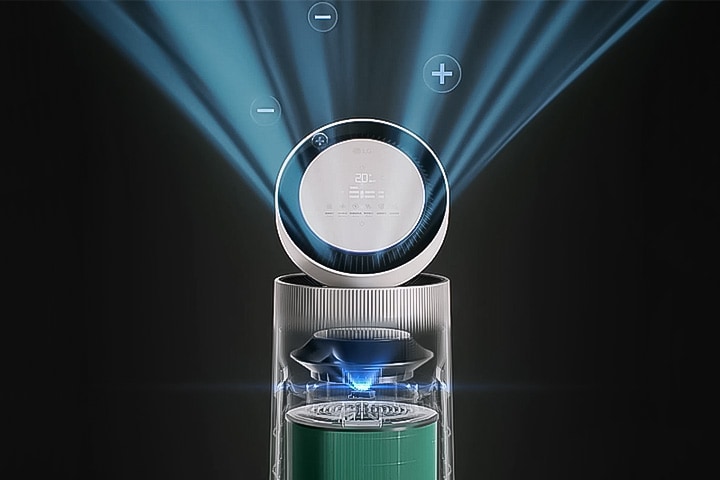
    Clean Booster Delivers Clean Air Farther

    Clean Booster is an air-circulation technology that pushes purified air farther, so clean air spreads quickly through the room. 


    On select LG PuriCare™ 360° models, it can send purified air up to 9 meters2), circulating it well beyond the unit and across a larger space. Actual airflow can vary with your model, your room, and how the purifier is running.

    Smarter Air Care with AI+

    Indoor air quality changes throughout the day. Opening a window, cooking, or simply having people move around the room can all affect the air. AI+ analyzes these changes and helps the air purifier automatically adjust to match what's happening around it.


    AI Smart Operation3)

    • Learns and analyzes your air quality patterns to automatically run in the way that suits your space.

    • When the air is clean, it eases back fan speed and dims the display to save energy.

    • When air quality drops, it steps up only as much as needed, so you get convenient air care without constantly changing settings.

    • Cuts power use by up to 50% or more versus the previous AI mode, saving on your electricity bill.

    See Your Indoor Air Quality at a Glance with the PM1.0 Sensor

    Most of us judge a room's air by how it looks or smells, but ultrafine particles give away neither. To manage indoor air with confidence, you first need an accurate reading, which is exactly what a built-in air-quality sensor with a clear display shows.

    On LG models with the PM1.0 sensor, the purifier picks up even ultrafine particles and shows your air quality in real time through the indicator light and the LG ThinQ app. That makes it easy to track how your indoor air is changing and simple to decide whether it's worth opening a window or running the purifier.

    The air in your home deserves an approach built around the way you live in it. Once you see how filters, CADR, air circulation, and sensing work together, comparing products stops feeling like guesswork.

    LG air purifiers pull all of this into one system, with specialized filters for your indoor environment, farther-reaching clean air through Clean Booster, and smart management powered by the PM1.0 sensor and AI. Pick the model that matches your space, and cleaner air is one less thing to think about.

    FAQ

    Does keeping the windows closed prevent PM2.5?


    Not entirely. Keeping the windows closed may help reduce PM2.5 from entering your home when outdoor air quality is poor, but fine particles can still be generated indoors through everyday activities such as cooking, burning candles or incense, and smoking. Managing PM2.5 indoors involves choosing the right time to ventilate, reducing indoor pollution sources, and using an air purifier.

    Can indoor PM2.5 levels be high even when outdoor air quality is good?

    Yes. Indoor PM2.5 levels can be influenced by activities such as cooking, smoking, burning candles, and limited ventilation. Even when outdoor air quality is good, indoor sources can temporarily increase particle levels.

    Can PM2.5 affect every room in the home?

    Airborne particles can move between connected indoor spaces through natural airflow, ventilation systems, and everyday movement within the home.

    How can I check my indoor air quality?

    Because airborne particles are invisible, indoor air quality cannot be judged by sight alone. An air purifier with a PM1.0 sensor and an air quality indicator can help you monitor changes in indoor air quality in real time. Some models also allow you to check air quality and the purifier's operating status through a connected app.

    How often should the filter be replaced?

    The HEPA filter should be replaced once a year. The product will automatically remind you when the filter needs replacing. You can view the notification not only on the product itself but also through the LG ThinQ app.

    *Filter replacement intervals are calculated based on 10 hours of daily use. Actual replacement intervals may vary depending on actual usage time and environment.

    [Disclaimer]

    1) Source: WHO, 2018, Environmental noise guidelines for the European Region (https://www.who.int/publications/i/item/9789289053563)

    2) Clean Booster

    *Tested by LGE's internal R&D laboratory. Test conditions: Conducted indoors in a 1309 cubic meter (11.0 x 3.4 x 35 meter) space, using the AS351NNFA model product. Temperature: 25±1.0℃. Wind speed set to Turbo Mode. Air velocity was measured by the distance from the test product. At a distance of 9m from the test product and a height of 3.3 meters above the ground, the wind speed was 0.26 m/s. These test results were obtained under specific testing conditions and may vary depending on the experimental environment.

    3) Source: LG Electronics “Customized air purification based on pollution sources and levels” ‘LG PuriCare AI+ Air Purifier’ AI sensor manages even air quality (https://www.lg.co.kr/media/release/28588)


    -Test application number: KR24J9U2 001

    -Test date: '24.10.24 ~ '24.10.25

    -Target model: AS55*G***

    -Test agency: TÜV Rheinland

    -Test conditions: Temperature 23±5℃, Humidity 55±15%

    -Test method: Integrated Power Consumption of each operation mode (8 hours after 15 minutes from the start of each operation mode).

    -Test result: AI+ mode for the air purifier has 49.6% higher energy saving performance than Smart+ mode (Integrated Power Consumption (Wh) AI+ Mode 28.260Wh Vs. Smart+ Mode 56.085Wh)

    Featured Products