Two people shaking hands, symbolizing business collaboration and trust

Building trust through responsible leadership

Guided by 'creating value for customers' and 'respecting people', LG Electronics applies 'Jeong-Do Management' and ethics to foster a sound culture and practice trusted responsible management.

* This image was generated by AI.


LG's brand slogan 'Life's Good' and the LG logo displayed on the LG Hope Screen in a city center

Jeong-Do Management

Jeong-Do Management, LG’s unique principle of competing fairly in the marketplace, serves as a foundational behavioral standard for all LG employees. It is articulated through LG's Code of Ethics and Code of Conduct, shaping sound judgment and responsible actions across the organization.

Code of Ethics

LG Code of Ethics serves as the standard for proper conduct and value judgments that all employees must adhere to. Established in 1994, it consists of the preamble of the 'Code of Ethics'—a declarative ethical charter—and the 'Code of Ethics Implementation Guidelines' containing specific principles of conduct. To date, it has undergone seven revisions to continuously strengthen related regulations and subordinate implementation guidelines. It is distributed and shared with over 120 local subsidiaries to ensure all employees are fully informed.

Whistleblowing and Reporting System

We operate an anonymous reporting system that allows employees to report any violations of Jeong-Do Management, thereby enhancing transparency and accountability in business operations. All submissions are strictly confidential in accordance with the internal whistleblower protection policy. Reports involving misconduct or corruption are thoroughly investigated, and when verified, appropriate disciplinary measures are taken based on the severity of the case.

Status of reported violations


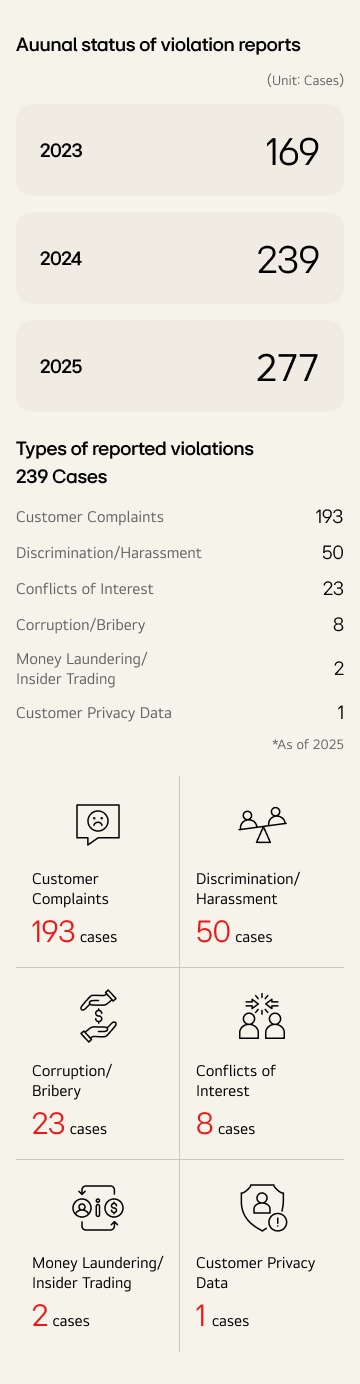
Dashboard presenting annual violation report statistics in two sections. Section 1 — Annual status of violation reports (unit: cases): 2023: 169 cases. 2024: 239 cases. 2025: 277 cases. Section 2 — Types of reported violations, totaling 277 cases as of 2025. A proportional bar chart breaks down the total by category, from largest to smallest: - Customer Complaints: 193 cases (largest segment) - Discrimination or Harassment: 50 cases - Conflicts of Interest: 23 cases - Corruption or Bribery: 8 cases - Money Laundering or Insider Trading: 2 cases - Customer Privacy Data: 1 case The same six categories are repeated below the chart as individual data cards, each displaying an icon, category label, and case count, confirming the figures above.

Jeong-Do Management (JDM) risk prevention system

LG Electronics operates a JDM risk prevention system for proactively preventing JDM risks and raise JDM awareness.

• Two-track process: Establish a process enabling joint management by operational departments (accounts receivable, expenses, promotional costs, etc.) and diagnostic departments.

• Pre-emptive inspection processes and system operations: Strengthening preventive activities, establishing pre-emptive inspection processes and systems for vulnerable areas in overseas subsidiaries and developing the scenarios (21 cases) and systems for anomaly detection.


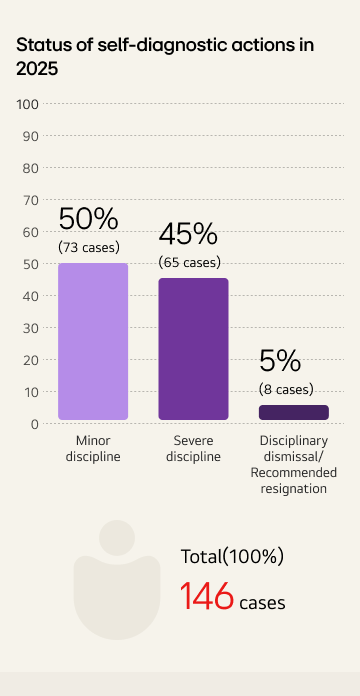
Horizontal bar chart titled “Status of self-diagnostic actions in 2025". Minor discipline accounts for 50% (73 cases), severe discipline 45% (65 cases), and disciplinary dismissal or recommended resignation 5% (8 cases), totaling 146 cases (100%).


A man in a suit examining documents on a desk with a magnifying glass

Compliance management

LG Electronics regards compliance management as a fundamental operational principle across all business activities, aiming to earn customer trust while enhancing corporate competitiveness.

* This image was generated by AI.

Compliance risk management
Standards and certification of compliance management

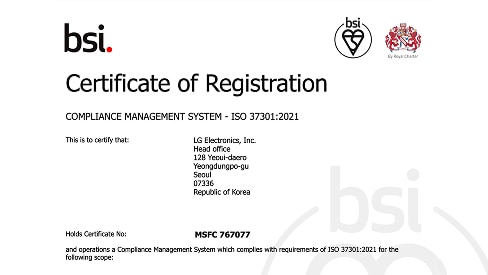
LG Electronics (LGE) has established 'LGE Compliance Policy' by a resolution of the Board of Directors in accordance with Article 40 of the enforcement decree of 'The Commercial Act of the Republic of Korea' and function as the basic principles of compliance management and the criteria for internal control, applicable to all executives and employees. Through this, LGE establishes the foundation for fair and transparent business execution and strengthens compliance awareness across the organization. Furthermore, LGE has acquired ISO 37301 certification and undergoes regular surveillance audits to verify that the system’s design, implementation, and operation are being properly executed. This objectively demonstrates the reliability and effectiveness of the company-wide compliance framework.

Compliance program

LG Electronics operates a program to effectively and systematically manage compliance risks. The Compliance Program is structured across all stages, from proactive identification of legal and regulatory changes to training, monitoring, reporting, and follow-up management, and also addresses both risk prevention and measures to prevent recurrence. LG Electronics strengthens its company-wide management system by regularly submitting reports on risk assessment results to top decision-making bodies, including the Board of Directors and the ESG Committee.


Based on the Code of Conduct and internal policies, LG Electronics annually conducts a compliance self-assessment survey covering a range of risk items, including bribery, collusion, discrimination, related-party transactions, and false advertising. In 2025, 45,984 employees—94.1% of all employees worldwide—participated, and the survey results are utilized in various organizational management activities, such as analyzing the level of risk awareness by department, improving training planning, and identifying priority inspection areas.

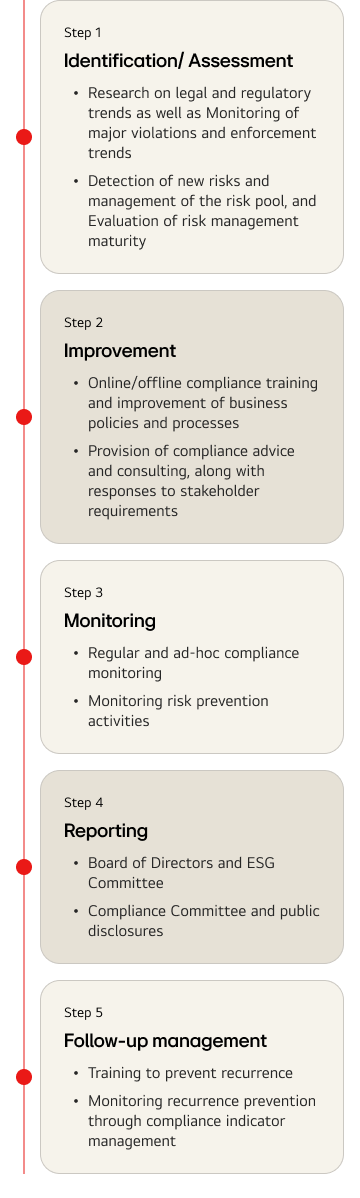
Compliance risk management process

Five-step compliance risk management process diagram. Step 1 Identification/Assessment: Research on legal and regulatory trends as well as monitoring of major violations and enforcement trends; Detection of new risks and management of the risk pool, and evaluation of risk management maturity Step 2 Improvement: Online/offline compliance training and improvement of business policies and processes; Provision of compliance advice and consulting, along with responses to stakeholder requirements Step 3 Monitoring: Regular and ad-hoc compliance monitoring; Monitoring risk prevention activities Step 4 Reporting: Board of Directors and ESG Committee; Compliance Committee and public disclosures Step 5 Follow-up management: Training to prevent recurrence; Monitoring recurrence prevention through compliance indicator management

Compliance training

Provide customized ethics and compliance training tailored to job roles and positions at least once a year, and enhance voluntary compliance by linking training completion to a pledge of commitment (online/offline).

- Target: All domestic and overseas employees

- Training content: Practice-oriented topics such as the Code of Ethics, the Code of Conduct, anti-corruption, fair trade, sexual harassment prevention, and privacy protection 

- Training programs: Training on new team leader, Overseas expatriate leadership training, New entrepreneur training, Dispatch manager onboarding training, etc.

* Separately conduct role-specific training focused on fair trade risks for relevant personnel.

Fair Trade

LG Electronics conducts all transactions based on the principle of free competition and ensuring equal opportunities for participation. Through transparent and fair dealings, it builds mutual trust and cooperative relationships, pursuing shared long-term development.

Operation of fair trade compliance program

LG Electronics manages key risks related to fair trade, including collusion, subcontracting, unfair trade practices, and advertising and labeling, in accordance with major domestic laws and regulations. In accordance with the Compliance Program (CP), the company regularly conducts pre-assessments, training, and improvement activities. It also operates a system for managing data requests and contracts to establish fair trade practices with suppliers, thereby strengthening its fair trade compliance activities.


Fair trade risk inspection and management


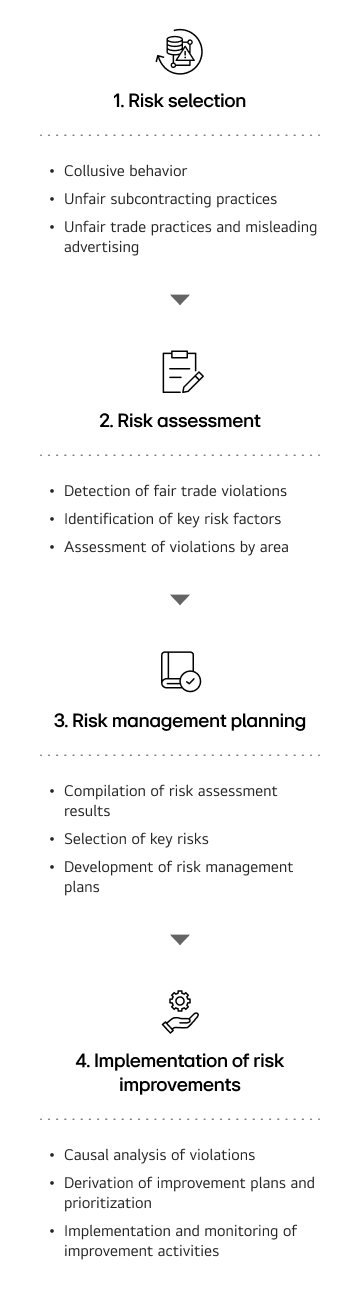
Four-step fair trade risk management process diagram. Step 1 Risk selection: Collusive behavior; Unfair subcontracting practices; Unfair trade practices and misleading advertising Step 2 Risk assessment: Detection of fair trade violations; Identification of key risk factors; Assessment of violations by area Step 3 Risk management planning: Compilation of risk assessment results; Selection of key risks; Development of risk management plans Step 4 Implementation of risk improvements: Causal analysis of violations; Derivation of improvement plans and prioritization; Implementation and monitoring of improvement activities


A man in a suit and glasses standing with his arms crossed next to a glowing digital shield graphic

Information security

The increasing variety of IoT products and services, coupled with new technologies, business models, and environmental changes, is gradually increasing the corporate responsibility to protect individual human rights and privacy. LG Electronics identifies personal information compliance risk factors that arise both domestically and internationally, and ensures the rights of its employees and customers by transparently disclosing its personal data processing practices.

* This image was generated by AI.

Information security and privacy protection

Information security and privacy protection organization operational framework

• It handles practical security operations, including response to security incidents, compliance with global regulations, regular security inspections, and the establishment of internal management plans for personal data protection.

• The working-level organization strengthens rapid response to security risks and inter-organizational cooperation by discussing major policies and issues related to information and personal data protection through the working council for information security. When necessary, these matters are submitted to the information security committee for linkage with company-wide decision-making.

• Dedicated information security personnel consist of experts holding professional certifications such as CISSP, CISA, CPPG, ISO 27001, and ISMS-P Auditor.

• The company supports continuous capability enhancement by including information security competency development items in the personal KPIs (Key Performance Indicators) of employees.


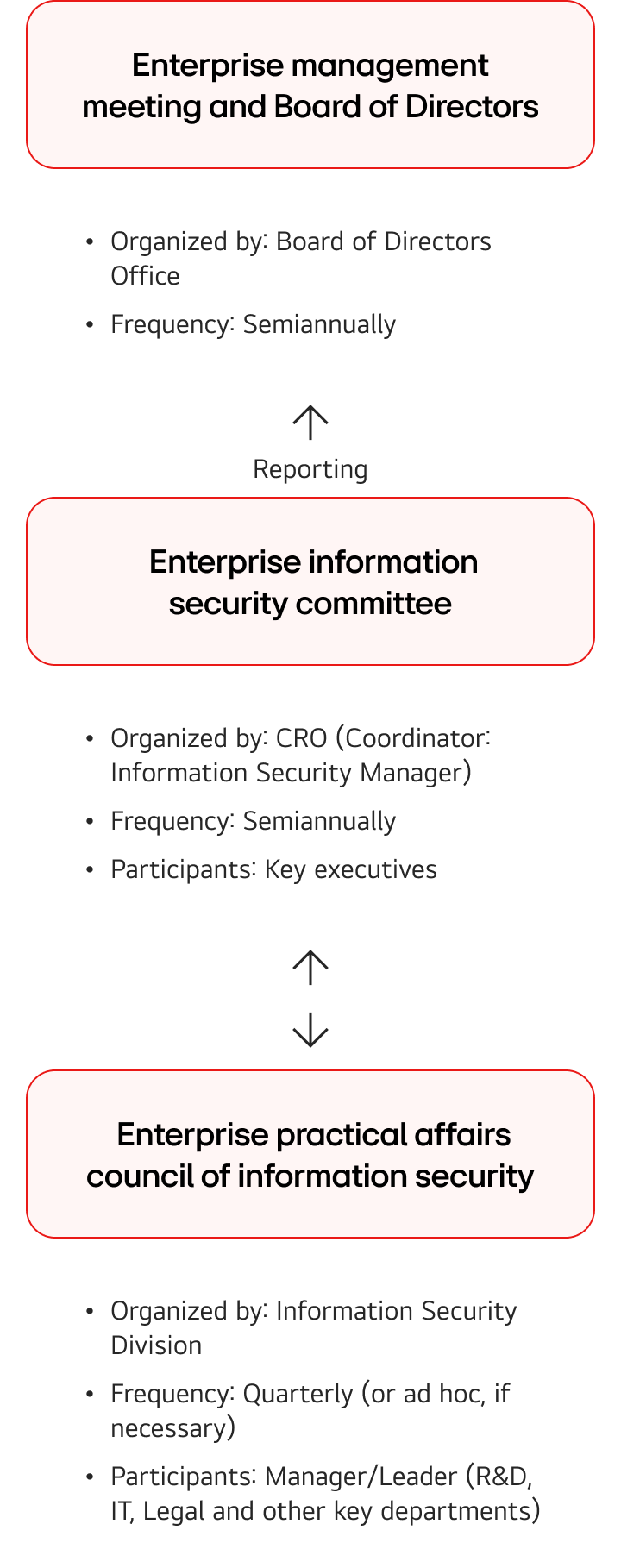
Diagram showing three interconnected enterprise governance bodies for information security. Left: Enterprise management meeting and Board of Directors — organized by the Board of Directors Office, held semiannually. Center: Enterprise information security committee — organized by the CRO (Coordinator: Information Security Manager), held semiannually, with key executives as participants. The committee reports to the Board of Directors meeting (indicated by a left-pointing arrow labeled "Reporting"). Right: Enterprise practical affairs council of information security — organized by the Information Security Division, held quarterly or ad hoc if necessary, with managers and leaders from R&D, IT, Legal, and other key departments as participants. The council has a bidirectional relationship with the information security committee (indicated by a left-right arrow).


Diagram illustrating an enterprise information security framework organized into four rows. Row 1 — Touchpoints channels: Three channel categories are listed: Products/Devices, Apps/Web/Services, and Business systems. The associated functions are Sales, Marketing, Customer Service, and System Operations. Row 2 — Assets to be protected: Four asset types are listed: Product, Manufacturing process, Personal information, and Trade secrets. The associated lifecycle stages are Planning, Development, Production, and Personal information/Data protection/Management. Row 3 — Management approach: Four security approaches are shown. At the base layer is ① Administrative security, which underpins the other three. Above it, ② Technical security and ③ Physical security have a bidirectional relationship with each other, and ③ Physical security and ④ Privacy protection compliance also have a bidirectional relationship. Diamond-shaped connectors indicate the integration points between these approaches. Row 4 — Areas of protection: Six coverage areas are listed: Business sites, Overseas subsidiaries (covering Production, Sales, and R&D), Service centers, Retail stores, Subsidiaries, and Suppliers.


① Administrative security ② Technical security③ Physical security④ Privacy protection compliance
Info security system operationDefense against hacking & malwarePhysical security system operationPrivacy management system operation
Asset identification & managementData leak preventionEquipment checks & anomaly responsePersonal data mapping & control
Incident response setupSecurity policies & solutionsSecurity zones & access controlRisk impact assessment & safeguards
Employee training & awarenessRisk assessment & remediationCCTV & critical facility managementData subject rights & regulatory response
Data Protection Impact Assessment (DPIA)

• A data protection impact assessment (DPIA) is conducted when a major feature is changed or a new service is established, with the planning stage of services (such as products, systems, and apps) that process personal data being subject to inspection.

• The purpose of this assessment is to prevent risks by proactively identifying vulnerabilities in the personal data processing process before launch and applying appropriate protective measures based on these findings.

• The DPIA is performed using a checklist, which involves analyzing data items and flow across the entire processing lifecycle of personal data—including collection, storage, use, provision, transfer, cross-border transfer, and destruction—and inspecting the level of technical and managerial safeguards.

• The assessment is managed to ensure objectivity through a third-party audit (DPIAC) conducted by an external vendor.

Product security

Product security management system


An infographic detailing LG Electronics' product security management system and compliance with global security regulations. The top section lists four key areas: Policy: LG Electronics product security standard, LG Electronics product security guideline, LG Electronics product security evaluation, and Supplier security management policy Organization: Product software security teams (Company/Division), Regulatory, legal, and procurement teams, Product development teams, and Quality assurance teams Education: Security awareness training, Secure coding training, Cybersecurity engineering training, and Product security technique training Security incident response: Product security incident response process (LG PSRT), Product security event classification criteria, Security updates, Bug bounty program (LG Bug Bounty) The bottom section specifies Global security regulations compliance: United States: US Cyber Trust Mark, NIST Cybersecurity Framework, NIST IR 8259. Europe: EU Cyber Resilience Act, EU RED Delegated Act, UK PSTI Act and Regulations, ETSI EN 303 645. For automotive electronic products: UNECE UNR. 155 CSMS, ISO/SAE 21434.

1) US Cyber Trust Mark Program: An IoT labeling program expected to be implemented by the U.S. government in 2025.

2) NIST Cybersecurity Framework: A cybersecurity improvement framework developed by the U.S. National Institute of Standards and Technology (NIST).

3) NIST IR 8259: A cybersecurity standard for IoT products established by NIST.

4) EU Cyber Resilience Act: A regulation, expected to take effect in 2026, that imposes baseline cybersecurity requirements on all products with digital elements within the EU.

5) EU RED Delegated Act: A mandatory security regulation, effective from August 2025 in the EU, requiring protection of networks, privacy, and monetary transactions for wireless devices.

6) UK PSTI Act and Regulations: A product cybersecurity regulation applicable to network devices, in effect in the UK since April 2024.

7) ETSI EN 303 645: A security requirement standard for IoT products developed by the European Telecommunications Standards Institute (ETSI).

8) UNECE UNR. 155 CSMS: A regulation mandating cybersecurity engineering activities for manufacturers and suppliers, enforced in UNECE member countries.

9) ISO/SAE 21434: A vehicle cybersecurity engineering standard jointly developed by International Organization for Standardization (ISO) and Society of Automotive Engineers (SAE).


Product security risk management

• LG Electronics applies the 'LG Secure Development Lifecycle (LG-SDL)' to systematically manage security risks throughout the entire product development cycle.

• LG-SDL is a process that embeds product security from the initial design stage. It executes core security activities at each phase, including defining security requirements, threat modeling, code review, vulnerability remediation, and security testing.

• Specifically, for products involving sensitive functionalities such as cloud connectivity, IoT capabilities, biometrics, microphones, and cameras, the company strengthens protection measures based on threat scenarios tailored to each technology.

LG-SDL: LG Secure Development Lifecycle

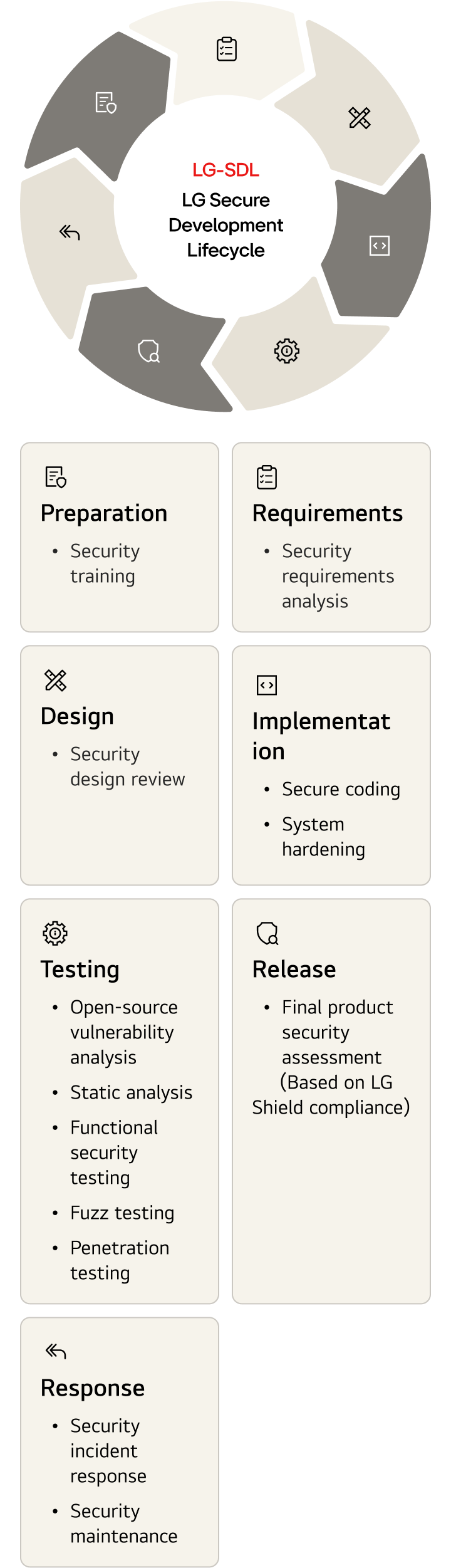
Circular diagram illustrating the LG-SDL (LG Secure Development Lifecycle), a seven-stage cyclical process for secure product development. The stages are arranged clockwise around a central label reading "LG-SDL: LG Secure Development Lifecycle," with detailed descriptions provided in callout boxes positioned around the circle. The seven stages in clockwise order, starting from the top: 1. Requirements — Security requirements analysis. 2. Design — Security design review. 3. Implementation — Secure coding and system hardening. 4. Testing — Open-source vulnerability analysis, static analysis, functional security testing, fuzz testing, and penetration testing. 5. Release — Final product security assessment, based on LG Shield compliance. 6. Response — Security incident response and security maintenance. 7. Preparation — Security training. The cycle then returns to Requirements, indicating a continuous and repeating process.


An image depicting employees and AI collaborating together using holographic interfaces in an office environment

Responsible AI management

LG Electronics practices Responsible AI that prioritizes the protection of human dignity and safety under the philosophy that "technology should be oriented toward humans," and is shifting its approach to global AI regulation from after-the-fact control to embedding it from the design stage. To this end, the company has established an integrated Responsible AI governance framework through regulatory analysis of key markets such as Europe, North America, and Korea, seeking to realize a trustworthy home appliance ecosystem by preventing the erosion of trust caused by misperception or exaggeration while providing customers with safe and novel AI product and service experiences.

* This image was generated by AI.

Responsible AI vision and governance

Responsible AI governance framework

A three-tier infographic titled "LG Electronics Responsible AI Governance Framework." The top tier is a beige rounded banner labeled "Vision/Philosophy" with the tagline "Responsible AI for a better life." The middle tier, labeled "LG Electronics Responsible AI Governance Framework," contains five white cards arranged horizontally, each with a small line icon at the top, a bold heading, and a short description. From left to right: (1) Organization: Company-wide operating system and consultative body for key issues; (2) Policy: Company-wide policies and implementation guidelines; (3) Process Establishment/Operation: AI risk/technology grading system and management process; (4) Technology and Data: Securing assets for collaborative application; (5) Adoption/Engagement: Company-wide rollout and dissemination to affiliates. The bottom tier, labeled "Key Management Items for Global Regulations/Standards," contains five white cards outlined in light pink/coral, each with a bold heading and a short description. From left to right: (1) Technical documentation: Model/service descriptions, etc.; (2) Post-management: Logs, input data management, etc.; (3) User information: Contact info, user manuals, etc.; (4) Risk management: Identified risks, mitigated risks, etc.; (5) Quality management: Test procedures/data management, etc. The overall color palette is warm beige and off-white with light coral accents, communicating a structured, hierarchical governance model connecting LG Electronics' Responsible AI vision to concrete operational pillars and global regulatory management items.

Responsible AI policy

Responsible AI policy manual

LG Electronics has established and operates the "Responsible AI Policy," which sets out the standards for responsible AI development and operation. The policy comprises detailed policies including AI governance, the responsibilities and authority of each organization, a code of ethics, and AI system risk classification and monitoring. It also codifies AI enabling systems such as employee training and a global regulatory library, and is continuously refined to reflect changes in global AI regulations and guidelines.


A human-centered approach

LG Electronics has established a human-centered accountability framework that places human dignity and safety as its top values in the use of AI. By systematically applying core principles such as fairness, reliability, regulatory compliance, and neutrality throughout the entire process of AI development and operation, the company designs its systems to prevent bias and discrimination against specific groups and to provide objective and responsible results. In addition, reflecting global regulatory requirements, the company secures privacy protection and the appropriateness of data use, and continuously strengthens an integrated accountability framework so that AI can provide customers with a trustworthy experience while minimizing social and ethical impact.

AI control framework

LG Electronics applies the "Human-in-the-loop" principle to ensure human intervention and oversight in key decision-making processes. In particular, the company applies safety-oriented design—such as emergency stops, protective stops, and user intervention—to Physical AI systems. The company enables users to recognize the system's judgment results and operating status in real time and to intervene immediately before and during physical actions. When a hazardous situation arises, the system is automatically switched to a safe state immediately, and information is provided transparently so that users can understand the system's status and the hazardous situation and make reasonable decisions. In addition, to ensure safety in the use of AI, LG Electronics thoroughly implements safety management in terms of intervention triggers, safety systems, securing transparency, and ethical compliance. Furthermore, the company clearly applies organizational accountability principles to results generated by AI systems or used in decision-making, based on the principle that AI serves as a tool to assist judgment, while ultimate responsibility lies with the entity that designs and operates the system.

Transparency and trust

Operation of AI transparency principles and guidelines

LG Electronics sets transparency as a core principle to minimize the information asymmetry that may arise in the use of AI. In particular, the company provides relevant information at an understandable level so that users can clearly recognize whether AI is being used, the results it generates, and whether AI has intervened. In addition, the company establishes standards and principles at an explainable level so that users and stakeholders can reasonably understand that the results were generated by AI, thereby managing the appropriate maintenance of AI transparency.

Responsible AI in marketing

LG Electronics has established AI marketing guidelines to prevent misleading or exaggerated expressions in the sales and marketing process and to secure brand trust. By operating an AI grade review committee in each division based on the level of technology and the level of personalization, the company has established a company-wide system that can proactively determine and manage the AI technology grade from the planning stage. Through this, the company has strengthened the linkage between marketing and legal review to reduce regulatory risks, while at the same time shortening the review lead time from an average of two weeks to three days. In addition, the company is carrying out company-wide management activities to prevent damage to the overall brand image caused by corrective requests and sanctions from domestic and international fair trade and consumer-related authorities.

Last updated July 13, 2026

Explore more