We use cookies, including cookies from third parties, to enhance your user experience and the effectiveness of our marketing activities. These cookies are performance, analytics and advertising cookies, please see our Privacy and Cookie policy for further information. If you agree to all of our cookies select “Accept all” or select “Cookie Settings” to see which cookies we use and choose which ones you would like to accept.

A workplace where everyone is respected
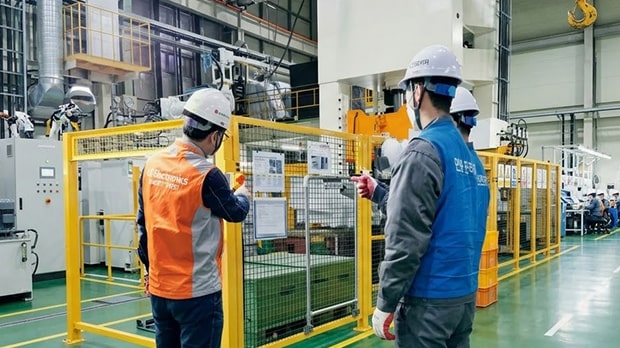
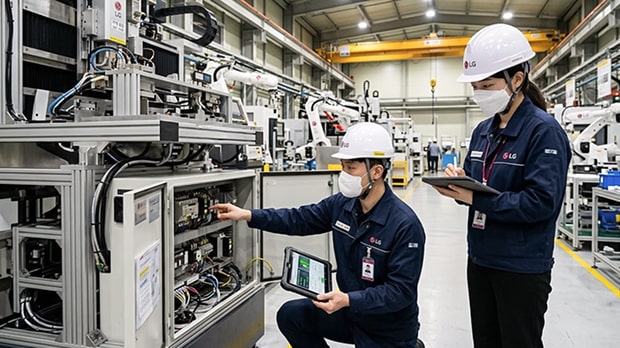
LG Electronics is committed to creating a workplace where people are respected, safety is ensured, and everyone has the opportunity to grow.
* This image was generated by AI.
We ensure the human rights and safety of all within our workplaces and supply chain.
LG Electronics upholds its social responsibility to protect workplace safety, health, and human rights through its RBA1)-based production site management program. Aiming to achieve zero critical non-conformances at 100% of production sites by 2030, the company conducts self-assessments and on-site audits to identify and address both potential and actual risks. Additionally, LG Electronics evaluates suppliers' ESG management practices and provides relevant training and consulting support.
1) RBA: Responsible business alliance, the world’s largest industry coalition dedicated to promoting responsible business practices across global supply chains
-
Production sites certified to ISO 45001100%(Excludes newly established entities (one in the U.S. and one in Mexico) that have not yet started mass production)
-
Percentage of production sites with zero critical nonconformances90%(Based on RBA audit requirements)
-
Percentage of high-risk suppliers0.8%(Based on self-assessment)
* Based on 2025 performance
Human rights management
LG Electronics has established a systematic operating framework to practice human rights management, enabling effective collaboration among board committees, a dedicated organization, and relevant departments. Through this framework, the company pursues responsible management to protect the human rights of its employees and stakeholders.
Human rights management policies
Revision of the global labor policy
Since first establishing its global labor policy in 2010, LG Electronics has continuously updated the policy to reflect revisions to global human rights standards and the RBA Code of Conduct.
LG Electronics global labor policy
-
01
Respect for human dignity/fair treatment/non-harassment
-
02
Prohibition of forced labor
-
03
Prohibition of child labor
-
04
Working hours
-
05
Wages and benefits
-
06
Freedom of association and collective bargaining
-
07
Compliance with labor-related laws and regulations
Human rights due diligence process
LG Electronics conducts human rights due diligence on all domestic and overseas production sites, as well as on its suppliers, to identify and assess actual and potential human rights risks that may arise from its business activities.
- STEP 01 Definition of human rights impact factors and planning
- STEP02 Identification of human rights impacts
- STEP 03 Human rights impact assessment
- STEP 04 Establishment and implementation of mitigation measures
- STEP 05 Monitoring and follow-up management
- STEP 06 Communication with stakeholders
STEP 01
Definition of human rights impact factors and planning
-
Define the factors that may lead to human rights impacts
-
Set the scope and targets of the assessment
-
- LG Electronics: All domestic and overseas production/business sites
- Supply chain: Tier 1 suppliers (being expanded to Tier 2 and Tier 3), and companies in the supply chain of cobalt and 4 major minerals
- Local communities1) For local communities, the focus is on preventing negative impacts through compliance with relevant laws, and local communities’ feedback is gathered via roundtables when significant changes or issues arise at business sites.1)
- Customers2) In terms of customers, efforts are made to proactively prevent negative impacts across the entire consumer experience and continuously improve service accessibility, enabling diverse users to use products without inconvenience.2)
STEP02
Identification of human rights impacts
-
Identify impacts through self-assessment based on the RBA Code of Conduct
-
Conduct on-site audits based on RBA VAP (Validated Assessment Program) audit standards
-
- In-depth checklists by department
- On-site inspection surveys
- Interviews with responsible personnel and on-site workers
STEP 03
Human rights impact assessment
-
Prioritize identified human rights impacts
-
Major human rights issues identified in 2025:
-
- Forced labor
- Child labor
- Working hours
- Wages and benefits
- Non-discrimination/non-harassment
- Freedom of association and collective bargaining
STEP 04
Establishment and implementation of mitigation measures
-
Establish mitigation and preventive measures at production sites and company-wide
-
- Production sites (LG Electronics and suppliers): Analyze root causes of identified negative human rights impacts and implement measures to prevent recurrence
- Company-wide (LG Electronics and suppliers): If repetitive or serious human rights issues are identified, establish remedial action expanded across the company
STEP 05
Monitoring and follow-up management
-
Conduct additional on-site audits
-
Conduct document-based reviews to verify evidence of improvement
-
Monitor KPIs
-
Report progress through relevant working groups and councils
STEP 06
Communication with stakeholders
-
Publish the sustainability report
-
Disclose information on the company website
-
Hold stakeholder roundtables
1) For local communities, the focus is on preventing negative impacts through compliance with relevant laws, and local communities’ feedback is gathered via roundtables when significant changes or issues arise at business sites.
2) In terms of customers, efforts are made to proactively prevent negative impacts across the entire consumer experience and continuously improve service accessibility, enabling diverse users to use products without inconvenience.
Human rights self-assessment and on-site audits at production sites
As a full member of the Responsible Business Alliance (RBA), LG Electronics conducts regular human rights due diligence at its domestic and overseas production sites, as well as with suppliers, in accordance with the procedures outlined in the UN Guiding Principles on Business and Human Rights (UNGPs).
2025 Human rights self-assessments and on-site audits at production sites
-
Inspection and audit scope
29 domestic and overseas production sites, In-house suppliers1)
-
Assessment categorySelf-assessmentsOn-site audit2)
Conducted assessments using the RBA self-assessment tool (Risk SAQ) for 29 production sites
A total of 22 on-site audits conducted, including 10 audits based on RBA standards (VAP) and 12 audits based on customer standards
-
ResultsSelf-assessmentsOn-site audit2)
6 sites classified as low-risk, 23 sites classified as moderate-risk, 0 sites classified as high-risk
Non-compliance cases decreased by 32.9% compared to the previous year
1) Self-assessments/on-site audits for in-house suppliers are conducted by each corporate entity (100% of 237 companies completed in 2025).
2) Number of customer-requested on-site audits - 33 cases in 2023, 19 cases in 2024, 22 cases in 2025.
Safety & Health
LG Electronics has established an integrated SHEE (Safety, Health, Environment, and Energy) management system to manage safety, health, environment, and energy, and strives to realize its environmental management and safety & health principles. To this end, the company establishes SHEE policies and mid-to-long-term goals to embed a world-class safety culture at its domestic and overseas business sites. We also endeavor to minimize the environmental impact of our operations through thorough management of emissions, including water resources and chemical substances.
| Goals | Achievements | Plan | |
|---|---|---|---|
| 2025 | Short-term (2026) | Mid-term (~2027) | |
|
|
2 accidents1) | 0 accidents | 0 accidents |
|
|
Achieved at or below 30% | At or below 30% | At or below 30% |
|
|
0 accidents | 0 accidents | 0 accidents |
|
|
- | Integration with the SHEE Compliance AI Agent |
|
1) [Safety and health risk management and fundamental safety system]
LG Electronics places the life and safety of its employees as its top priority. However, safety accidents recently
occurred at its production subsidiary in Thailand and during a business trip in the United States. Recognizing the gravity of these incidents, LG Electronics conducted a thorough root
cause analysis and overhauled its safety management system across all global business sites to prevent recurrence.
1. Ensuring fundamental safety in global production processes
Following the electrodeposition coating process accident at its production subsidiary in Thailand, LG Electronics
installed triple safety mechanisms based on a 'fail-safe' design that maintains safety even during human error or equipment malfunction, and extended this measure to all domestic and
overseas business sites operating the same process. The company also re-conducted risk assessments across all business sites and strengthened onsite safety management by standardizing
equipment safety criteria and revising work instructions.
2. Enhancing safety and health management for overseas business trips
Regarding the accident during a business trip to a client in the United States, LG Electronics identified the
circumstances in close cooperation with the client and established a preventive travel safety management system to protect employees from the pre-trip stage. A new 'Business Traveler
Safety and Health Training' course was introduced for all employees, covering local regulations, advance preparations, and emergency response. The company also made it mandatory to verify
pre-trip risk assessments, the designation of a safety officer, and completion of special training through its system.
Safety and health management policy
Through LG Electronics' unique 'Safety and Health Management Policy', we have strengthened the expertise and safety training of our employees, and are striving to improve the safety and health management system and disseminate a safety culture.
- Practice of safety and health: We actively implement workplace safety and health and employee health promotion activities based on the management policy.
- Training and expertise enhancement: We conduct essential safety and environment training by job level to ensure all employees realize the safety and health management policy and safety culture in the field, and enhance specialized training to cultivate the expertise and execution capabilities of personnel in the safety and environment sectors.
- Management system certification: We strive to expand the integrated management system certification of our global production sites and support the acquisition and maintenance of the occupational health and safety management system (ISO 45001) for production sites.
Safety and health management system
1. Operation of the safety and environment IT management system
For the management of global environment, safety, health, and energy, we operate various IT management systems as follows.
SHEE Portal
Company-wide safety, health, environment, and energy management system
Facility management system
FOMS (Facility Operation Maintenance System)
Employee health management system
HMS (Health Management System)
Chemical substance registration/
management system
CMS (Chemical Management System)
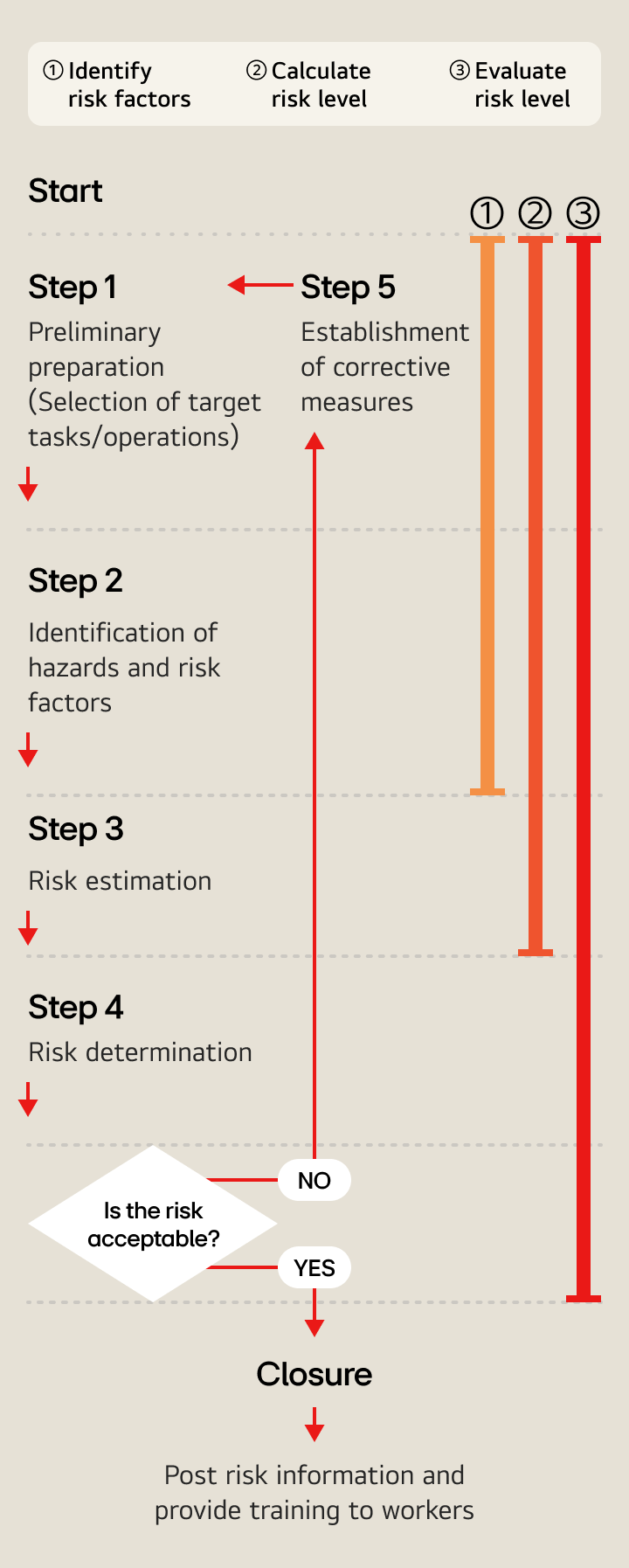
2. Identification of potential hazards and corrective actions
LG Electronics proactively identifies potential hazards in business sites through risk assessments. Regular evaluations are conducted across all business sites to detect hazardous and risk factors. Based on the results, the risks are categorized by level of severity and prioritized accordingly. When a risk factor is classified as high-risk, a detailed corrective action plan is established. Upon implementing corrective measures, a quantitative evaluation is conducted to assess the effectiveness of the improvements, based on frequency and severity.
LG Electronics has established a process that allows all employees and suppliers to stop work and evacuate in the event of an imminent danger that could lead to an industrial accident, in accordance with the rights granted under the Industrial Safety and Health Act (ISHA, Korean Act). This process is designed to protect personnel from hazardous situations that may arise during operations, tasks, or the use of equipment. In particular, when a hazardous risk factor is identified, work stoppage is enforced immediately, and a Stop Work Order (SWO) is visibly posted at the site. Once the SWO is issued, a strict protocol is followed in which the Chief Safety/Health Officer verifies that the risk has been resolved. Work may only resume after official approval is granted. This process enhances on-site safety and contributes to establishing a company-wide safety culture.
This diagram shows the step-by-step response process for managing hazardous situations at worksites.
-
Occurrence of a hazardous situation
Imminent risk of an industrial accident or similar incident
-
Suspension of work
Employees or contractors must immediately stop work and evacuate
-
Reporting
The situation must be reported to the supervisor and the site safety and health team (or safety unit).
-
Corrective actions
The supervisor and the head of the site safety management department must verify the risk factors and implement corrective measures. (*Work suspension remains in effect until all measures to prevent further harm are completed.)
-
Resumption of work
The head of the safety management department or a designated safety officer must confirm the elimination of the risk and verify the implementation of safety measures before work can resume.
3. Operation of employee health management program
LG Electronics has established a physical and mental health management plan to promote the health of its employees and operates the following facilities and programs.
-
Regular medical checkups
We intensively manage individuals requiring follow-up and high-risk groups based on the results of regular medical checkups.
-
Specialized health management facilities
We operate an affiliated clinic, health management rooms, and psychological counseling centers to establish plans and run programs for mental and physical health promotion.
-
Health promotion programs
We conduct activities such as smoking cessation, metabolic syndrome management, weight management, and job stress caring.
4. Safety accident reporting process
LG Electronics has established measures to promptly respond to accidents and prevent recurrence based on its standardized accident reporting manual.
-
Initial report
- Quick communication of the situation
- Conduct emergency response
-
Information report
- Constitute the crisis response committee
- Identify the accident type
-
Accident investigation and measures to prevent recurrence
- Analyze the root cause
- Establish measures to prevent recurrence
-
Accident closing report
- Review the response system
- Report final result
5. Board reporting on safety and health issues and plans
| Category | Frequency | Subject |
|---|---|---|
| Board reporting on safety and health | Annually | Regular reporting of key safety and health matters to the board of directors |
| Occupational safety and health committee | Quarterly | Deliberation and resolution of important matters concerning the safety and health of workers |
| Executive council on safety and health | Monthly | Deliberation and resolution by executives on important matters of the safety and environment center |
Environment
LG Electronics prioritizes environmental protection as a core value of our business activities and strictly complies with environmental laws and international agreements. We continuously strive to minimize our environmental impact, setting environmental impact reduction targets in connection with the UN Sustainable Development Goals (SDGs) and working to implement them.
Download environmental management policyChemical substance management
LG Electronics has introduced the LG Chemical Management System (LG CMS) across all of its domestic business sites to manage and mitigate risks arising from global chemical regulations, including the Act on the Registration and Evaluation of Chemical Substances (K-REACH), the Chemicals Control Act, and EU REACH1).
1) EU REACH: EU Registration, Evaluation, Authorization and Restriction of Chemicals
Preliminary screening
All chemical substances used for production and R&D across domestic and international business sites
Prior acquisition of chemical substance information, including Material Safety Data Sheets (MSDS) and LoC (Letter of Confirmation)
Preliminary review by specialized departments on regulatory compliance by country and the hazards/risks of substances
Procurement and receiving
Only chemical substances that have passed the preliminary screening process are permitted for receiving
Receiving allowed only after verifying appropriate storage and usage locations
Usage management
All products in use are managed with chemical product labeling
Designation of chemical substance managers and training for relevant personnel
Operation and management of chemical handling facilities in compliance with legal requirements
Disposal management
Periodic inventory checks of chemical products to verify current status and dispose of unused products
Disposal in accordance with national waste management regulations
Chemical regulatory compliance
To respond to chemical regulations, we regularly monitor the legal requirements and regulatory trends of each country, revise/amend internal standards, and establish response measures. We also conduct activities for the elimination and substitution of hazardous substances in accordance with internal management standards at each of the following stages.
-
Regulatory analysis
Review chemical regulations and establish response measures
Conduct hazardous chemical removal and substitution activities in accordance with internal management standards
Monitor global chemical regulatory trends
-
Production quality
Review the components of chemical substances used in the production stage
-
Supply chain management
Establish hazardous substance management standards for suppliers and collect chemical usage information across the supply chain
Comply with chemical handling standards and operate facilities
Prepare and maintain MSDS/substance specifications, etc.
-
Operations
Operate chemical substance-related information management systems
Conduct prior review of newly handled chemical substances
Strengthen management of hazardous chemical substances and RBA-managed substances
-
R&D
Assess hazards of materials used in research and development
Water resource management
LG Electronics effectively manages water resources by building a comprehensive water inventory, assessing various water-related risks, including source depletion, quality degradation, increased usage, and monitoring water consumption at production sites.
Key management measures
-
Risk assessment and monitoring
Based on the water inventory, we regularly assess water resources risks (water scarcity, water quality deterioration, increased usage) and monitor water consumption at production sites.
-
Water use efficiency improvement
We enhance water use efficiency by introducing a 'Zero Liquid Discharge (ZLD) system', which allows already used water to be recycled for landscaping or industrial purposes.
-
Contingency management
We prepare contingency plans for unexpected water supply disruptions by securing emergency water reserves, managing facilities to enable operation for at least two days even during a water supply disruption.
-
LG Electronics provides systematic safety management training covering the entire chemical life cycle, from procurement to storage, use, and disposal. Employees receive training on chemical hazards, risks, and handling precautions. The company provides emergency protective equipment appropriate for the chemicals in use and ensures employees are trained to use it correctly. Additionally, LG Electronics signed a Memorandum of Understanding (MOU) with the National Institute of Chemical Safety to enhance chemical accident response capabilities, introducing virtual reality (VR)-based experiential training content. The company established chemical accident VR training facilities within the safety experience centers at Changwon LG Smart Park, Magok LG Science Park, and Pyeongtaek Digital Park. These facilities provide training that allows employees to virtually experience potential industrial accidents, such as laboratory incidents and toxic gas leaks, thereby improving their practical response capabilities.
-
Status of environmental management, safety and health, energy, and quality certifications at global sites — includes information on Sites and certifications for North America (USA), Latin America (Mexico, Brazil), Europe/CIS (Poland, CIS), Middle East & Africa (Egypt, Saudi Arabia, Türkiye), India, Southeast Asia (Thailand, Vietnam, Indonesia), China, and Korea.
US
- Business site LGETN (Tennessee)
- Environmental management ISO 14001
- Safety and Health ISO 45001
- Energy ISO 50001
- Quality certification -
Mexico
- Business site LGEMN (Monterrey)
- Environmental management ISO 14001
- Safety and Health ISO 45001
- Energy -
- Quality certification ISO 9001
- Business site LGERS (Reynosa)
- Environmental management ISO 14001
- Safety and Health ISO 45001
- Energy -
- Quality certification ISO 9001
- Business site LGEVR (Ramos)1)
- Environmental management ISO 14001
- Safety and Health ISO 45001
- Energy -
- Quality certification ISO 9001
Brazil
- Business site LGESP_M (Manaus)
- Environmental management ISO 14001
- Safety and Health ISO 45001
- Energy ISO 50001
- Quality certification ISO 9001
Poland
- Business site LGEMA (Mlawa)
- Environmental management ISO 14001
- Safety and Health ISO 45001
- Energy ISO 50001
-
Quality certification
ISO 9001
IATF 16949
- Business site LGEWR (Wrocław)
- Environmental management ISO 14001
- Safety and Health ISO 45001
- Energy ISO 50001
- Quality certification ISO 9001
CIS
- Business site LGERA (Ruza)
- Environmental management ISO 14001
- Safety and Health ISO 45001
- Energy ISO 50001
- Quality certification CIG-023
Egypt
- Business site LGEEG (Cairo)
- Environmental management ISO 14001
- Safety and Health ISO 45001
- Energy -
- Quality certification ISO 9001
Saudi Arabia
- Business site LGESR (Riyadh)
- Environmental management ISO 14001
- Safety and Health ISO 45001
- Energy -
- Quality certification ISO 9001
Türkiye
- Business site LGEAT (Istanbul)
- Environmental management ISO 14001
- Safety and Health ISO 45001
- Energy ISO 50001
- Quality certification ISO 9001
India
- Business site LGEIL_N (Noida)
- Environmental management ISO 14001
- Safety and Health ISO 45001
- Energy ISO 50001
- Quality certification ISO 9001
- Business site LGEIL_P (Pune)
- Environmental management ISO 14001
- Safety and Health ISO 45001
- Energy -
- Quality certification ISO 9001
Thailand
- Business site LGETH (Rayong)
- Environmental management ISO 14001
- Safety and Health ISO 45001
- Energy ISO 50001
- Quality certification ISO 9001
Vietnam
- Business site LGEVH (Hai Phong)
- Environmental management ISO 14001
- Safety and Health ISO 45001
- Energy ISO 50001
-
Quality certification
ISO 9001
IATF 16949
Indonesia
- Business site LGEIN_C (Cibitung)
- Environmental management ISO 14001
- Safety and Health ISO 45001
- Energy ISO 50001
- Quality certification ISO 9001
- Business site LGEIN_T (Tangerang)
- Environmental management ISO 14001
- Safety and Health ISO 45001
- Energy ISO 50001
- Quality certification ISO 9001
China
- Business site LGEPN (Nanjing (Washing Machine))
- Environmental management ISO 14001
- Safety and Health ISO 45001
- Energy ISO 50001
- Quality certification ISO 9001
- Business site LGENT (Nanjing (New Tech))
- Environmental management ISO 14001
- Safety and Health ISO 45001
- Energy ISO 50001
- Quality certification ISO 9001
- Business site LGENV (Nanjing (Automobile))
- Environmental management ISO 14001
- Safety and Health ISO 45001
- Energy -
- Quality certification IATF 16949
- Business site LGETR (Taizhou)
- Environmental management ISO 14001
- Safety and Health ISO 45001
- Energy ISO 50001
- Quality certification ISO 9001
- Business site LGETA (Tianjin)
- Environmental management ISO 14001
- Safety and Health ISO 45001
- Energy ISO 50001
- Quality certification ISO 9001
- Business site LGEQA (Qingdao Chiller)
- Environmental management ISO 14001
- Safety and Health ISO 45001
- Energy -
- Quality certification ISO 9001
- Business site LGEQH (Qinhuangdao)2)
- Environmental management ISO 14001
- Safety and Health ISO 45001
- Energy -
- Quality certification ISO 9001
- Business site LGEHZ (Huizhou)
- Environmental management ISO 14001
- Safety and Health ISO 45001
- Energy ISO 50001
- Quality certification ISO 9001
Korea
- Business site Changwon1
- Environmental management ISO 14001
- Safety and Health ISO 45001
- Energy ISO 50001
- Quality certification ISO 9001
- Business site Changwon2
- Environmental management ISO 14001
- Safety and Health ISO 45001
- Energy ISO 50001
- Quality certification ISO 9001
- Business site Gumi
- Environmental management ISO 14001
- Safety and Health ISO 45001
- Energy ISO 50001
- Quality certification ISO 9001
- Business site Pyeongtaek
- Environmental management ISO 14001
- Safety and Health ISO 45001
- Energy ISO 50001
-
Quality certification
ISO 9001
IATF 16949
E-Mark CIG-023
- Business site Pyeongtaek (Chiller)
- Environmental management ISO 14001
- Safety and Health ISO 45001
- Energy ISO 50001
- Quality certification ISO 9001
* Excluding newly established subsidiaries that have not yet stabilized mass production (one in the U.S., LGEUS CAC; one in Mexico, LGEMX)
1) LGEVR newly acquired in December 2025
2) LGEQH withdrew from business operations in December 2025
**As of December 2025)
Supply chain management
Based on the philosophy of 'Trust and Communication, Change and Innovation, and Shared Destiny,' LG Electronics is creating a new future together by growing continuously with its suppliers. To this end, in addition to providing substantial support through the '5 Major Strategic Tasks for Shared Growth,' we build a better supply chain by strengthening ESG risk management as a member of the Responsible Business Alliance (RBA).
Supplier shared growth strategy
Key value
Vigorous efforts for sustainable growth with suppliers
Three major spirits
-
Trust and communication
- Jeong-Do Management
- Fair competition
-
Change and innovation
- Manufacturing competitiveness
- No.1 spirit
-
Shared destiny
- Social responsibility
- Mutual win-win
Supplier ESG management support program
-
Direct funding
Learn more -
Technology support (in partnership with government)
Learn more -
ESG management support
Learn more -
Support for carbon emissions management capabilities
Learn more -
Support for training and benchmarking
Learn more -
Incentive system
Learn more
Supply chain risk management
LG Electronics has established and operates a comprehensive risk management framework to systematically identify and manage ESG risks across its supply chain.
- Conduct supplier self-assessments through internally developed management system.
- Perform on-site audits and implement corrective actions for suppliers assessed as high-risk based on the self-assessment results.
- Strengthen environmental risk management by conducting greenhouse gas emissions survey targeting major suppliers (since 2022).
Status of LG Electronics' major suppliers
| Classification | Unit | 2025 |
|---|---|---|
| Tier 1 suppliers: Excluding suppliers with purchasing amounts less than krw 100 million, agencies, non-manufacturers, and service providers.1) | Companies | 1,080 |
| Core Tier 1 suppliers: Core suppliers are identified based on transaction amount and share, ESG management status, the supply of key components related to future technologies, and the need for enhanced oversight due to the specialized nature of the supplied parts.2) | 130 (Transaction volume: Top 70% or above) |
- 1) Tier 1 suppliers: Excluding suppliers with purchasing amounts less than krw 100 million, agencies, non-manufacturers, and service providers.
- 2) Core tier 1 suppliers: Core suppliers are identified based on transaction amount and share, ESG management status, the supply of key components related to future technologies, and the need for enhanced oversight due to the specialized nature of the supplied parts.
New supplier registration process incorporating ESG Factors
LG Electronics confirms compliance with the supplier code of conduct and international trade regulations when selecting new suppliers, and assesses them based on the following evaluation factors:
New supplier registration process
-
Transaction request
Suppliers
-
Review
Procurement team
-
Sanction screening
Compliance team
-
Follow-up management
Procurement team
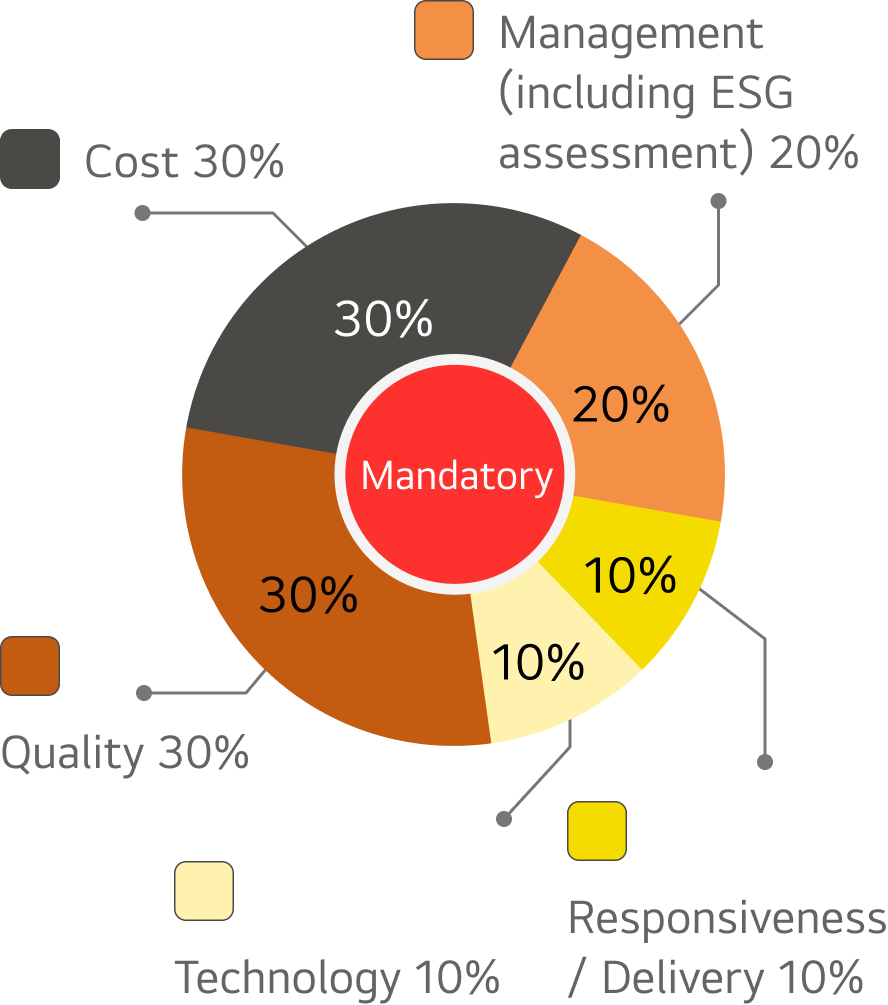
Evaluation items for new supplier assessment
This diagram shows the evaluation items for new supplier assessment. Environment is a mandatory item, while other factors are weighted: Management including ESG assessment (20%), Cost (30%), Responsiveness/Delivery (10%), Quality (30%), and Technology (10%).
Green Program Plus (GP Plus)
- Since 2005, we have operated the ‘Green Program Plus (GP Plus)’ to enhance the environmental competitiveness of our suppliers and lay the foundation for shared growth by transferring technology and know-how.
- To comply with the global environmental regulations on hazardous substances management in products, the management scope of the GP Plus has been expanded to include supply chain.
Supplier training and technical support
- To strengthen green partnerships with suppliers, we provide systematic annual training on hazardous substance regulatory compliance, green professional skills, and ghg management for environmental staff at suppliers and LG Electronics.
- We run a 'Hazardous Substance Measurement Expert' program for supplier testing staff to advance their management and measurement capabilities and ensure high data reliability.
Conflict minerals
LG Electronics establishes management standards and conducts due diligence on relevant suppliers in accordance with the 'OECD Due Diligence Guidance for Responsible Supply Chains of Minerals from Conflict-Affected and High-Risk Areas (CAHRAs)', and transparently discloses this information.
* Conflict minerals refer to Tin, Tantalum, Tungsten, and Gold (3TG) mined in the Democratic Republic of the Congo (DRC) and adjoining countries. These minerals are linked to social issues that cause severe human rights violations by becoming a funding source for armed groups.
LG Electronics is committed to avoiding the use of minerals mined from conflict-affected areas or those that are associated with labor rights violations or environmental degradation. We adhere to responsible mineral-related policies and standards, and operate a global conflict minerals management organization to ensure the responsible sourcing and procurement of minerals. This global conflict minerals management organization implements various measures to verify the effective operation of our responsible minerals sourcing program. These include analyzing external trends such as customer requests, regulatory compliance, use of RMI tools, international forums, and demands from NGOs and the media. Through our conflict minerals management system, we manage and improve supplier updates and smelter information when inaccuracies or uncertainties are identified. We also conduct internal reporting and support procedures to enhance the effectiveness of the conflict minerals program, address customer requests, and mitigate conflict mineral risks. In addition, as a member of the Responsible Minerals Initiative (RMI)1), LG Electronics participates in working groups and promotes smelter engagement, mineral information disclosures, and conflict mineral due diligence. The company also contributes to origin verification and audit support efforts.
1) Responsible Minerals Initiative (RMI): Provides member companies with regular updates on global smelter mineral usage and hosts forums to share best practices for addressing conflict mineral issues
The Responsible Minerals Assurance Process (RMAP), overseen by the Responsible Minerals Initiative (RMI), is a due diligence and assurance initiative that certifies smelters that do not source conflict minerals. To ensure the responsible sourcing of minerals used in its products, LG Electronics monitors the origin of the four major conflict minerals—tantalum, tungsten, tin, and gold—across its suppliers and requires that all smelters in the supply chain be RMAP-conformant. Although the introduction of new components or changes in current status of smelter certification may result in the temporary use of non-conformant smelters, LG Electronics has set a target of 100% use of conformant smelters and conducts regular inspections and maintenance. However, as certification status may vary annually due to market conditions and changes in the composition of the supply chain, LG Electronics conducts regular inspections and continuous management activities to ensure 100% use of certified smelters.
Conflict minerals management
- LG Electronics has established and complies with its own management standards to operate the requirements and processes of the conflict minerals management system. These standards apply not only to all products developed, manufactured, sold, or supplied by LG Electronics, but also to products and raw materials developed, manufactured, or custom-ordered by suppliers.
- LG Electronics regularly reviews and updates its conflict minerals management standards and provides training on the updated requirements to employees and suppliers. In cases where raw materials supplied to LG Electronics contain conflict minerals, the company conducts due diligence in accordance with the OECD Guidance.
Conflict minerals assessment, due diligence, and risk evaluation
- To avoid the use of unethical resources such as conflict minerals, cobalt, and mica, LG Electronics conducts inspections and due diligence on its suppliers and raw materials and regularly assesses the associated risk levels. Information on suppliers using conflict minerals is obtained through the RMI’s RMAP due diligence results, the Reasonable Country of Origin Inquiry (RCOI), and other publicly available data, and the origin of conflict minerals is verified through the Hazardous Substances Management System (HSMS) and the Conflict Minerals Management System (CMMS). Through these assessments, key risk factors are identified, and for suppliers identified as high-risk, appropriate actions are taken following investigation. In addition, LG Electronics requires all smelters in its supply chain to obtain responsible minerals certification and continuously communicates with suppliers and partners to encourage smelters’ participation in the certification program.
Risk assessment process for conflict minerals
Conflict minerals management process. Consists of four stages: Data Submission, Verification, Due Diligence, and Assessment, with the first three stages forming the Inspection process. Covers the flow from collecting supplier and smelter data through CMMS and HSMS-based verification and RMI due diligence to requesting remediation from high-risk suppliers.
Inspection
-
Data Submission
- Submit data related to production and sourcing of conflict minerals such as all suppliers, smelters and refiners
- Submit origin data of cobalt and mica in addition to 4 major conflict minerals since 2019
-
Verification
- Cross-check between submitted data and actual origin of conflict minerals and cobalt registered in CMMS
- Check whether raw materials contain conflict minerals or cobalt through HSMS
- Update RMAP certification status identified by RMI due diligence program
- Verify risks of conflict minerals and cobalt incurred by suppliers of LG Electronics based on RMI due diligence result
- Manage erroneous information on smelters, and use of banned or uncertified smelters through monthly monitoring
- Assess risk level of conflict minerals of suppliers according to RMI or other due diligence and request suppliers with a high-risk level for remediation
Last updated July 13, 2026
Explore more
- Completed the establishment of a system to survey suppliers’ carbon emissions data and improve management reliability
- Advanced emissions data through the analysis of supplier data
Last updated July 13, 2026
- Provide consulting by dispatching experts in various fields to enhance the manufacturing competitiveness of suppliers.
- Transfer LG Electronics’ know-how on establishing production line automation and informatization infrastructure in various areas, including smart factory, quality/productivity, and field improvement fundamentals (FI-11).
- Support suppliers in enhancing total productivity, increasing sales, and creating new jobs.
- Support the costs of ESG assessment and consulting from authoritative external certification bodies to help suppliers establish their ESG systems and strengthen competitiveness.
- Interest-free direct funding totaling about KRW 37.5 billion, KRW 172.6 billion in shared growth fund support, KRW 67.1 billion in ESG fund support (as of 2025)
Last updated July 13, 2026
- Expansion of beneficiary suppliers in the ESG domain by operating a dedicated team for government programs
- Support suppliers' participation in government programs such as ESG consulting, solar power, and equipment replacement to achieve carbon reduction effects for suppliers
Last updated July 13, 2026
- Operation of incentive programs based on regular supplier evaluations (e.g., increased order volume, provision of preferred right to development)
Last updated July 13, 2026
- Establish a real-time communication channel by setting up a partnership proposal system and a voice of supplier (VOS) system within the supplier portal system.
- Operate a separate shared growth portal system to facilitate continuous exchange of opinions with suppliers and share relevant information.
- Provide a range of technical support services for suppliers to secure next-generation technologies.
- In the case of joint technology development, dispatch technical personnel directly to support the enhancement of technological capabilities of small and medium-sized enterprises(SMEs).
- Provide guidance and consulting to help suppliers participate in government support programs for small and medium-sized enterprises by the ministry of trade, industry and energy, and the ministry of SMEs and startups.
- Operate the technology escrow system to protect core technologies (LG Electronics bears the entire cost from 2013).
- Since 2022, in collaboration with government agencies (Korea Institute of Patent Strategy Promotion, KISTA), host excellent technology seminars to introduce promising technologies and research outcomes held by universities and public research institutes.
- Support suppliers in enhancing their technological capabilities, facilitating technology transfer, and promoting commercialization.
- Support for third-party ESG audits of domestic and overseas suppliers
- Reduction of high-risk supplier ratio through ESG self-assessments and on-site inspections
Last updated July 13, 2026
- Operate various training and recruitment support programs to enhance the human resource competitiveness of suppliers.
- Established the shared growth academy within the LG Electronics learning center to provide free job-specific training to employees of suppliers.
- Developed training programs that allow supplier employees to participate more flexibly and develop their capabilities in cooperation with universities in the Changwon region.
- Operate an LG Electronics supplier recruitment channel on JobKorea to assist supplier recruitment.
- Conduct recruitment support activities, including utilizing the online recruitment platform 'i-ONE JOB,' in collaboration with the industrial bank of Korea.
- Strengthened supplier ESG competency through ethics policy education
- Education programs provided for both domestic and overseas suppliers
Last updated July 13, 2026
To recognize the value of respecting human rights, LG Electronics has established the LG Electronics human rights policies and is implementing them company-wide. These policies are formulated to reflect international human rights standards and industry norms, including the UN Guiding Principles on business and human rights (UNGPs), the Universal Declaration of Human Rights, the ILO Core conventions, and the RBA Code of Conduct, and they function as practical guidance for protecting the human rights of key stakeholders, including employees. Additionally, LG Electronics enhances employee understanding and promotes practical implementation of the human rights through training and awareness-raising activities targeted at employees. These policies are regularly updated to incorporate the latest international human rights standards and stakeholder expectations, with all revisions being transparently disclosed to the public.
| Policy | Scope | Content |
|---|---|---|
|
Human rights principles |
All internal and external stakeholders |
All stakeholders, including LG Electronics employees, suppliers, local communities, and consumers, possess human dignity and value, and have the right to pursue happiness. The human rights principles, established by integrating existing human rights-related policies, respect relevant international standards and mandate compliance with the laws and regulations of the countries and regions where LG Electronics operates. In cases where local laws conflict with international standards, the more stringent standard is applied. The principles also cover key areas of human rights impact identified through human rights impact assessments, as well as remedy and grievance handling and human rights governance. |
|
Global labor policy and guidelines |
Employees, suppliers, and stakeholders |
All employees and related personnel of LG Electronics possess human dignity and value, and have the right to pursue happiness concerning their labor. LG Electronics complies with labor and human rights standards established by international organizations, such as the UN and ILO, and upholds the protection of human dignity as a fundamental value in its business operations, regardless of age or gender. LG Electronics adheres to labor-related laws and regulations in each country and region, and is committed to ensuring employment stability and fair wages for employees from both social and economic perspectives, while striving to maintain a safe and supportive work environment. Furthermore, LG Electronics states that these standards are basic obligations for all suppliers doing business with the company, and represent values that must be shared with all stakeholders. |
|
Safety and health management, Environmental management policy |
Employees |
LG Electronics prioritizes the safety and health of its employees, customers, and local community members. The company strives to create a safe and healthy workplace by taking a leading role in the field of occupational health and safety and through its commitment to continuous improvement. Additionally, LG Electronics considers the environment a critical element of its business operations. The company is committed to preserving the global environment and promoting sustainable social development, as well as improving the quality of life for stakeholders, by minimizing resource use, operating clean technology & processes, developing environmentally conscious products, and optimizing energy efficiency. |
|
Code of Ethics |
Employees |
LG Electronics shares the management philosophy of “Customer-Value Creation” and “People-Oriented Management,” promoting autonomous management based on freedom and responsibility, in line with the spirit of its management charter. The company respects the principles of a free market economy that encourages fair and open competition, and seeks mutual benefit with all stakeholders based on trust and cooperation. To this end, LG Electronics has established a code of ethics as a standard for proper behavior and sound value judgment for all employees and is committed to its faithful implementation. |
|
Code of Conduct |
Employees |
Through transparent and responsible business practices, LG Electronics aims to strengthen both employee capabilities and corporate competitiveness, thereby creating greater value for all stakeholders, including customers, employees, and shareholders. Accordingly, LG Electronics employees worldwide pledge to comply with local laws and regulations, engage in fair competition, and conduct business in accordance with the company’s global standards. |
|
Diversity and inclusion policy |
Employees |
LG Electronics believes that a corporate culture that respects the diverse experiences and backgrounds of individuals fosters flexible thinking, cultivates insight, and empowers employees to fully demonstrate their talents. The company supports the diverse preferences and choices of all employees and does not tolerate discrimination based on such differences. At LG Electronics, everyone is expected to recognize and respect each other’s differences and to work as their authentic selves. In our culture of diversity and inclusion, every employee can contribute creative and innovative solutions by bringing a variety of perspectives to the table. |
|
AI ethics principles |
Employees |
In response to growing ethical concerns surrounding artificial intelligence, LG Electronics has contributed to the establishment of AI ethics principles by participating in the LG AI ethics committee and its working groups, which focus on the ethical development and use of AI. These principles serve as a standard for appropriate behavior and sound value judgment that all LG employees involved in AI development and utilization must comply with, helping to ensure AI reliability and prevent ethical issues in advance. The LG AI ethics principles are built upon five core values: Human dignity, fairness, safety, accountability, and transparency. |