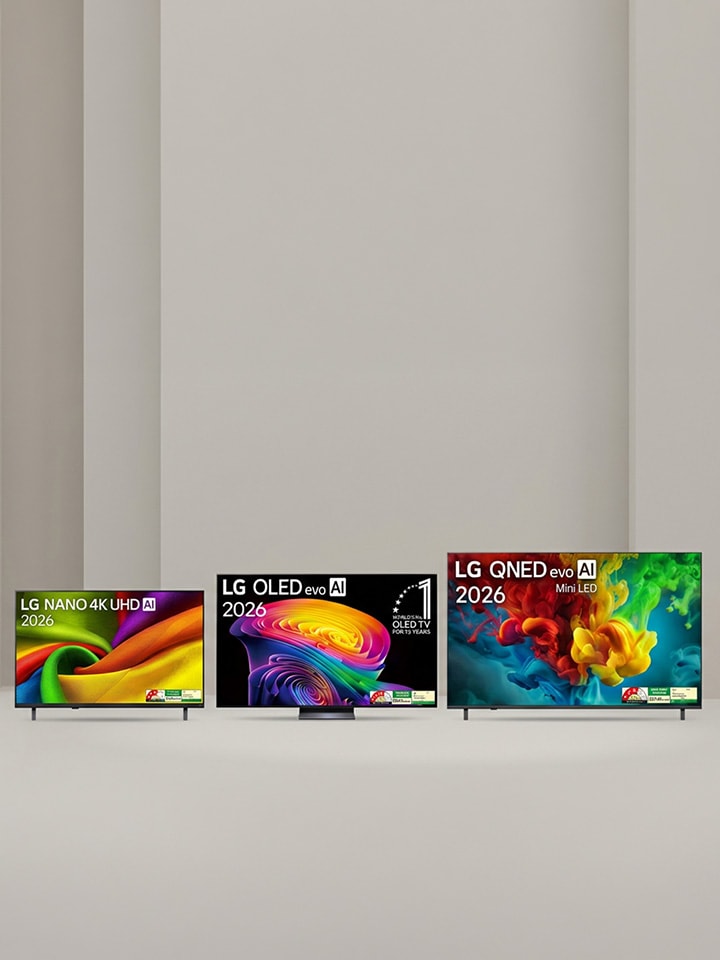
Which TV size is perfect for your living room? Usually, anything beyond 106 cm (42) or 139 cm (55) can be a good fit for a standard room. But is this information enough to buy a TV? Clearly not. When you are investing much of your time and budget into an entertainment device, you want to be entirely sure that the TV you buy stands out. This size guide can help you with that.

Biggest TV Size Myth That Burns Budget


Bigger is not always better. The right screen size depends on three things most buyers ignore: viewing distance, room width, and how you use the TV. A 190 cm (75) screen can feel like a home cinema in one living room — and completely overwhelming in another. Let's fix that, one size at a time.

139 cm (55): When Smaller Is Better

A 139 cm (55) TV is often underestimated and wrongly dismissed as "too small." It is genuinely well-suited to apartments and bedrooms, sofas placed closer to the screen, and viewers who mostly watch news, YouTube, or casual shows. Sit too close to a much larger screen, and your eyes end up constantly scanning left to right — that causes fatigue, especially over long sessions. On the LG side, this size spans everything from the accessible 55NU870BPLA in 4K UHD to the 55QNED82BLA in QNED evo Mini LED, so "smaller" doesn't have to mean fewer features.

Choose 139 cm (55) if your room is compact and everyday comfort matters more than cinematic impact.

165 cm (65): The Sweet Spot for Most Living Rooms

If there's one size that works for the widest range of Indian homes, it's 165 cm (65). It's large enough to feel immersive without overwhelming a standard living room, and it suits sofas placed 2.5-3 metres away and mixed use across movies, sport, gaming, and daily viewing. Many buyers who regret their purchase regret going smaller than this — not bigger. LG's OLED evo lineup, including the OLED65C6PLA and OLED65G6PLA, sits comfortably in this size, pairing self-lit OLED contrast with a screen size that fits most walls without dominating them.

Choose 165 cm (65) if you want the safest, most future-proof option for a typical living room.

190 cm (75): Amazing, or a Genuine Mistake

A 190 cm (75) TV delivers serious impact. Done right, in the right room, it feels like a home cinema. Done wrong — in a room that's too small — it dominates the space and becomes uncomfortable to watch rather than immersive. This size works best with a wide wall and a deeper room, a sofa seated at least 3 metres away, and a household that primarily watches movies, sport, or other immersive content. LG's 75QNED82BLA, built on QNED evo Mini LED with an α8 AI Processor Gen3, is a strong example of what this size can deliver when the room genuinely supports it.

Choose 190 cm (75) if your space can support it, not just your budget.

Pro-Tip for Size


  • 139 cm (55): comfortable at viewing distances* of roughly 1.8-2.3 metres

  • 165 cm (65): comfortable at viewing distances* of roughly 2.3-2.8 metres

  • 190 cm (75): comfortable at viewing distances* of roughly 2.8-3.5 metres

*Please note that this is only suggestive viewing distance. It may differ in reality, according to various other factors like room size, area where TV is placed, etc.

Room Size Matters More Than TV Size


Two people can buy the exact same TV and have completely different experiences — the difference is almost always room layout, not the television. Before deciding on a size, always check the wall width (not just the diagonal size you're comparing), how far back the sofa can realistically move, and the height of any console or unit the TV sits on. If a TV feels too big once it's installed, you generally won't "get used to it" — you'll just stop enjoying the room.

Size, and LG Fit in a Look


Screen Size Best Fit For Example LG Models
139 cm (55") Apartments, bedrooms, closer seating 55NU870BPLA, 55QNED82BLA
165 cm (65") Standard living rooms, mixed use OLED65C6PLA, OLED65G6PLA
190 cm (75") Large rooms, dedicated home cinema feel 75QNED82BLA

So, Which Size Should You Choose?


Choose 139 cm (55) if your room is small and seating sits close. Choose 165 cm (65) if you want the best all-round experience for a typical Indian living room. Choose 190 cm (75) if your room is large and genuinely built for immersion. The best TV is not the biggest one you can afford — it is the one that fits your room and how you actually live in it. Still unsure? Measure your viewing distance first; that one step alone prevents most TV buying regret.

Once size is sorted, everything else — OLED vs QNED, webOS features, gaming performance — becomes a much easier decision. Check out LG TV Range now.

*Disclaimer: The features and specifications mentioned above may vary from model to model. Please check the product page on lg.com/in before the final purchase or ask your retailer for all the details.

FAQs


A. LG's OLED evo TVs are built with gaming in mind — models in the C6 and G6 series support Game Optimizer, VRR, and ALLM, with some OLED evo panels supporting 4K VRR up to 165Hz for genuinely smooth, tear-free motion. Since OLED panels are self-lit, response times are near-instant compared to LED-based panels, which is exactly what fast-paced gaming benefits from most.

A. A 121 cm (48) LG OLED, such as the OLED48C6PLA, uses self-lit pixels that switch off individually for true blacks and sharp contrast — something LED-based TVs, which rely on a backlight, cannot fully replicate. At this size, the difference is most noticeable in dark scenes and HDR content; for everyday bright-room viewing, a good LED or QNED panel can still hold its own at a lower price point.

A. A 4K UHD LED TV is generally the more cost-effective choice upfront and performs well for everyday, well-lit viewing. OLED costs more but delivers noticeably better contrast and colour accuracy, particularly for movies and dark scenes — so the better question isn't which is cheaper, but which picture advantage is worth paying for given how you watch.

A. Modern OLED panels are commonly rated for tens of thousands of hours of use before any noticeable dimming, and normal household viewing habits (mixed content, no static logos left on screen for extended hours daily) make this a non-issue for most buyers. Panel longevity is less about a hard expiry date and more about avoiding hours of static, high-brightness content on the same fixed spot.

A. Look at app ecosystem, update support, and remote-control experience rather than the operating system name alone. LG's webOS platform, for instance, comes with the Re:New Program offering up to 4 software upgrades over 5 years, so the smart TV keeps gaining features long after purchase — a genuinely useful factor for a 4K home theatre setup you plan to keep for years.