We use cookies, including cookies from third parties, to enhance your user experience and the effectiveness of our marketing activities. These cookies are performance, analytics and advertising cookies, please see our Privacy and Cookie policy for further information. If you agree to all of our cookies select “Accept all” or select “Cookie Settings” to see which cookies we use and choose which ones you would like to accept.

Being a pro-gamer, it is tough to compare TV specs, deciding whether to spend on an OLED or settle for something more “value for money.” Somewhere in that research, you've probably typed “QLED vs OLED for gaming” into Google.
LG's answer to that segment is QNED, a Mini LED-based line-up built on its own colour and dimming technology. But the range extends beyond it.
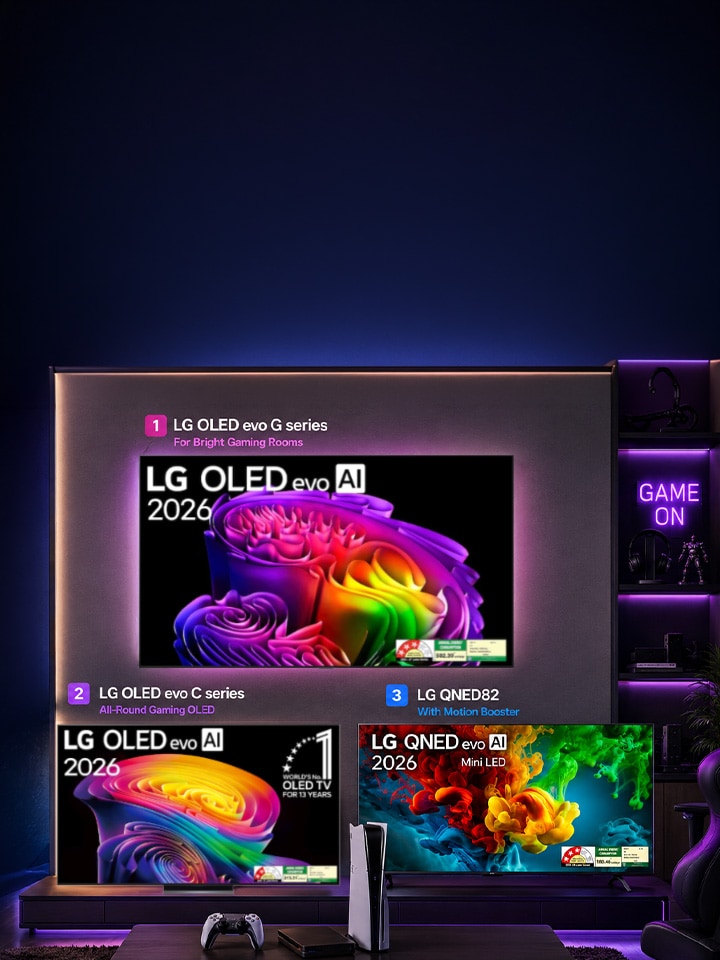
Which TV to buy for gaming? If this is something you have asked yourself, you have landed at the right stop. Here are the six LG TVs worth shortlisting if gaming is the priority, and exactly what each one gets right.
How to Compare OLED vs QNED for Gaming?
LG's OLED TVs use self-lit pixels that switch on and off individually, which is why response times can drop as low as 0.1ms on the OLED evo C series. QNED evo, on the other hand, uses a Mini LED backlight controlled through Precision Dimming, layered with LG's Dynamic QNED Color technology for 100% Color Volume, as certified by Intertek. Both lineups support variable refresh rate (VRR) and AMD FreeSync, so the real differentiator for gamers is refresh rate ceiling, response time, and whether the TV can do all this wirelessly.
Top 3 LG TVs for Gaming
1. LG OLED evo C series — All-Round Gaming OLED
The C series is LG's dedicated gaming OLED, supporting G-Sync and AMD FreeSync alongside a 4K 165Hz refresh rate, so fast-paced titles stay free of tearing or stutter. It's the world's first TV certified with VESA DSC (Display Stream Compression) and ships with HDMI 2.1 for lossless, low-latency signal transfer. Its OLED panel's 0.1ms response time pairs with ultra-low-latency ALLM, and world-first Bluetooth ultra-low-latency technology brings cloud-gaming delay under 3ms on NVIDIA GeForce NOW — close enough to wired play that competitive gamers shouldn't notice a difference. Brightness Boost Pro adds up to 3.2x more brightness, for high quality visuals.
2. LG OLED evo G series — For Bright Gaming Rooms
If your gaming setup sits near a window, the G series is built for that. Reflection Free Premium technology maintains “Always Perfect Black” even in bright lights of living room, unlike a plain matte “glare-free” panel that washes blacks into grey. It carries the same gaming toolkit as the C series — G-Sync, AMD FreeSync, 165Hz, 0.1ms response, ALLM, and VESA DSC gaming certification* — plus Brightness Boost Ultra for up to 3.9x more brightness and an Alpha 11 AI Processor with a Dual AI Engine (5.6x stronger NPU, 50% faster CPU, 70% better GPU) that precisely controls all 8.3 million pixels. Basically, stronger and faster specs for a gaming experience that gives you an ultra-immersive high.
*this is an update in progress.
3. LG QNED82 – With Motion Booster
Experience ultra-fast gaming with 144Hz, AMD FreeSync Premium, and VRR. With Motion Booster bringing up refresh rates to reduce motion blur and the first-ever BT ULL-certified controller, enjoy high-performance, ideal for competitive gaming, with boosted-up refresh rates up to 288Hz*.
*Motion Booster 288 delivers up to 288Hz refresh rate at optimized Full HD resolution for ultra-smooth gameplay.

Quick Spec Comparison
| Model | Panel | Max VRR | Sync Certification | Standout Gaming Feature |
| OLED evo C | Self-lit OLED | 165Hz | G-Sync, FreeSync | 0.1ms response, VESA DSC, <3ms Bluetooth cloud gaming |
| OLED evo G | Self-lit OLED | 165Hz | G-Sync, FreeSync | Reflection Free Premium for bright rooms |
| QNED82 | Mini LED | 144Hz | FreeSync Premium | 144Hz, TV with Motion Booster |
Conclusion
There's no single “best” TV on this list — only the best fit for how and where you play. If every millisecond matters in competitive shooting game, you can choose OLED evo C series as LG's most complete gaming TV. If your room gets flooded with daylight, the OLED evo G series holds its picture together. Want zero cables? This list can help you go wireless without compromising the gaming features. And if a bigger screen with strong value matters more than the absolute low input lag, you can take your pick from the list. Either way, run your shortlist against these gaming specs, not just screen size, before you check out on Gaming TV and Soundbar Range on LG website.
*Please note that the specifications mentioned in the write up differ model to model, and can vary for different screen sizes, models, series, etc. It is advised to check TV range on LG website for complete information before you make the purchase.
FAQs
A. QNED combines Mini LED backlighting with LG's Nano Technology-based Dynamic QNED Color for 100% Color Volume. The other key difference from OLED: QNED uses a backlight (MiniLED), so it can run brighter overall, while OLED's self-lit pixels switch off individually for true blacks and faster response times, which matters more for gaming.
A. Yes. OLED55C6PLA is LG's dedicated all-rounder — built to deliver strong picture quality for movies (Dolby Vision, FILMMAKER MODE) while also supporting G-Sync, AMD FreeSync, a 165Hz refresh rate, and 0.1ms response time for gaming. A 139 cm (55) C series model works well for a household that splits time between streaming and gaming.
A. Within LG's OLED range, the C series is the gaming-optimised pick, thanks to its 165Hz refresh rate, G-Sync and FreeSync support, HDMI 2.1. The G series matches it spec-for-spec on gaming and adds Reflection Free Premium Hyper Radiant Colour Tech for brighter rooms, so the choice between the two comes down to both lighting and gameplay.
A. For bright rooms, LG's Reflection Free Premium technology OLED evo is built for good lighting. On the smart TV side, webOS adds real value beyond aesthetics — it brings AI support, AI Concierge recommendations, and personalised viewing experience.
A. Within LG's QNED evo range is all built around the AI Processors, with VRR up to 144Hz and ALLM— making them a solid mid-tier choice for households that want both without stepping up to OLED.