Watching sports on TV is very different from watching a movie or a regular show. A cricket ball can travel across the screen in a fraction of a second, a footballer can sprint from one end of the pitch to another, and a Formula 1 car can disappear around a corner before you have time to blink. To enjoy these moments clearly, your TV needs more than just 4K resolution.

The best 4K TVs for sports combine high brightness, smooth motion handling, accurate colours, strong contrast and wide viewing angles. Screen size also matters, especially when you want to recreate the excitement of watching a match in a stadium at home.

LG's current TV lineup includes OLED evo, QNED evo Mini LED and other 4K AI TV options designed to deliver an immersive viewing experience. LG's dedicated sports TV range also highlights features such as TruMotion, ClearMR, Sports Portal and Sports Alert for sports-focused entertainment.

So, what should you look for when choosing the best 4K TV for sports? Let's break down the key factors.

What makes a 4K TV good for sports?


A good sports TV should make fast action look natural, keep players and the ball sharp, reproduce the colours of the pitch accurately and remain easy to watch even when people are sitting at different positions around the room.

The most important factors are:

  1. Brightness: Helps maintain visibility in bright rooms and makes highlights stand out.
  2. Motion handling: Reduces blur during fast movement.
  3. Viewing angles: Keeps colours and contrast consistent when watching from the side.
  4. Contrast: Helps separate players, equipment and backgrounds.
  5. 4K resolution: Provides greater detail, especially on larger screens.
  6. Screen size: Creates a more immersive match-day experience.
  7. Upscaling: Improves the appearance of lower-resolution sports broadcasts.
  8. Smart features: Make it easier to find matches, scores and sports content.

LG's sports-focused TVs combine these picture technologies with features such as Sports Portal and Sports Alert, helping viewers access sports content and stay updated on their favourite teams.

1. Brightness: See every detail, even in a bright room


Brightness is one of the most important considerations when buying a TV for sports.

Many matches are watched during the day, with sunlight entering through windows or with bright indoor lighting. A TV with good brightness can maintain picture visibility in these conditions, so details don't look washed out.

Brightness also helps HDR content look more impactful. Highlights such as stadium lights, reflections, white cricket uniforms and bright football kits can appear more vivid when the TV can produce strong highlights.

OLED evo for contrast and controlled brightness

LG OLED evo TVs are designed around self-lit pixels, allowing the display to produce deep blacks and precise contrast. Current LG OLED evo models also incorporate advanced brightness technologies; for example, the 2026 LG OLED evo G6 features Hyper Radiant Color technology and an LG α11 AI Processor Gen3, with LG stating up to 3.9x higher peak brightness compared with its reference model under its specified test conditions.

This can be particularly useful when a match moves between darker and brighter scenes, such as a night football game or a cricket match under stadium lights.

QNED evo Mini LED for bright, dynamic sports

If brightness is a major priority, LG QNED evo Mini LED TVs are another strong option. Mini LED backlighting combined with local dimming can help deliver high brightness while improving contrast.

The LG QNED90, for example, uses Mini LED with Precision Dimming Pro and Dynamic QNED Color. LG also positions the model specifically for dynamic sports viewing on an Ultra Big TV.

For a living room with plenty of ambient light, a QNED evo Mini LED can therefore be a compelling choice for sports fans looking for a large, bright screen.

2. Motion: Keep up with every fast-moving moment


Motion handling is arguably the most important picture characteristic for sports.

A fast-moving footballer, a cricket ball, a tennis serve or a racing car can become difficult to follow if the TV struggles with motion. This is where refresh rate and motion-processing technologies become important.

A 120Hz native refresh rate is a strong specification to look for in a sports TV. It allows the TV to display more frames per second than a conventional 60Hz display, which can help fast movement appear smoother.

LG's current sports TV recommendations include models with 120Hz displays, while selected models offer higher refresh rates for gaming and variable refresh rate applications.

TruMotion for smoother sports action

LG TruMotion is designed to improve the appearance of moving images. LG states that its AI-based processing can identify content genres and adjust judder levels, making it suitable for fast-moving content such as football and racing.

LG OLED evo models also feature ClearMR certification on selected models. ClearMR is designed to evaluate motion clarity, making it another specification worth considering when comparing TVs for sports.

The result is simple: when the action gets faster, the TV should help you follow it without distracting blur or unnatural motion.

3. Viewing angles: Important when the whole family watches together


Not everyone watches a match from the centre of the sofa.

During a big game, people may sit on different sofas, chairs or even on the floor. If a TV loses colour, brightness or contrast significantly when viewed from the side, some viewers may not get the same experience as the person sitting directly in front of the screen.

This makes viewing angles especially important for sports.

OLED technology is particularly well suited to group viewing because self-lit pixels can maintain strong picture consistency across a wide range of viewing positions. This makes OLED evo a strong choice when several people regularly watch sports together.

LG's OLED range is designed around precise pixel-level control, while its QNED range uses advanced colour and backlight technologies to deliver a vibrant viewing experience.

When choosing between models, consider the actual layout of your room rather than simply choosing a TV based on its specifications.

4. Colour and contrast: Make the match look more lifelike


Sports broadcasts contain large areas of colour: green cricket fields, football pitches, blue tennis courts, team jerseys and colourful stadiums.

A TV needs to reproduce these colours accurately without making them look artificial.

LG QNED evo TVs use Dynamic QNED Color, with selected models offering 100% Color Volume certification. This is designed to maintain rich colour expression across different brightness levels.

OLED evo, meanwhile, combines deep blacks with strong colour performance. This can be particularly effective for night matches, where bright players and stadium elements need to stand out against darker surroundings.

For sports, good contrast is not simply about making the picture look dramatic. It helps separate the subject from the background, making players and equipment easier to follow.

5. 4K resolution: More detail on a bigger screen


4K Ultra HD offers a resolution of 3,840 × 2,160 pixels. That extra detail becomes particularly useful as screen sizes increase.

A larger 4K TV can make a sports broadcast feel more immersive, allowing you to see more detail in players, jerseys, stadiums and the playing surface.

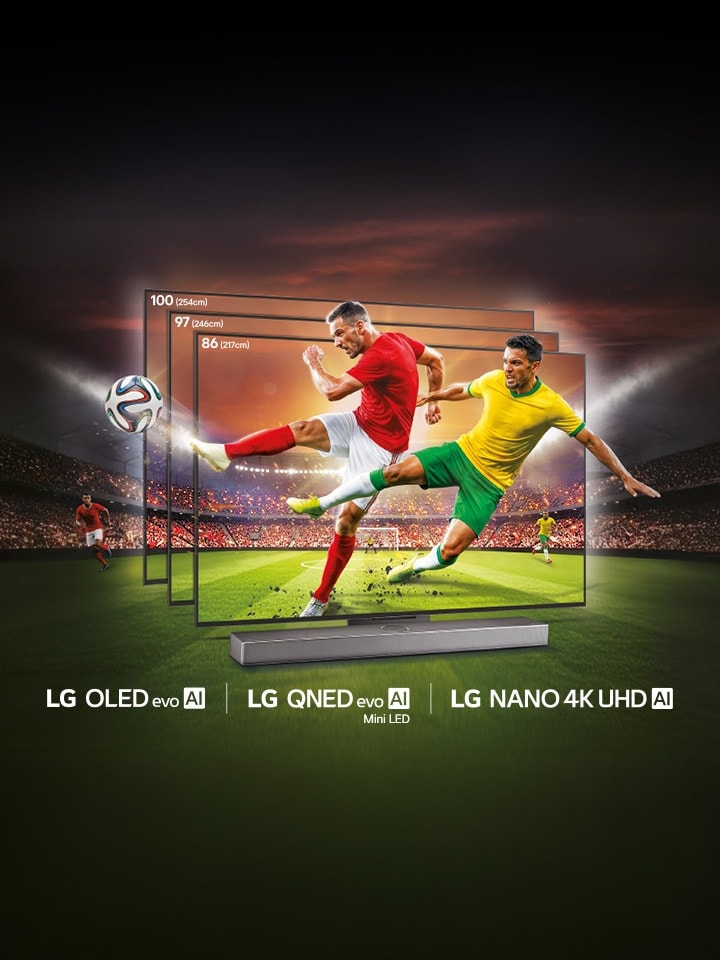
LG offers 4K TVs across its OLED evo, QNED evo and other TV ranges, with Ultra Big TV options extending to very large screen sizes. LG's current QNED86 lineup, for example, includes sizes going up to 254 cm(100).

However, bigger is not always better. The ideal size depends on your viewing distance and room layout. A large screen works best when you have enough distance to comfortably take in the entire picture.

6. AI processing and upscaling can improve sports broadcasts


Not every sports broadcast is delivered in native 4K.

Depending on the broadcaster, streaming service and match, the source quality can vary. This is where image processing and AI upscaling can make a difference.

LG's AI TVs use dedicated AI processors to analyse content and improve picture quality. Current LG sports TV recommendations include AI Super Upscaling, while selected models use advanced alpha AI processors.

For sports fans, this can help make lower-resolution content look cleaner and more detailed on a large 4K screen.

7. Smart sports features can make match day easier


Picture quality isn't the only thing that matters.

Modern AI TVs can also make it easier to find and follow sports content. LG's Sports Portal brings sports-related content, streaming apps, highlights, live games and league information together in one place. Sports Alert can also provide notifications related to favourite teams.

Selected LG TVs also offer AI-powered sports features. For example, LG's 2026 QNED evo lineup highlights Sports Forecast through AI Concierge, alongside Sports Alert and Sports Portal.

These features can turn the TV into more than a screen for watching a match. They can become a central hub for following your favourite teams and competitions.

Which LG 4K TV technology is best for sports?


The right choice depends on what matters most to you.

  1. Choose LG OLED evo if:

    You prioritise deep blacks, strong contrast, motion clarity and consistent viewing from different seating positions. OLED evo is particularly attractive for premium sports viewing and rooms where multiple people watch together.

  2. Choose LG QNED evo Mini LED if:

    You want a bright, large-screen sports experience with vibrant colours and strong contrast. Mini LED and advanced dimming make selected QNED evo models well suited to dynamic sports viewing.

  3. Choose a large LG 4K AI TV if:

    Your priority is a more immersive viewing experience and access to smart features, AI processing and sports-focused entertainment features.

    Ultimately, there is no single best 4K TV for every sports fan. The best TV is the one that matches your room, viewing distance, preferred sports and picture priorities.

The bottom line


When buying a 4K TV for sports, don't focus only on resolution. Look at the complete viewing experience.

Brightness helps you see the action clearly in different lighting conditions. Motion handling keeps fast movement smoother. Viewing angles ensure everyone gets a good picture, even when sitting away from the centre. Colour and contrast make players and the playing field look more lifelike, while 4K resolution and AI upscaling help bring out detail on larger screens.

LG's current OLED evo and QNED evo ranges bring together these technologies with sports-focused smart features such as Sports Portal, Sports Alert and AI-powered experiences.

So, whether you're following cricket, football, tennis, Formula 1 or another fast-paced sport, choose a TV that can keep pace with the action. Because when the match reaches its most exciting moment, you shouldn't be watching a blur—you should be seeing every moment clearly.

FAQs


A. A larger 4K screen can provide a more immersive sports experience, particularly when viewed from an appropriate distance. LG offers Ultra Big TV options in its lineup, including very large QNED evo models.

A. AI upscaling can improve the appearance of lower-resolution content by processing and enhancing the image for a 4K display. This can be useful because sports content is not always broadcast or streamed in native 4K. LG's current TV lineup includes AI Super Upscaling on selected models.

A. Useful LG features include TruMotion for motion processing, Sports Portal for accessing sports content, Sports Alert for team updates and AI-powered features on selected models.

A. Check the TV's native refresh rate, motion technology, brightness, contrast, viewing-angle performance, screen size, HDR support, AI upscaling and smart sports features. Also consider your room's lighting and the distance between your seating position and the TV.

A. 4K resolution is an important part of the experience, but it is not the only factor. For sports, motion handling, brightness, contrast and viewing angles can be equally important because the content contains constant fast movement and wide shots.

A. For a bright room, an LG QNED evo Mini LED TV can be a strong option because selected models combine Mini LED backlighting, advanced dimming and vibrant colour performance. OLED evo models can also be suitable depending on the specific model and room conditions.

Explore LG 4K TVs: LG's current TV lineup includes OLED evo, QNED evo, NANO 4K UHD AI and other Smart TV options designed for different viewing needs.