Somewhere between switching on the TV and actually watching something, a lot happens in the background. Your TV isn't just "displaying" a show anymore — it's reading every frame and every sound wave in real time, then quietly deciding how to make it look and sound better. That's the job of an AI processor.

LG's α (Alpha) AI Processor family sits at the centre of this. It works on picture quality, sound quality, brightness, personalisation, and even gaming responsiveness — all at once, frame by frame.

Three names come up a lot when talking about this: AI Picture Pro, AI Sound Pro, and AI Concierge. Think of them as three specialists working inside one chip — one watching the picture, one listening to the sound, one learning your habits.

What Is an AI Processor in a TV?


Here's the simple version. A normal TV processor is defined as a chip that decodes and displays a video signal — it shows you what's sent to it, nothing more. An AI processor goes further. It analyses content frame by frame, recognising faces, objects, text, and backgrounds as they change on screen, then adjusts picture and sound automatically to match.

On top of that, according to LG AI processor page, LG AI TV learns your viewing preferences, understands your lifestyle, and optimizes every aspect of your TV experience to create the most ideal, personalized entertainment experience, just for the user.

LG's Alpha AI Processor family covers this in tiers*. As per the official processor lineup, here's how it breaks down:

Processor Used In What It's Known For
α7 AI Processor Gen9 NANO 4K UHD, QNED65, QNED70 4K picture with better sharpness and depth, 9.1.2ch virtual surround
 α8 AI Processor Gen3 OLED (B6), QNED82 & QNED85 Upscales every frame, enhances facial expressions, AI Voice Remastering for clearer conversation
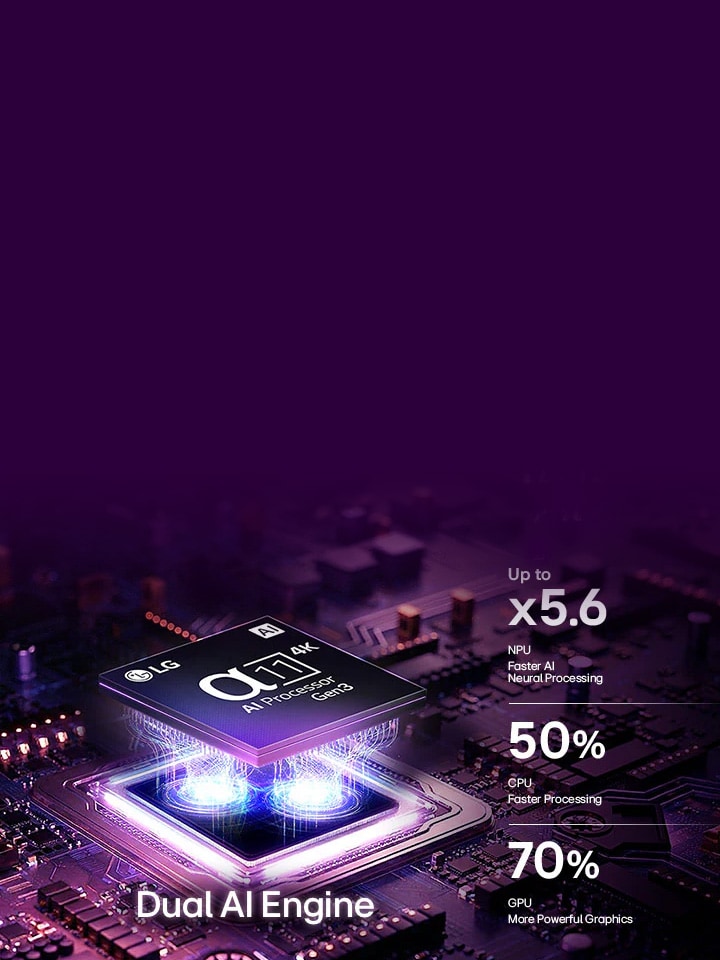
α11 AI Processor Gen3 OLED (C6),OLED (G6) Upscales every pixel with a Dual AI Engine, AI Object Remastering for the best sound experience.

The higher you go, the more the processor is doing per frame — which is exactly why picture clarity and gaming performance scale up with it too.

*Please note that the list is not exhaustive. To know more about the processors used in each LG TV, check out LG TV range

How Does AI Picture Pro Optimise Every Scene?


This is where picture clarity actually comes from. AI Picture Pro doesn't apply one fixed filter to everything you watch — it reads the scene first, then decides.

In short, here's what happens behind the scenes:

  1. AI Super Upscaling — lower-resolution content is analysed and rebuilt closer to 4K clarity, which is the whole idea behind the UHD vs HD debate people search for before buying.
  2. AI Noise Reduction — grain and compression artefacts are smoothed out without softening real detail.
  3. HDR and brightness optimisation — contrast and brightness are adjusted scene by scene, not just once at setup.

A sports match gets faster motion handling so the ball doesn't blur. A movie gets deeper contrast and filmic tone. Nature documentaries get richer, more natural colour separation. Animation gets cleaner, flatter colour accuracy.

And gaming gets faster response with reduced input lag. The flagship α11 AI Processor Gen3, for instance, is known to precisely control 8.3 million pixels for this level of accuracy, powered by an NPU that's 5.6× more powerful and a GPU that's 70% more powerful than its predecessor.

How Does AI Sound Pro Create Immersive Audio?


Picture quality alone doesn't hold attention — sound is what makes a scene feel real. AI Sound Pro refers to LG's real-time audio processing layer that reads what's playing and reshapes the sound around it.

  1. Virtual surround sound — expands standard audio into a wider soundstage, up to virtual 11.1.2 channels.
  2. Voice enhancement — dialogue is pulled forward so it stays clear, even during action-heavy scenes.

The result: stadium sound during a match, cinema-style depth during a movie, and clean dialogue during a series — all without touching a single settings menu.

How Does AI Personalisation Make the TV Smarter?


One short press on the AI button on your remote opens up your AI Concierge* which provides customized keywords and recommendations based on your search and watching history.

*AI Concierge's supported menus and apps may vary by country.
*AI Concierge's menu displays may be different upon release.
*AI Concierge's keyword recommendations may vary according to the app and time of day.

Paired with webOS, this extends into personalised recommendations, individual user profiles, and voice recognition that can tell family members apart and tailor suggestions for each person. In short, the smarter the processor, the smarter the whole viewing experience becomes — not just sharper pictures.

Conclusion


Buying a TV today isn't really about screen size anymore — it's about how much thinking happens behind that screen. LG's Alpha AI Processor family, from the base to the flagship α11 with its Dual AI Engine, is essentially what decides whether a movie night, a match, or a gaming session actually feels the way it's meant to. Picture clarity, immersive sound, and a TV that learns your habits — that's the real upgrade. Check out LG TV range today.

*Disclaimer: it is recommended to check the model carefully before you make the purchase for LG TV to confirm AI processor capabilities. Information in this write up could vary model to model.

FAQs


A. Depends on the model tier — α8 AI Processor Gen3 (B6), α11 AI Processor Gen3 (C6), or the flagship α11 AI Processor Gen3 with Dual AI Engine (G6). Each step up does more picture and sound work in real time.

A. Models running the α9 or α11 AI Processor — they handle frame-by-frame upscaling, HDR optimisation, and fast motion response, exactly what gaming and movies both need.

A. It usually comes down to the processor inside, not just the panel. A higher-tier Alpha processor means sharper upscaling, better sound separation, and lower input lag — all of which matter more than screen size alone.

A. Several brands make OLED TVs, but the day-to-day experience varies mainly by processing power. LG's edge sits in its Alpha AI Processor lineup, built specifically for real-time scene analysis, upscaling, and sound remastering.

A. Simply put, it is not recommended to attempt this yourself. TV internals need proper handling and genuine parts. The safest step is contacting LG's authorised service centre so the replacement is done right without affecting your warranty.