We use cookies, including cookies from third parties, to enhance your user experience and the effectiveness of our marketing activities. These cookies are performance, analytics and advertising cookies, please see our Privacy and Cookie policy for further information. If you agree to all of our cookies select “Accept all” or select “Cookie Settings” to see which cookies we use and choose which ones you would like to accept.
[Executive Corner] The Daylight Test: Why the True Value of Perfect Black Is Revealed in Bright Rooms
-
extension : zipReflection Free Premium Images.zip
-
extension : imgReflection Free Premium Image 1.jpg
-
extension : imgReflection Free Premium Image 2.jpg
-
extension : imgReflection Free Premium Image 3.jpg
-
extension : imgReflection Free Premium Image 4.jpg
-
extension : imgReflection Free Premium Image 5.jpg
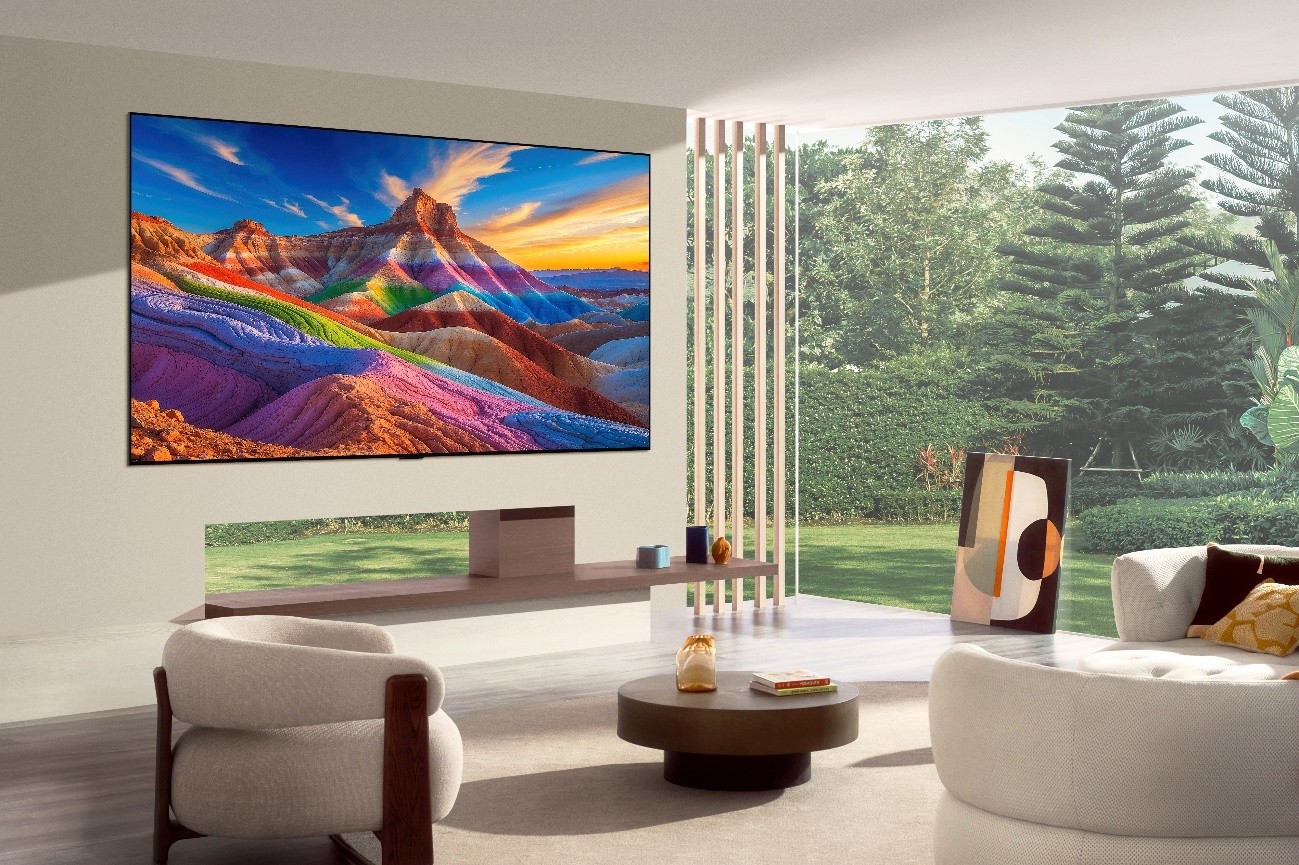
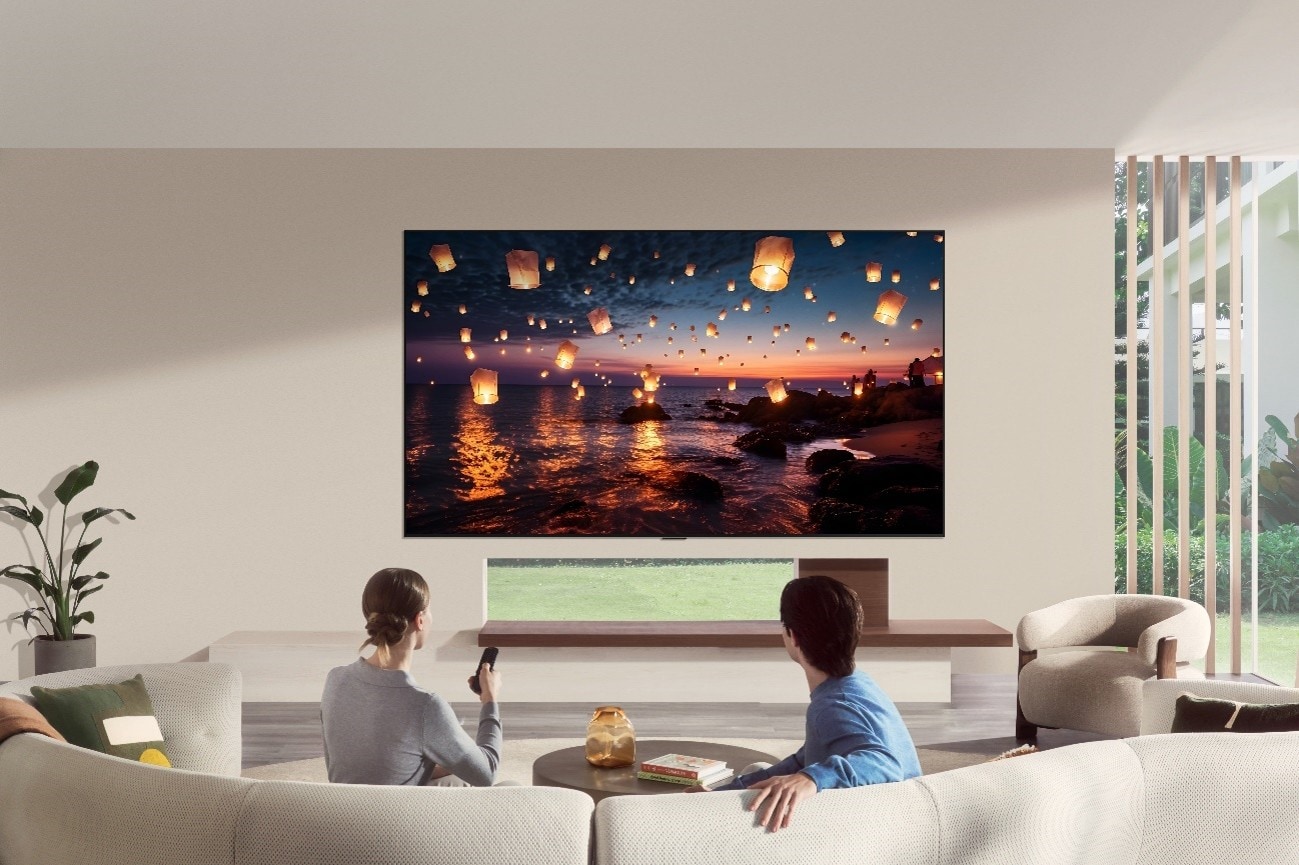
Every premium TV looks spectacular in a pitch-black, cave-like room. But that isn’t how most of us watch. More often than not, when we actually have a moment to sit down and catch up on our must-see shows, there’s either sunlight pouring in through the windows, or all the lights are on inside the house. And it is in these bright environments that the true value of a display’s black levels become more apparent.
At LG, we recognized that mastering this daylight viewing experience required a two-fold solution: maximizing screen brilliance and shielding that brilliance from ambient light. This realization led us to pair Brightness Booster Ultra, which dramatically elevates luminance, with Reflection Free Premium technology, a picture quality solution designed to help preserve OLED evo’s Perfect Black1 and Perfect Color,2 even in the most brightly lit rooms.
The Hidden Trade-Off of Reducing Reflection
Coatings or technologies that reduce screen glare are nothing new. The conventional approach is to scatter incoming light across the screen’s surface, breaking up the sharp, mirror-like reflections that make a TV hard to watch in a light-soaked spaces. It works up to a point. But it causes a side effect that we weren’t willing to accept.
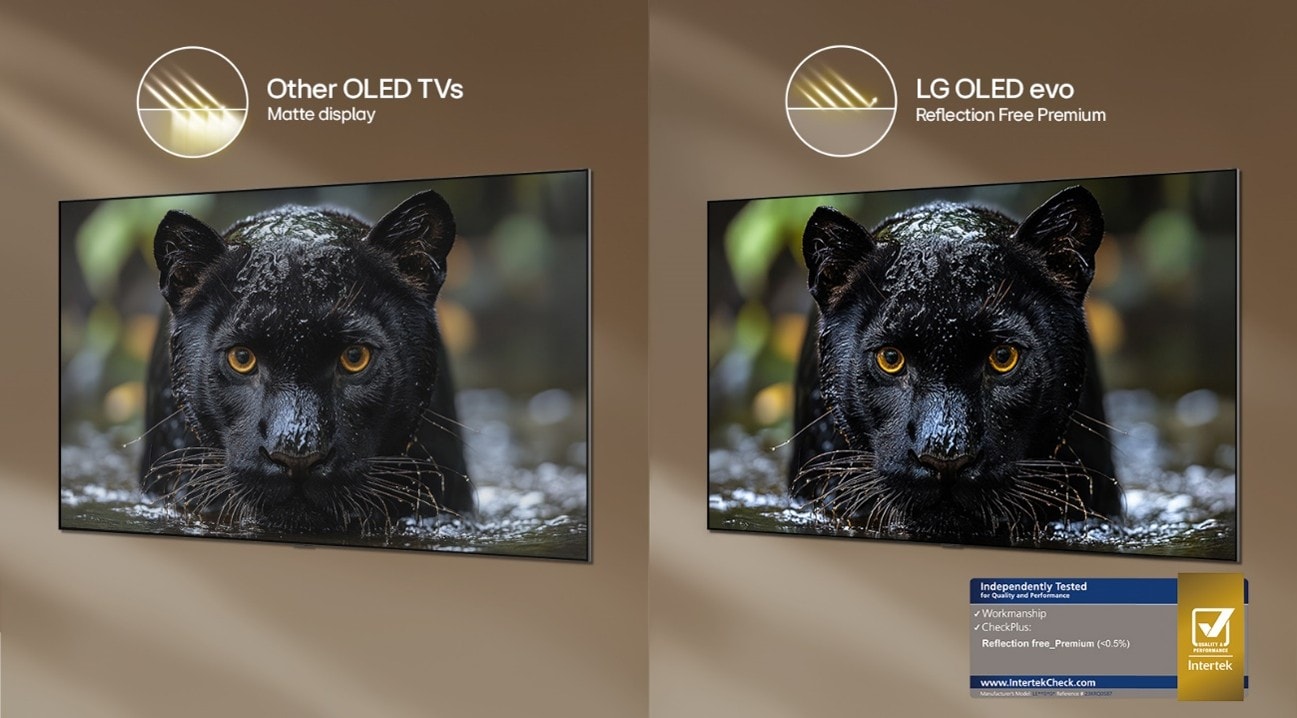
True reflection-reduction technology must do more than simply lower the reflectance rate. It must be able to minimize reflections without compromising the original picture quality. Diffusion-based anti-reflection treatments successfully cut down on mirror-like reflections, but they frequently make the screen look hazy, blurring fine details and degrading color vibrancy.
Picture a canvas painted with vivid, richly saturated colors, and then imagine someone spreading a layer of dust across the entire surface. The images on the canvas are still visible, but the colors have become muted, flat and lifeless. The same thing happens when a TV employs a conventional light-scattering coating to combat reflections: the picture is still there, but the vitality is gone.
The real question, then, is not “Does your TV have anti-reflection technology?” It’s “Does that technology preserve the picture quality you paid for in the first place?”

Why Perfect Black Isn’t Just About Dark Scenes
The impact of conventional reflection-reduction technology on picture quality goes deeper than you might realize. Take “black level” for instance. This isn’t a standalone specification of interest only to tech reviewers. It’s the foundation everything else in the picture is built on, including color accuracy and fine detail.
Consider a tightly zoomed-in scene: a woman with blonde hair fills the screen. Around her hairline, subtle shadows help distinguish individual strands from the skin beneath. If black levels become washed out, those shadow gradations begin to disappear. You can no longer tell exactly where the hairline ends and the skin begins.
The effect compounds at higher resolutions. A 4K image can only reveal the full extent of its razor-sharp detail, such as a single bead of sweat or the weave of a silk scarf, if there is enough contrast between neighboring pixels. When black levels wash out, that contrast margin shrinks, and the finest details become indistinct. As a result, the benefits of 4K resolution can become harder to perceive. Not because the number of pixels has somehow shrunk, but because weakened contrast makes it difficult to perceive visual nuance and subtlety. However, when Perfect Black remains intact, all those minuscule details stay clearly defined and the overall image retains its depth and vibrancy.
LG’s Answer: Absorb, Don’t Scatter
Our answer to dealing with reflections came from an obsession with detail. Rather than scattering incoming light, LG’s Reflection Free Premium technology is engineered to absorb it, taking in the vast majority while dispersing the rest in multiple directions. What little reflection remains is not enough to distract the eye. Relying on light-absorbing materials alone cannot drop a screen’s reflectance below the 1 percent mark, as residual light inevitably bounces back. Through earlier advances in reflection reduction, our previous generation of OLED had already overcome this barrier, achieving an impressive reflectance rate of 0.6 percent.
Pushing reflectance down by a further 0.1 percentage point required an additional technological breakthrough. To achieve this, we developed a three-layer coating designed to make incoming light waves collide and cancel each other out, much like two ocean waves meeting and flattening into calm water. Any minuscule amount of light that survives this process is then finely dispersed to minimize visible, mirror-like reflections.
The road to Reflection Free Premium technology wasn’t straightforward. Although the difference between 0.6 and 0.5 percent may sound marginal, developing and optimizing the three-layer coating took a year and a half of relentless engineering.
The real challenge wasn’t just dropping the reflectance rate but doing so without introducing secondary issues like color shifts, screen haze or loss of sharpness.
Matching reflectance, color accuracy, surface quality and sharpness all at once proved to be a monumental engineering hurdle. Even the slightest mismatch in the formulation ruined the entire result. We built and tested hundreds of display samples, repeatedly refining the formulation to find the perfect balance. But in the end, as a growing number of customers can now attest, these exhaustive efforts yielded significant and measurable returns.
The latest LG OLED evo displays have been independently certified by Intertek as Reflection Free Premium,3 achieving an exceptionally low reflection rate of around 0.5 percent. However, this certification goes far beyond just measuring how much light bounces off the screen. It is a comprehensive evaluation of uncompromised picture quality. Achieving the “Premium” tier signifies that the display can deliver outstanding picture quality in bright environments, reducing reflections without sacrificing resolution, low-tone detail visibility or color accuracy.
This rigorous standard unlocks a new level of freedom in how we design our days around entertainment. Historically, enjoying a truly cinematic experience at home meant choosing between living in a dimly lit cave or accepting a compromise on what we saw. LG OLED evo removes this barrier entirely. By satisfying Intertek’s dual demands for reflection reduction and absolute image fidelity, the technology protects from the daylight so it doesn’t dilute the deep, velvety shadows and rich textures of your favorite content. You no longer have to wait for sundown or manually adjust your environment to appreciate every subtle detail on screen.
Ultimately, this breakthrough actively and effectively safeguards everything that makes the OLED experience so incredible: pure blacks, vibrant colors, high contrast, smooth gradations and sharp details.
Premium Picture Quality, Designed for Real Living
Reflection Free Premium technology is applied to the LG OLED evo W6 and G6 AI TVs, bringing the technology described above to LG’s latest flagship OLED lineup.
These flagship models are powered by Brightness Booster Ultra, which achieves luminance levels up to 3.9 times brighter than conventional OLEDs.4 By pairing this intense brilliance with the glare-absorbing defense of Reflection Free Premium, LG OLED evo’s signature depth and vividness remain uncompromised, even when daylight floods the room. Combining refined design with this powerful engineering synergy, our TVs deliver peak performance in real-world living spaces.
For many years, the display industry wrestled with the challenge of how to lower screen reflectance without sacrificing picture quality. A rejection of the compromise solutions that have come before it, Reflection Free Premium technology is our declaration that a true premium viewing experience – and the true value of Perfect Black – should be available at any time, regardless of lighting conditions.
By Lee Myong Young, Research Fellow at Display Picture Quality Development Team, LG Media Entertainment Solution Company at LG Electronics
# # #
1 LG OLED Display is verified by UL for delivering black levels ≤0.24nit up to 500lux, based on IDMS Section 11.5 Ring light reflect measurement.
2 LG OLED Display is verified by UL for delivering color consistency levels >99 percent up to 500lux, based on IDMS Sections 11.5 Ring light reflect measurement.
3 LG OLED display is certified by Intertek for Reflection Free measured to IDMS 11.2.2 sampling-sphere implementation. Reflection Free Premium applies to W6 and G6 series (except 97, 48-inch models).
4 Brightness may vary based on model, screen size, and market region. Peak brightness is 3.9 times brighter than conventional OLED @3 percent window by internal measurements.