We use cookies, including cookies from third parties, to enhance your user experience and the effectiveness of our marketing activities. These cookies are performance, analytics and advertising cookies, please see our Privacy and Cookie policy for further information. If you agree to all of our cookies select “Accept all” or select “Cookie Settings” to see which cookies we use and choose which ones you would like to accept.

Transition to a circular economy
We are advancing towards a world without waste. LG Electronics is shaping the future of the circular economy by recycling and reusing materials, and through products and services designed for longevity.
* This image was generated by AI.
We are building a circular economy by turning waste into resources.
Resource circulation strategy
This diagram illustrates LG Electronics’ circular economy framework across the entire product life cycle, from resource sourcing and production to use and end-of-life. It highlights material selection, parts reuse, in-process scrap recycling, durability and repairability, waste appliance collection, and the establishment of a closed-loop resource system to enhance resource efficiency and recyclability.
Resource procurement
Material selection
- Selection and use of recycled materials considering cost-effectiveness and environmental friendliness (recycling rate, carbon emissions, etc.)
Reusing components
- Project to extract and utilize reusable components from recovered e-waste
Production
Modular process
- Modular and standardized product design
- Efficient production lines
- Quality management systems
- Improved parts replaceability
Recycling scrap
- Residual scrap from the production process is collected and reintegrated into component manufacturing
Usage
Durability
- Products are designed for extended lifespans
- Standardized quality management systems are established and operated
Repairability
- Modular designs
- Providing repair manuals
- Maintaining spare parts inventory
- Ensuring fair access to repair services
- Complying with relevant regulations
Subscription service
- Enhance the subscription management platform and expand service coverage
- Customers are encouraged to participate in environmental initiatives, including waste reduction and a circular economy
End-of-Life
Collecting
E-waste
- Operates a global e-waste collection and take-back system
Promotes a closed-
loop system
- E-waste collected at the recycling center (Chilseo, CRC) are recycled and utilized for producing recycled raw materials/parts, and manufacturing refurbished products.
Resource
Recovery
- Waste packaging collected by Pantos are recycled as a raw packaging materials and/or for recycled EPS production via resin manufacturers and recycling companies.
Improvement of resource efficiency
Use of recycled materials
Aiming for a cumulative 600,000 tons of recycled plastic by 2030 (Since 2021)
- Expansion of recycled material usage by conducting product stability and quality reliability tests to enhance resource efficiency
- Current use of recycled materials in major product lines including refrigerators, washing machines, air conditioners, TVs, and monitors etc.
- Continuous promotion of alternative part and technology development to expand the scope of recycled plastics, and expansion of application areas across product categories
| Year | Recycled Plastic Use(K tons) | Recycled Raw Material Use(K tons) | Cumulative Use (K tons) | Achievement rate (Target cumulative 600K tons) |
|---|---|---|---|---|
| 2022 | 16.1 | 33.0 | 59.0 | 9.8% |
| 2023 | 21.6 | 54.4 | 114.0 | 19% |
| 2024 | 27.5 | 74.1 | 188.0 | 31% |
-
Recycled Raw Material Use
-
Recycled Plastic Use
-
Cumulative Use
-
Achievement rate (Target cumulative 600K tons)
Material and structural improvements
- From the development stage, LG minimizes product size and weight while improving performance and usability through ongoing material and structural optimization.
- Eco-conscious elements are integrated into design and production to enhance resource efficiency and reduce waste generation.
TV
-
Weight
19% reduced
(2.8kg) -
Product volume
7% reduced
(0.013m3) -
Packaging weight
3% reduced
(0.11kg) -
Recycled plastic
Newly applied (0.71kg of recycled plastic)
* Model: 50UR8250KNA vs. Previous Model (50LF6500)
Air Conditioner
-
Weight
22% reduced
(8.5kg) -
Product volume
7% reduced
(0.025m3) -
Packaging weight
42% reduced
(2.1kg) -
Recycled plastic
27% increase in usage (0.37kg of recycled plastic)
* Model: FQ18EV4EEN vs. Previous Model (FQ18HDNHEN)
Eco-conscious packaging
To minimize resource use, LG Electronics promotes the downsizing and weight reduction of packaging materials while expanding the application of eco-conscious packaging solutions.
-
2022
- Reduction of packaging material usage and packaging volume by business division based on the ‘Packaging Design Guidelines’
-
2023
- Developed and applied recycled cushioning material containing 50% waste polystyrene
- Expanded use of eco-conscious printing and FSC-certified packaging materials
-
2024
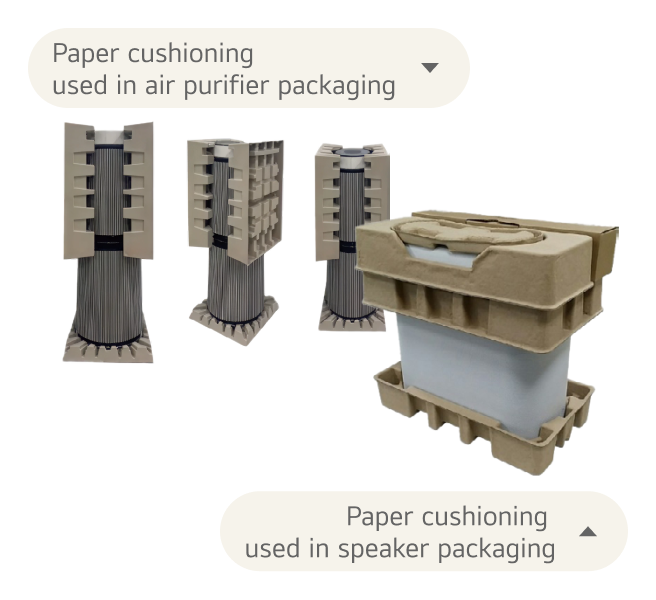
- Air purifier (Montblanc, 24kg): Developed a high-weight pulp mold, which is currently being applied
- Vacuum cleaner (NR, 25kg): Currently developing a high-weight pulp mold
- Contribution to improving paper packaging recycling rates by establishing a database on recycled pulp content ratios
- Reinforcement of eco-conscious activities, such as efficient resource use based on packaging design and logistics optimization, by strengthening the identification of packaging improvements and achieving development targets by business division
Global Take-back and Recycling System
LG Electronics operates a global take-back and processing policy based on the Individual Producer Responsibility (IPR) principle to minimize the environmental impact of e-waste.
- Established and operating recovery and recycling systems in 91 regions across 56 countries (As of the end of 2024)
- Global E-waste Take-back & Recycling Policy: Provides specific operational standards, including compliance with recovery/recycling regulations, customer guidance, and management of regional recycling partners
2030 Target: Cumulative 8M tons of E-waste Recovery
LG Electronics has set a cumulative recovery target of 8 million tons from 2006 to 2030, in 2024, is on track to recover e-waste cumulative 5.01 million tons.
-
2023
4.48M tons
-
2024
5.01M tons
E-waste program (Korea)
When customers request pickup, our specialized installation personnel will visit their homes directly to collect electronic waste. Small electronic waste items are collected free of charge for 5 or more items. For fewer than 5 items, please use the dedicated collection bins provided at community centers or service centers.
-
Customers Applying for
Recovery Service -
Large Appliances
Recovered by installation expert
Small Appliances
Collected through dedicated collection box at LG Electronics Service Center
-
Disassembly and Sorting of Waste Products
-
Recycling into Raw Materials
E-waste program (Global)
- In accordance with WEEE (Waste Electrical and Electronic Equipment) regulatory requirements for end-of-life electronic products by country, providing end-of-life electronic product collection and processing services in 91 regions across 56 countries (as of the end of 2024)
- (Expansion) To introduce a new regional electronic waste collection/processing system, engage in preliminary discussions with local governments and industry associations regarding countermeasures and exchange opinions
-
Global take-back & recycling policy
Learn more -
Take-back & recycling global network
Learn more
E-waste collection and treatment performance
Global
A world map showing E-waste collection and treatment performance, with markers placed on North America, Latin America, Europe, Africa, Asia, CIS, and Korea.
Korea
E-waste treatment volume (Unit: Ton)
In Korea, WEEE collection and treatment increased from 121,831 tons in 2022 to 126,848 tons in 2023 and remained at a similar level at 125,138 tons in 2024.
- 2022
- 2023
- 2024
Europe
E-waste treatment volume (Unit: Ton)
In Europe, WEEE collection and treatment volumes decreased from 152,185 tons in 2022 to 101,898 tons in 2023, then rebounded to 124,089 tons in 2024.
- 2022
- 2023
- 2024
North America
(United States, Canada)
E-waste treatment volume (Unit: Ton)
In North America, WEEE collection and treatment rose from 27,572 tons in 2022 to 30,635 tons in 2023, before slightly decreasing to 28,334 tons in 2024.
- 2022
- 2023
- 2024
Asia
(Japan, India, Australia, Singapore)
E-waste treatment volume (Unit: Ton)
In Asia, WEEE collection and treatment declined from 148,221 tons in 2022 to 134,110 tons in 2023, then increased to 151,774 tons in 2024.
- 2022
- 2023
- 2024
CIS
(Russia)
E-waste treatment volume (Unit: Ton)
In the CIS region, WEEE collection and treatment fell sharply from 23,677 tons in 2022 to 10,291 tons in 2023, reaching a very limited level of 92 tons in 2024.
- 2022
- 2023
- 2024
Latin America
(Brazil, Colombia, Mexico, Peru)
E-waste treatment volume (Unit: Ton)
In Latin America, WEEE collection and treatment increased significantly from 16,545 tons in 2022 to 51,361 tons in 2023 and further expanded to 95,905 tons in 2024.
- 2022
- 2023
- 2024
Africa
(Republic of South Africa)
E-waste treatment volume (Unit: Ton)
In Africa, WEEE collection and treatment slightly decreased from 7,394 tons in 2022 to 7,298 tons in 2023 and remained at the same level in 2024.
- 2022
- 2023
- 2024
* Estimated figures are used for certain countries.
** 2023 data revised due to change from estimated to actual figures.
Promoting Zero Waste to Landfill
LG Electronics promotes the use of recyclable resources by thoroughly sorting and separating waste at all worksites and pursuing Zero Waste to Landfill (ZWTL) certification. At major
domestic sites, heat generated during incineration is recovered and reused either in operations or supplied externally as an energy source, contributing to improved energy efficiency.
As a result of these efforts, LG Electronics achieved a 97.4% waste recycling rate across all domestic and overseas worksites in 2024, achieving its original 2030 target of 95% well ahead of
schedule.
Waste recycling rate at worksites
This chart compares site waste recycling performance and targets. The recycling rate increased from 95.5% in 2023 to 97.4% in 2024, while the target for 2030 is set at 95.0%.
-
2023
95.5%
-
2024
97.4%
-
2030 Target
95.0%
- 95%
- 90%
- 85%
Zero Waste to Landfill (ZWTL¹)) certification
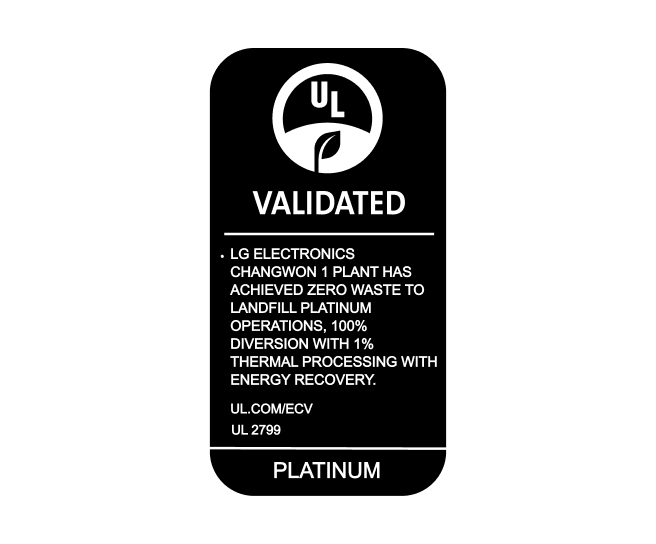
To ensure the transparency and credibility of its waste recycling practices, LG Electronics renews its "Zero Waste to Landfill" annually through UL, a global safety certification institute. The company is also expanding this initiative across all domestic and international business sites.
ZWTL Certification sites
-
Platinum level (11 sites): Changwon Smart Park 1 & 2, Gumi Future Park 1, Pyeongtaek Digital Park, Pyeongtaek Chiller, LG Electronics India Limited, Taizhou LG Electronics Refrigeration Co.,Ltd., LG Electronics WROCLAW SP ZOO, LG Electronics Mlawa SP. ZOO, LG Electronics Tianjin Appliances Co., Ltd., LG Electronics Vietnam Hai Phong Co.Ltd.
Gold level (4 sites): Magok Science Park, Seocho R&D Campus, Gasan R&D Campus, LG Electornics (Thailand) Co.Ltd
1) Zero Waste to Landfill (ZWTL): An eco-friendly certification by UL, a standards institute in North America, awarded in three levels based on waste recycling rates (Silver (90-94%), Gold (95-99%), and Platinum (100%))
Driving Zero Waste at Our Sites
Pyeongtaek Digital Park - Hanuri: Replaced about 1.36 million single-use plastic cups used for beverage service with reusable alternatives.
-
Pyeongtaek Chiller: In 2024, the material used for pallets in the painting process was changed from wood to steel for reuse, resulting in a 20-ton reduction of incinerated waste wood.
-
Changwon Smart Park 1: Improved packaging methods in 2024, successfully reducing 66 tons of defective vinyl packaging waste generated on-site. Starting in 2025, aims to divert 167 tons of previously landfilled waste glass to recycling by sourcing new vendors.
-
Magok Science Park, Gasan R&D Campus, Seocho R&D Campus, Yangjae R&D Campus, Pyeongtaek Digital Park, and Pyeongtaek Chiller: Participated in the Bi:Cycle Campaign1), establishing a closed-loop recycling system for used paper hand towels in restrooms to strengthen recycling efforts.
1) An eco-friendly campaign led by Yuhan-Kimberly that promotes resource circulation by collecting and sorting waste, producing goods from recycled materials, and encouraging their use.
LG recycling center
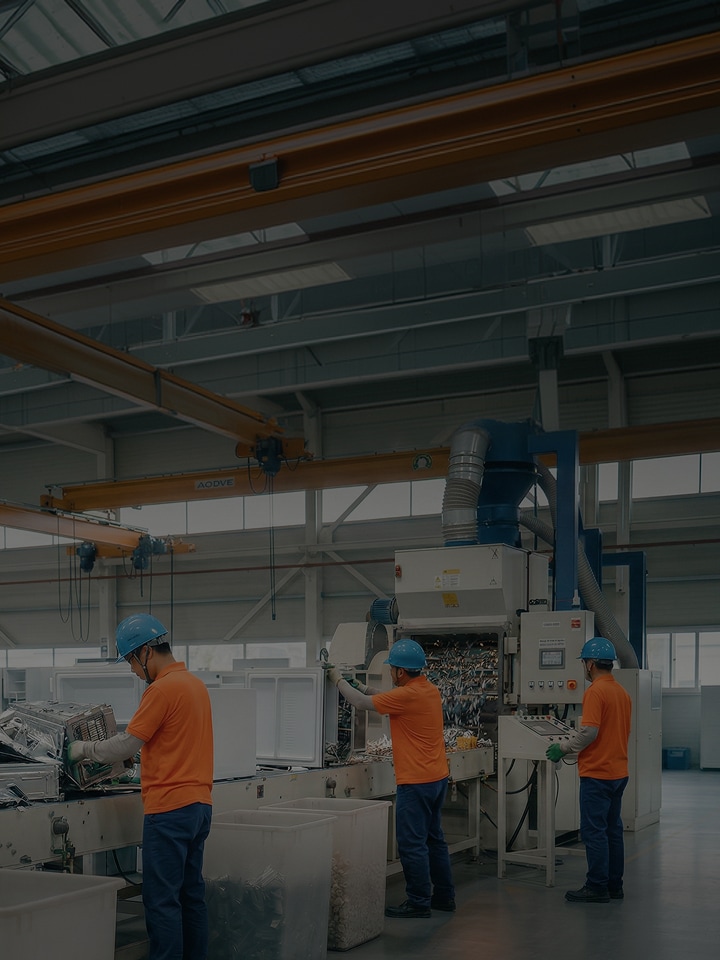
The LG Recycling Center promotes resource circulation by collecting and recycling waste home appliances through material separation and recovery. It conducts recycling of waste appliances and return product analysis while researching eco-conscious design that considers resource circulation from the product planning stage. In addition, LG minimizes environmental impact by developing technologies for utilizing recycled resources and complying with environmental assurance systems for the safe treatment of hazardous substances.
Explore more
This video provides a comprehensive look at the systematic resource circulation process at the LG Recycling Center, showcasing how end-of-life home appliances are transformed into valuable new materials. Collected appliances undergo a careful pre-processing stage to safely extract refrigerants before being dismantled and shredded through both manual and mechanical efforts. These fragments are then meticulously sorted into high-purity raw materials such as iron, copper, aluminum, and plastic using advanced technology. By reintegrating these recovered materials back into the production of new LG products, the center completes a sustainable loop that minimizes environmental impact and promotes a circular economy.