We use cookies, including cookies from third parties, to enhance your user experience and the effectiveness of our marketing activities. These cookies are performance, analytics and advertising cookies, please see our Privacy and Cookie policy for further information. If you agree to all of our cookies select “Accept all” or select “Cookie Settings” to see which cookies we use and choose which ones you would like to accept.

Key Takeaways
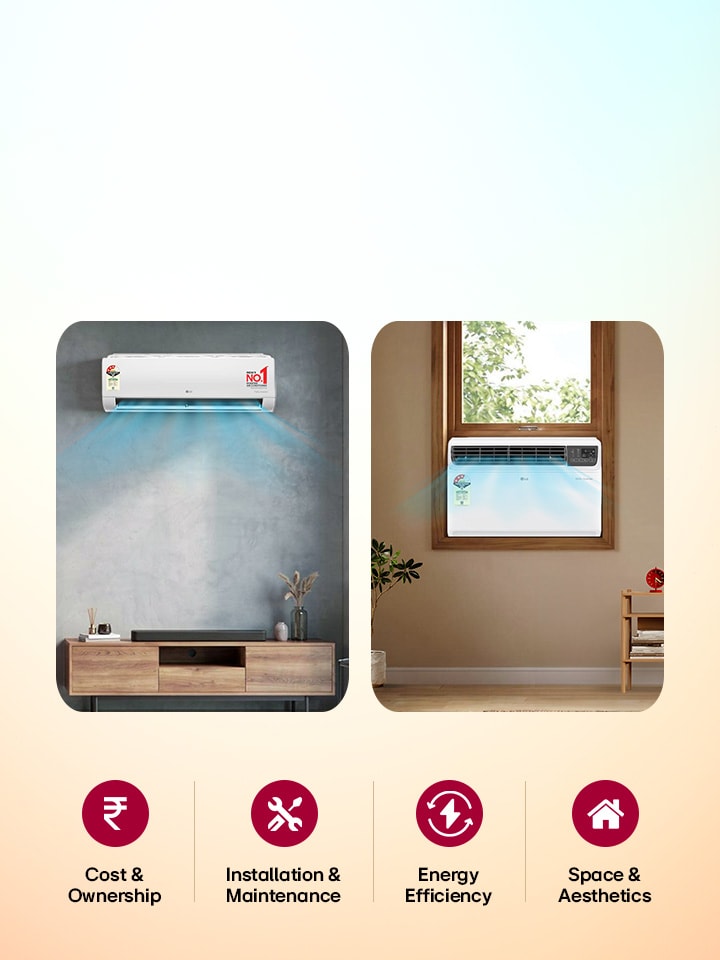
- Installation cost differential matters: Split AC installation is generally expensive than window ACs, but split installations offer cleaner aesthetics and quieter operation with the compressor placed outdoors
- Maintenance simplicity varies by design: Window ACs feature single-unit servicing that's straightforward and economical, while split ACs need professional maintenance for both indoor and outdoor units
- Space requirements differ fundamentally: Window ACs demand dedicated window or wall opening space, making them ideal for compact rooms, while split ACs offer flexible indoor unit placement with minimal wall-mounting requirements.
Which AC is Better Split or Window?
Design Comparison
| Feature | Window AC | Split AC |
| Units | Single compact box | Two separate units |
| Component Location | All in one unit | Indoor + Outdoor division |
| Typical Use | Small to medium rooms | Medium to large spaces |
| Visual Impact | Occupies window space | Wall-mounted, minimal intrusion |
How Do Installation Requirements Compare?
Window AC Installation
The best way to install a window AC is through an existing window opening or dedicated wall cavity. The process is relatively straightforward.
- Step 1: Measure window dimensions to ensure proper fit
- Step 2: Create support brackets or use existing window frame
- Step 3: Slide unit into position and seal gaps
Installation timeline: 1-2 hours
Structural modification: Minimal if window exists
Split AC Installation
Split AC installation requires more technical expertise but offers greater placement flexibility.
- Step 1: Select optimal indoor unit location (typically high on wall)
- Step 2: Mount outdoor unit on external wall or balcony
- Step 3: Drill holes for refrigerant pipes and drainage
- Step 4: Connect both units with copper piping and electrical wiring
Installation timeline: 2-4 hours
Which AC Is Best If I Live In a Rented Apartment?
For tenants, window ACs offer easier relocation without structural modifications to walls. However, split ACs may last slightly longer (10-15 years) due to better component protection, making them worthwhile for homeowners planning long-term residence.
How Do Pricing and Ownership Costs Compare?
Initial Purchase Price
| Capacity | Window AC Price* Range | Split AC Price* Range |
| 1 Ton | ₹25,000-₹35,000 | ₹30,000-₹45,000 |
| 1.5 Ton | ₹32,000-₹42,000 | ₹38,000-₹55,000 |
| 2 Ton | Not commonly available | ₹48,000-₹70,000 |
*These are only indicative figures. Actual Prices vary by star rating, features, and model to model. Please check lg.com/in for final prices and model comparison.
Long-Term Operating Costs
Energy efficiency determines monthly electricity bills. LG's Dual Inverter technology, available in both categories, significantly reduces power consumption compared to fixed-speed compressors.
Split ACs generally offer better efficiency[2.1], especially with inverter technology, though LG's window inverter models have narrowed this gap substantially.
Which Features Does LG Offer in Each Category?
LG has equipped both product lines with advanced technologies to ensure neither category compromises on innovation.
LG Window AC Features
- Dual Inverter Compressor: Available in select models for energy savings
- Convertible 4-in-1 Cooling: Adjustable tonnage for varied cooling needs
- Silent Operation: Noise reduction during operation
LG Split AC Features
- Smart Inverter: Deep learning technology that adapts to usage patterns
- AI Convertible 6-in-1 Cooling: Tonnage adjustment from 40% to 110%
- ThinQ Connectivity: Complete smart home integration with voice assistants
- Viraat Mode: Increases cooling capacity up to 124% for rapid temperature drop
- Monsoon Comfort Technology: keeps you comfortable during the humid weather
LG air conditioners have ADC safety sensors, Gold Fin+ Protection, and 10-year compressor warranties.
How Do Maintenance Requirements Differ?
Window AC Maintenance
The best approach for window AC servicing is periodic professional cleaning. Since a window AC has just one unit, the cost of maintenance is low, and it is easier to service.
Split AC Maintenance
Since a split AC has 2 units, requiring periodic maintenance to ensure optimal results. Professional servicing addresses both indoor and outdoor units, including refrigerant gas level checks and pipe insulation.
However, split ACs with features like LG's HimClean can reduce manual cleaning frequency significantly.
LG air conditioners have ADC safety sensors, Gold Fin+ Protection, and 10-year compressor warranties.
Which Type of AC Suits Your Home Better?
Choose Window AC if you:
- Need cooling for small to medium rooms (up to 150 sq ft)
- Prefer lower upfront investment
- Want simpler installation in rental properties
- Have suitable window space available
Choose Split AC if you:
- Need cooling for larger spaces (150+ sq ft)
- Prioritize quiet operation (bedrooms, study rooms)
- Value aesthetic interior design
- Plan long-term residence
Both options deliver excellent cooling when sized correctly for your space. LG's innovation ensures you get premium technology regardless of which category you choose.
FAQs
A. Yes, LG offers ThinQ connectivity in select window AC models including AW-Q18WWZA, AW-Q24WWYA, and AW-Q18WWXA. While split ACs offer additional AI learning capabilities through Inverter technology, window models deliver basic functionality at a lower price point.
A. LG's Gold Fin protection is an advanced anti-corrosive coating applied to the condenser heat exchanger fins. It protects against humidity, salty air, and smoke, boosting durability and preventing rust.
A. LG's window ACs with Convertible 4-in-1 allow you to adjust tonnage across four levels (typically 100%, 80%, 60%, 40%) to match cooling needs and save energy. Split ACs with Convertible 6-in-1 offer six levels including the ability to boost cooling during extreme heat.