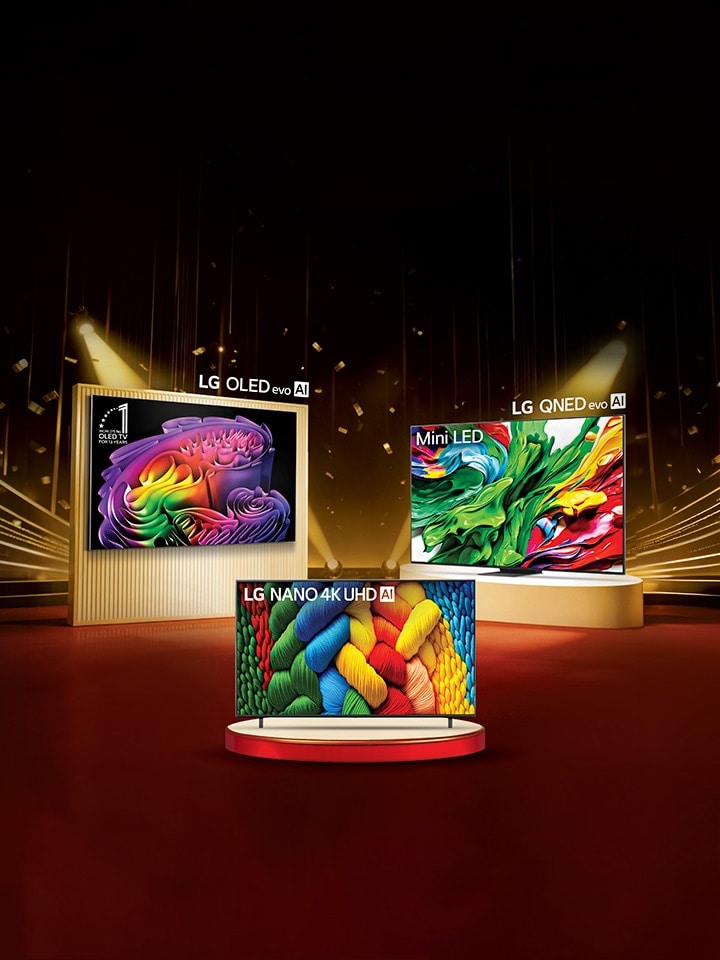
TV comparison at a retailer shop gets tougher, when factors like price and performance clash with each other. What to prioritise and what to leave? That becomes the key dilemma.

“Best OLED TV in India” or “webOS vs Android” - whatever is the debate, this blog can solve some of your doubts when it comes to TV Price vs Performance, and when should you pay more? Let’s settle it, so you pay more only when it truly improves your evenings.

Take Your Pick Quick: Which LG TV Tier Fits Your Room?


Simply put, buy the least expensive tier that solves your real problem. As per LG India’s model pages, this ladder of 2026 models looks like this:

Your situation LG tier Model to check
Bedroom or study Smart TV AI 81.28 cm (32) 32LB659BPLA
Everyday family viewing NANO 4K UHD 139 cm (55) 55NU870BPLA
Bright room, sports, console QNED evo Mini LED 139 cm (55) 55QNED82BLA
Dark-room movies, serious gaming OLED evo 139 cm (55) OLED55C6PLA

Notice the pattern: each tier trades something general for something specific. Even the 81.28 cm (32) 32LB659BPLA brings the α5 AI Processor Gen9 and HDR10 Pro, so a small screen does not mean a basic one.

What Price Should I Pay for a TV?


The answer is: pay for the difference you will notice. Please note that live prices are reflected on each lg.com/in model page, so here is what every step up adds. Note that 4K and UHD refer to the same 3,840 x 2,160 resolution, four times the pixels of Full HD.

Feature NANO 4K UHD 55NU870BPLA QNED evo 55QNED82BLA OLED evo OLED55C6PLA
HDR brightness and contrast Direct backlight; HDR10 Pro tone mapping Mini LED; Dolby Vision; 100% Color Volume certified Pixel dimming; Perfect Black; Dolby Vision
Lower-quality sources α7 AI Processor 4K Gen9, 4K Super Upscaling α8 AI Processor 4K Gen3, AI Super Upscaling 4K α11 AI Processor 4K Gen3, Dual AI Engine
Motion and sports 60Hz native; TruMotion 120Hz native (VRR 144Hz) 120Hz native (VRR 165Hz); 0.1 ms response
Gaming ports 3 HDMI (eARC, ALLM) 3 HDMI (4K 120Hz, eARC, VRR) 4 HDMI (4K 120Hz, eARC, VRR)
Sound 20W, 2.0 Ch 20W, 2.0 Ch 40W, 2.2 Ch

Where does the money go? From 55NU870BPLA to 55QNED82BLA, you add Mini LED, Dolby Vision and native 120Hz. From QNED evo to OLED evo, you add self-lit pixels, a fourth HDMI port and 40W sound.

HDR, known as High Dynamic Range, refers to brighter highlights and deeper shadows. Mini LED is a type of backlight with finer light control, while OLED lights each of its 8.3 million pixels individually, which is why dark-room movies gain most from it. Much everyday content, from cable to OTT, is not native 4K, so the α processor’s upscaling quietly earns its price.

How Do I Decide in Four Steps?


  1. Step 1: Note your room’s light. Bright lounge? Choose Mini LED. Dark room? Choose OLED.
  2. Step 2: List your sources. Cable and OTT benefit from stronger upscaling.
  3. Step 3: Count your gaming devices. Consoles need native 120Hz and 4K 120Hz HDMI.
  4. Step 4: Check the remote. On the 55NU870BPLA, the AI Magic Remote is sold separately, and voice and certain AI features need it.

Which TV Features Are Worth Paying For, and Which Are Not?


Worth paying for Can usually skip
Native 120Hz with VRR, if you game or watch fast sport 165Hz VRR, unless your PC or console outputs 165Hz
Dolby Vision for film lovers Motion Booster 288 for casual play; LG notes it runs at optimised Full HD resolution
OLED Perfect Black for dark rooms Gaming features on a TV used for news and serials
webOS Re:New: up to 5 years of free upgrades on select models 40W built-in sound, if a soundbar is planned; LG’s WOW Orchestra syncs the two

UHD vs HD: The Honest Comparison


Ultra HD wins on resolution, clarity, and the depth of the viewing experience. But the right choice still depends on your screen size, viewing distance, and budget.

Factor HD Full HD 4K UHD
Resolution 1280x720 1920x1080 3840x2160
Best for screen sizes Up to 40 inches 40 to 55 inches 50 inches and above
Content availability Good Excellent Growing rapidly
Pixel density at large sizes Soft at large sizes Good Sharp at any size
Future-proofing Limited Moderate Strong

One more thing worth knowing: screen size affects how much the resolution difference actually shows up. On a 32-inch screen at normal viewing distance, HD and FHD look similar. On a 65-inch screen, 4K UHD and FHD are not in the same conversation.

Conclusion


Paying more improves the experience when it solves a real problem: glare, dark-room contrast, fast motion or a console. Otherwise, the 139 cm (55) 55NU870BPLA already delivers 4K clarity. It is recommended to compare live prices on lg.com/in, then choose the tier your room needs. Check LG TVs on the website and select the one that balances budget and performance for you.

Disclaimer: Features vary from model to model. Please check the specifications carefully before the purchase.

FAQs


A. The best way is lg.com/in, where each model page carries its live price. Start with 55NU870BPLA, 55QNED82BLA or OLED55C6PLA. LG also lists instant cashback on No Cost EMI with selected cards. Offers change, so check before buying.

A. You can check and buy directly on lg.com/in. LG lists five 81.28 cm (32) models: 32LB659BPLA, 32LB657BPLA, 32LB653BPLA, 32LB651BPLA and 32LB650BPLA. LG runs various deals time to time, with No Cost EMI on select products and free shipping in serviceable pin codes. Please note that the offers depend on brand discretion.

A. Simply put, price depends on size, and lg.com/in shows it per model. The OLED evo C6 comes in 106 cm (42), 121 cm (48), 139 cm (55), 164 cm (65), 195 cm (77) and 210 cm (83). Compare these on LG’s OLED evo page and check the cashback on each.

A. Open the NanoCell page on lg.com/in for live prices. There are sales and discounts available on the website, check carefully before buying.

A. Essentially, LG makes its case with webOS 26. LG’s site cites an AVForums Editor’s Choice badge for Best Smart TV System 2025/26, free LG Channels, over four thousand global streaming apps, and up to 5 years of free upgrades through webOS Re:New on select models.