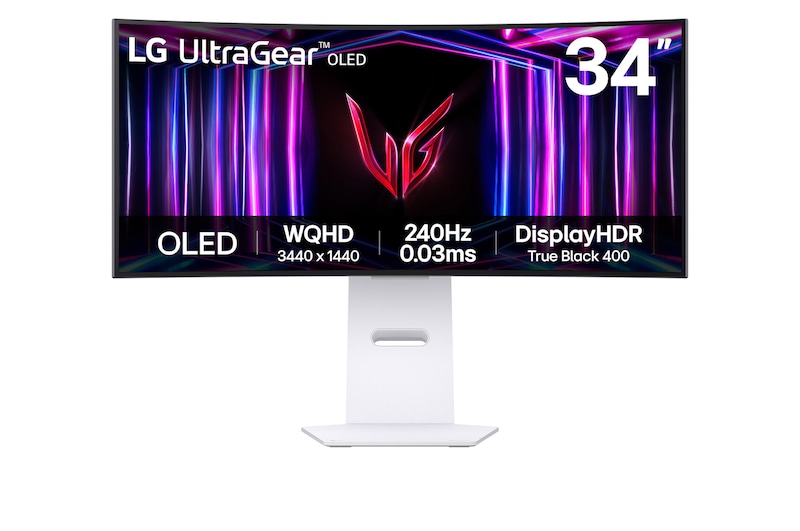
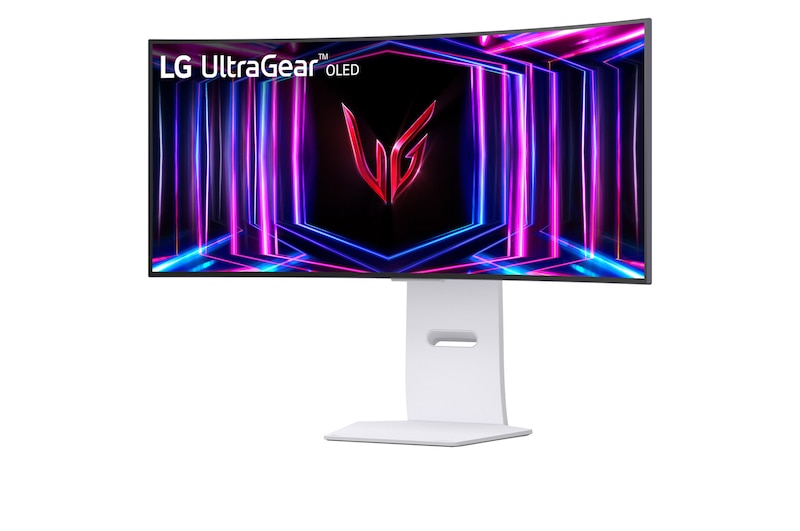
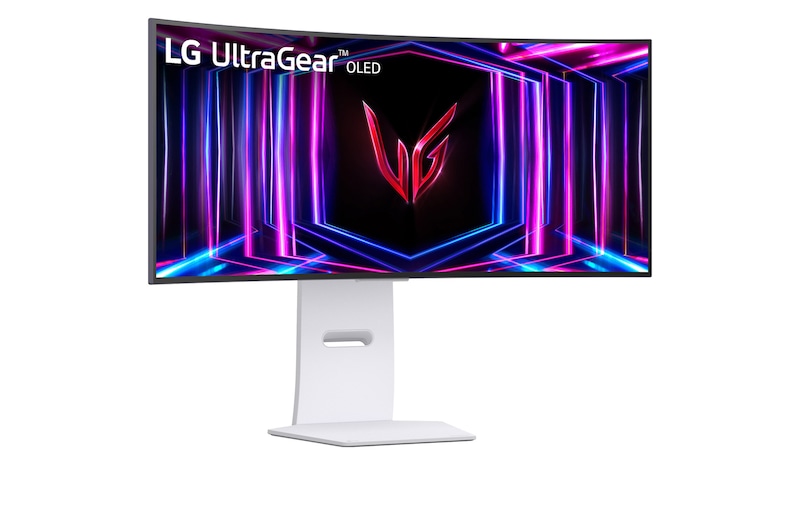
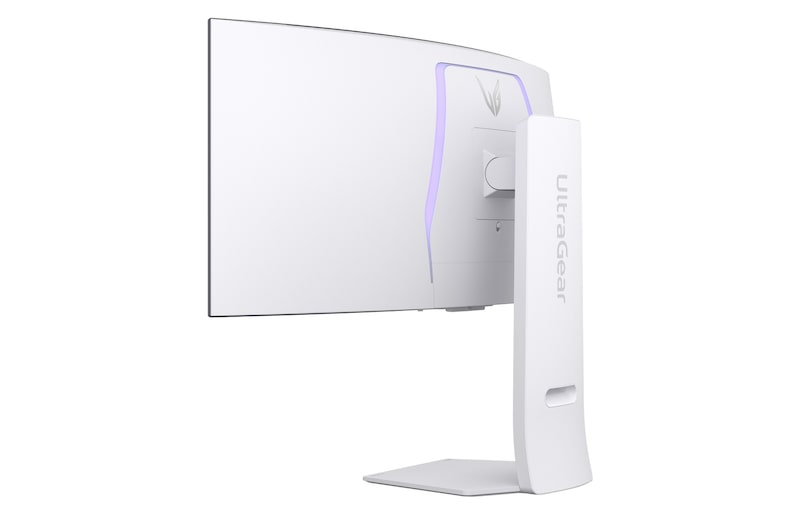
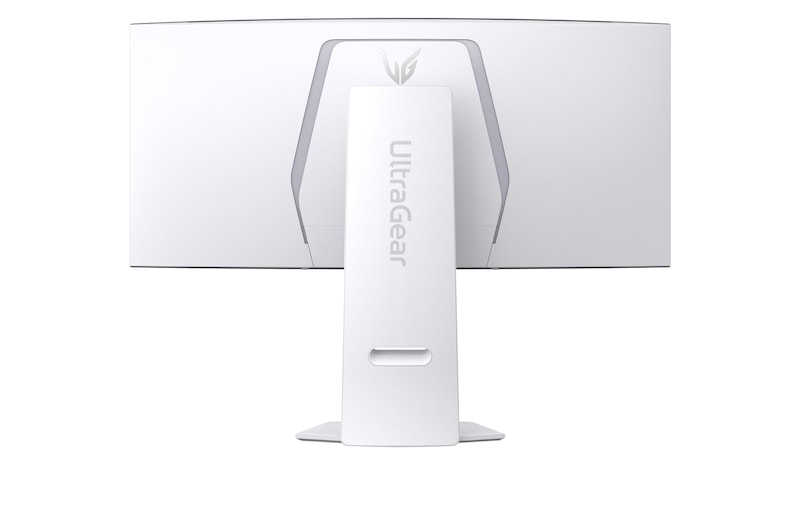
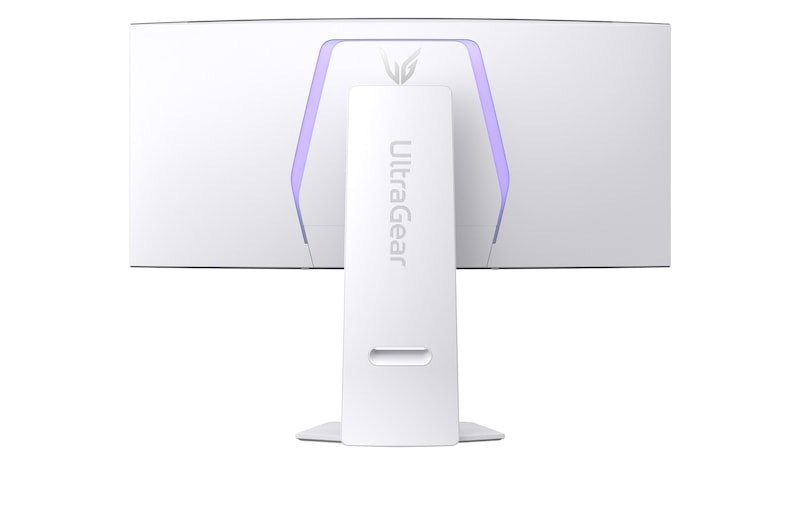
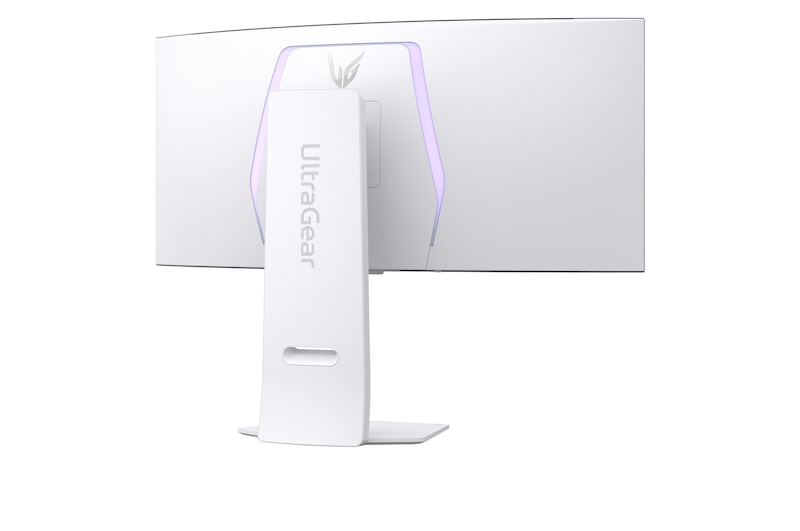
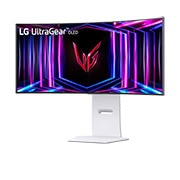
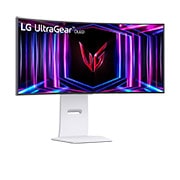
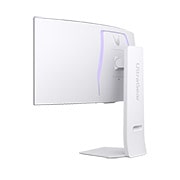
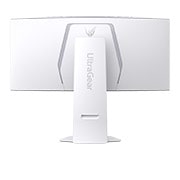
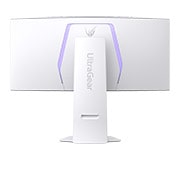
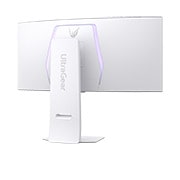
34" UltraGear™ OLED all-new 800R curved gaming monitor | 21:9 Ultra-WQHD 240Hz, 0.03ms (GtG), DisplayHDR True Black 400

All Spec

INFO

  • Product name

    UltraGear

  • Year

    Y24

DISPLAY

  • Aspect Ratio

    21:9

  • Brightness (Min.) [cd/m²]

    250cd/㎡

  • Brightness (Typ.) [cd/m²]

    275cd/m²

  • Color Bit

    10bit

  • Color Depth (Number of Colors)

    1.07B

  • Color Gamut (Min.)

    DCI-P3 94% (CIE1976)

  • Color Gamut (Typ.)

    DCI-P3 98.5% (CIE1976)

  • Contrast Ratio (Min.)

    1200000:1

  • Contrast Ratio (Typ.)

    1500000:1

  • Curvature

    800R

  • Panel Type

    OLED

  • Pixel Pitch [mm]

    0.231 × 0.231 mm

  • Refresh Rate (Max.) [Hz]

    240

  • Resolution

    3440 x 1440

  • Response Time

    0.03ms (GTG)

  • Size [cm]

    86.2

  • Size [Inch]

    33.9

  • Surface Treatment

    Anti-Glare

  • Viewing Angle (CR≥10)

    178º(R/L), 178º(U/D)

FEATURES

  • Reader Mode

    YES

  • AMD FreeSync™

    FreeSync Premium Pro

  • Auto Input Switch

    YES

  • Black Stabilizer

    YES

  • Color Calibrated in Factory

    YES

  • Color Weakness

    YES

  • Crosshair

    YES

  • Dynamic Action Sync

    YES

  • FPS Counter

    YES

  • HDR 10

    YES

  • HDR Effect

    YES

  • HW Calibration

    HW Calibration Ready

  • NVIDIA G-Sync™

    G-SYNC Compatible

  • Others (Features)

    VESA DSC Tech, 4way Joystick

  • PBP

    2PBP

  • PIP

    YES

  • RGB LED Lighting

    Unity Hexagon Lighting

  • Smart Energy Saving

    YES

  • User Defined Key

    YES

  • VESA DisplayHDR™

    DisplayHDR™400 TRUE BLACK

  • VRR

    YES

SW APPLICATION

  • OnScreen Control (LG Screen Manager)

    YES

  • Dual Controller

    YES

  • LG Calibration Studio (True Color Pro)

    YES

CONNECTIVITY

  • DisplayPort

    YES(1ea)

  • DP Version

    1.4 (DSC)

  • HDMI

    YES(2ea)

  • Headphone out

    4-Pole(Sound+Mic)

  • USB Downstream Port

    YES(2ea/ver3.0)

  • USB Upstream Port

    YES(1ea/ver3.0)

POWER

  • AC Input

    100~240V (50/60Hz)

  • DC Output

    19.5V 10.8A

  • Power Consumption (DC Off)

    Less than 0.3W

  • Power Consumption (Sleep Mode)

    Less than 0.5W

  • Type

    External Power(Adapter)

MECHANICAL

  • Wall Mountable [mm]

    100 x 100mm

DIMENSIONS/WEIGHTS

  • Dimension in Shiping (W x H x D) [mm]

    927 x 295 x 550

  • Dimension without Stand (W x H x D) [mm]

    784.1 x 358.3 x 167.1

  • Dimension with Stand (W x H x D) [mm]

    784.1 x 585.9 x 278.7(UP) / 784.1 x 465.9 x 278.7(Down)

  • Weight in Shipping [kg]

    14.0

  • Weight without Stand [kg]

    5.9

  • Weight with Stand [kg]

    9.3

ACCESSORY

  • HDMI

    YES (ver 2.1)

  • Adapter

    YES

  • Calibration Report (Paper)

    YES

  • Display Port

    YES

  • HDMI (Color/Length)

    Black / 1.8m

  • Others (Accessory)

    Door

  • Power Cord

    YES

  • USB A to B

    YES

STANDARD

  • CE

    YES

What people are saying

FAQ

How to choose a gaming monitor?

Start with your priorities. Want crisp visuals? Go for 4K resolution. Need ultra-smooth motion? Prioritize a high refresh rate (144Hz or more) and low response time. If you're after deep contrast and color accuracy, consider OLED or Nano IPS, Nano IPS black panels. Don’t forget adaptive sync tech like NVIDIA G-SYNC or AMD FreeSync™ Premium to eliminate screen tearing. LG’s UltraGear™ series offers a range of gaming monitors tailored to your play style—from casual console gaming to high-intensity PC competition.

What is the refresh rate of a gaming monitor?

Refresh rate, calculated in Hertz (Hz), refers to how many displays are updated within one second. For example, a 120Hz indicates that the display refreshes 120 times per second. Gaming monitors with high refresh rates offer smoother visuals with less screen tearing.

How many hertz is good for gaming?

For most gamers, 144Hz is the sweet spot for fluid, responsive gameplay. Competitive players may want even faster refresh rates like 240Hz for that extra edge in fast-paced shooters or esports titles. LG’s lineup of UltraGear™ Gaming Monitors includes models that go from 144Hz to 240Hz and beyond (when used in dual mode, LG's models support 165Hz and 330Hz OR 240Hz and 480Hz)*, all designed to keep up with the action while minimizing lag and screen tearing.


It depends on what—and how—you play. Many gamers go with 144Hz for fluid, responsive gameplay. Competitive players may want faster refresh rates like 240Hz for that extra edge in fast-paced shooters or esports titles. LG’s lineup of UltraGear™ Gaming Monitors includes models that go from 144Hz to 240Hz and 480Hz, all designed to keep up with the action while minimizing lag and screen tearing.


*Actual refresh rates may vary depending on computer graphics specifications and configurations.

What are the differences between OLED, IPS, and VA panels?

OLED panels emit their own light at the pixel level, delivering near-perfect blacks, exceptional contrast, and vivid colors. They also offer ultra-fast response times, making them ideal for high-end gaming monitors, premium TVs, and professional video editing.


IPS panels are known for their accurate color reproduction and wide viewing angles, maintaining clear images from various positions. This makes them well-suited for office work, design, and gaming. Their excellent color accuracy is especially appealing to gamers who want to experience visuals exactly as the developers intended.


VA panels boast the highest contrast ratio among LCD types, providing an immersive experience for watching movies and videos. While not as fast as TN panels, they offer nearly comparable performance.

Should I get a curved monitor?

If you want a more immersive gaming experience, curved gaming monitors are a great choice. The curvature helps keep your eyes focused on the center of the screen naturally, which is great for long gaming sessions.


LG's UltraGear GX9 supports 800R curvature and a 21:9 ultrawide aspect ratio, delivering immersive visuals and an ideal viewing distance. At an 800mm viewing distance, its 800R curvature creates a viewing angle of 90 degrees across both the center and the edge—pulling you deeper into the game.

Is 1440p or 4K better for gaming?

Both have their strengths. For many gamers, 1440p (QHD) hits a sweet spot between resolution and performance, especially for competitive gaming where frame rate matters most. It’s easier to push higher FPS without overloading your GPU. 4K, on the other hand, is all about detail and immersion—perfect for single-player adventures or next-gen console play. LG’s UltraGear™ gaming monitors offer both QHD and 4K options, so whether you prioritize speed or stunning visuals, there’s a perfect fit for your setup.

Can I connect my monitor to my PC with a USB-C?

Connecting your gaming monitor via USB-C is simple—just plug one end of the cable into your device’s USB-C port, and you’re good to go. You can charge your laptop too if your PC is connected to your monitor with a USB-C port.


*Supported models may vary.

What is DisplayPort 2.1?

DisplayPort 2.1, the latest version of the DisplayPort standard, delivers ultra-fast data speeds for flawless high refresh rate gameplay. It is developed by VESA (Video Electronics Standards Association) to provide high-performance display connectivity for computers and monitors.

Many of LG’s latest models support DisplayPort 2.1*, which doubles the bandwidth of DP 1.4. That means you get higher resolutions, smoother frame rates, and lower latency—perfect for fast-paced gaming.


*Note: We have received numerous reports from users of NVIDIA 50-series graphics cards experiencing screens turning off when using DisplayPort 2.1 with 10-bit or 12-bit settings. If you are experiencing the same, as a temporary workaround, you can switch the DisplayPort input to 1.4 in your monitor's OSD menu or adjust the color setting to 8-bit in the NVIDIA Control Panel. This issue has been reported to NVIDIA for a more permanent solution.

What is HDMI 2.1?

With HDMI 2.1 supported, you’ll enjoy features like Variable Refresh Rate (VRR), Auto Low Latency Mode (ALLM), and support for 4K at up to 120Hz. Whether you’re gaming on a console or PC, these upgrades give you the flexibility and performance to match any setup.

Our Picks for You