Part 14. Heart of future Mobility delivered by LG Electronics, Cloud

by Soonin Chung Professional Researcher, Vehicle component Solutions Company, LG Electronics
MobilityBlog06/09/2021
01

The cloud service allows your documents to be accessed from anywhere.

You all have heard of the cloud before, right? Cloud technology enables you to store your files on a remote server via the Internet instead of saving them locally on your laptop or smartphone. Files uploaded to the cloud can be accessed from any device as long as you are connected to the Internet.

02

Cloud technology enables ubiquitous workspaces.

Let’s say you’re working on a presentation on your laptop at home. If you upload the presentation on the cloud, you can access it from your work laptop. You can even edit or work on the presentation while in transit on your smartphone. Also, the cloud’s massive storage space allows you to upload large files, high-definition videos, and many pictures. It’s even quite fast.


Cloud technology is relevant in the office space and the future of cars as well. Let’s see how they’re related.

The relationship between autonomous vehicles and the cloud

03

How connectivity enables autonomous driving

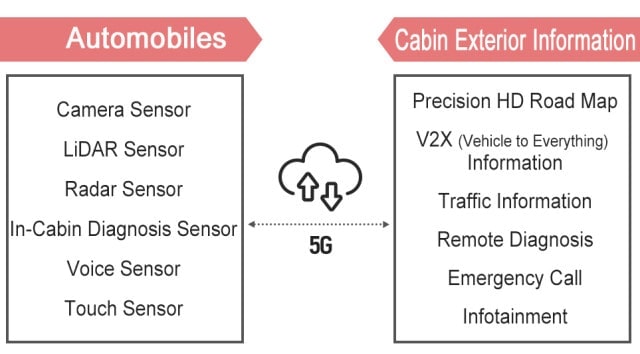
Since autonomous vehicles don’t require a driver, the vehicle has to detect its location, lanes, streets, tunnels, bridges, traffic signs, traffic lights, new roads, and streets under construction. For the vehicle to autonomously drive safely without accidents, these factors have to be updated in real time.


Autonomous vehicles need more than just traffic information. Autonomous vehicles need infotainment services that provide information on parking lots near a destination, competitively priced gas stations, available electric vehicle charging stations, and restaurants.

04

Autonomous vehicles operating via digital 3D roadmaps

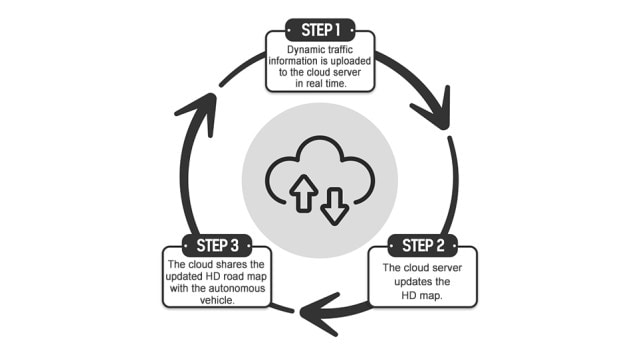
Where do autonomous vehicles acquire road information? They receive 3D map data from the cloud. Autonomous vehicles navigate based on this map.

05

Autonomous vehicles’ operational algorithm

The three steps above are repeated to make autonomous driving possible. Each step must take place quickly and accurately in real time. For each step, autonomous vehicles require a tremendous amount of widely varied high-definition data. Cloud technology enables high-volume data to be processed.

The relationship between smart cities and the cloud

06

Leveraging “edge cloud” technology to build the smart city of the future

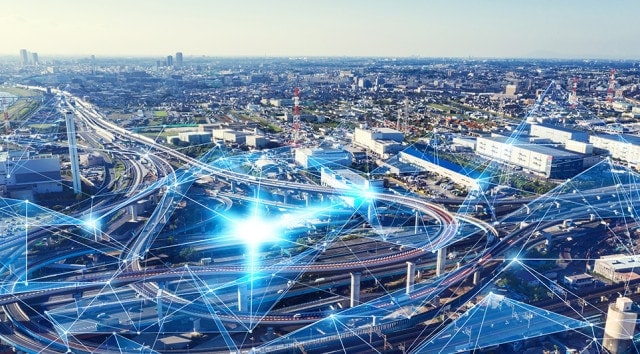
To go beyond autonomous vehicles and build a smart city, you need a cloud network that is always connected on a national and global scale.


Click here to learn more about smart cities.


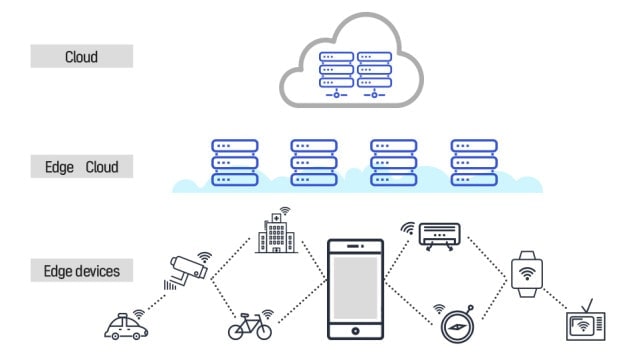
The cloud network’s response rate and speed inherently slow down the farther it gets from a device. But if multiple devices get closer to the cloud network, the network’s accuracy and speed dramatically improve. That’s why the cloud network was designed to be near connected devices. This is what’s called “edge cloud” technology.

07

Edge cloud architecture

Let’s look at autonomous vehicles for example. In autonomous vehicles, braking, acceleration, and decision-making must be done swiftly in real time, like many other connected devices in the smart city. For an autonomous vehicle to receive processed data from multiple devices sent from long way away, it is bound to come across delays, and this inefficiency can increase the risk of accidents. For example, autonomous vehicles have to brake immediately if there’s an obstacle ahead. But imagine if there’s a delay in connection and the brakes are activated a bit too late.


Edge cloud technology prevents dangerous scenarios like these. For the edge cloud to process large-scale data, it distributes data among small-scale edge cloud devices.

08

An autonomous vehicle operating via the edge cloud

Edge cloud sensors inside the autonomous vehicle maintain vehicle distance, change lanes, and recognize traffic signals. Autonomous vehicles can avoid congestion by receiving analyzed traffic data from the edge cloud that are gathered from other autonomous vehicles.

The relationship between LG Electronics and edge cloud technology

09

The cloud is mandatory for the devices powering autonomous vehicles.

Be it vehicles, robots, drones, or flying cars, autonomous driving devices must be connected to the cloud. For autonomous driving to take place, 3D map and traffic data must be utilized instead of the human eyes.

10

LG Electronics is integrating cloud technology in the devices that power autonomous vehicles.

LG Electronics has already integrated the cloud in autonomous vehicle parts, autonomous robots, and smart home entertainment devices. Connectivity with the cloud and location-based technology is essential when developing parts for autonomous vehicles, telematics, cockpits, AVN, and various automotive parts. Data from autonomous vehicles, consumer electronics, and IoT devices are collected via the cloud and continuously applied to LG Electronics’ products and services to improve their quality.

11

Cloud technology and smart cities will connect all devices and services around the world.

All products and services are expected to be connected to the cloud in the future. And the cloud will play a vital role in the improvement, development, and advancement of products and services. LG Electronics’ R&D will always stay on the cutting edge for a brighter future. We hope you’re as excited as we are.